BJP-JDS stage protest in Karnataka Assembly over passage of resolutions against Centre’s step motherly treatment

News Network
February 23, 2024

assemblyprotest.jpg

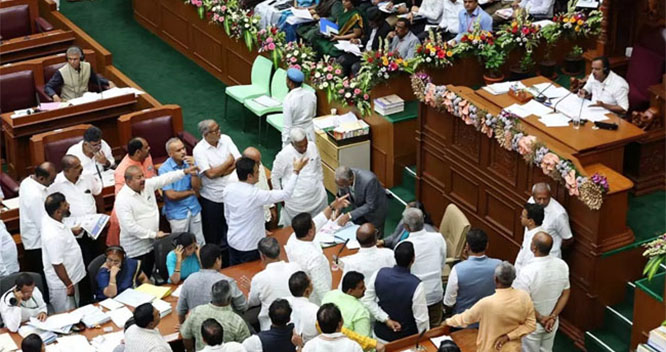
Bengaluru, Feb 23: The opposition BJP and JD(S) staged a protest against the Congress government in Karnataka over passing of resolutions against Narendra Modi-led administration’s step motherly treatment, which rocked the Legislative Assembly proceedings on Friday, forcing adjournments.

The Business Advisory Committee (BAC) of the Assembly, meanwhile, at its meeting Chaired by Speaker U T Khader decided to extend the session by a day to Monday, which was otherwise scheduled to conclude today, for passage of the finance bill and Chief Minister’s reply to discussion on the Budget.

The Opposition demanded that the government withdraw the resolutions.

Leader of Opposition R Ashoka even read out a “counter resolution” condemning the resolutions moved and passed by the government on Thursday as “false, imaginary and politically motivated”, and accused the government of blaming the Centre to hide its failures.

As the opposition’s resolution was read without following due procedures and without the consent of the Speaker, it was not considered or put to vote.

The state government had on Thursday moved and ensured passage of resolutions urging the union government to make sure that no injustice is done to the state in allocation of financial resources, and to frame a legislation regarding fixation of MSP for all crops of farmers.

As the House met for the day on Friday, BJP and JD(S) members trooped into the well of the House.

Ashoka said resolutions were brought against the central government all of a sudden and unilaterally, without bringing it to their notice or discussing it at the BAC meeting; it was also not mentioned in the agenda.

“Why did the government bring the resolution in a hush hush manner, despite having a majority in the House? They could have mentioned it in the agenda and introduced the resolution openly as per procedure and we too would have put forward our stand and objections against the resolutions.

Assembly and its rules have been insulted,” he said while demanding that the resolutions be withdrawn.

Law and Parliamentary Affairs Minister H K Patil, who had moved the resolution on Thursday, defended the government’s action and said the resolution was passed keeping the interest of Karnataka and its people in mind. It was against the injustice meted out to the state and was with facts and figures.

“We had moved the resolution and it was brought by the large number of members of this House. It is the unanimous voice of the people of Karnataka and I condemn the opposition’s objections to this unanimous voice of seven crore people of the state,” he said.

Noting that the government doesn’t need opposition’s consent to bring any resolution in the interest of the people of the state, Patil said resolutions have been moved and passed as per law and there is no question of withdrawing it. “You (opposition) introspect whether you are for Karnataka’s interest or want to do politics.” This elicited a sharp reaction from Ashoka, who asked what Congress MPs from Karnataka were doing in the Parliament, instead of raising the issue there, to which Minister Krishna Byre Gowda retorted by saying that BJP’s 25 MPs in Lok Sabha from the State never raised any issue in the interest of the state. This led to heated arguments between both sides.

Former Chief Minister Basavaraj Bommai said the Congress which ruled the country for about 55 years in 75 years of independent India, had kept the devolution of funds to states at 20 per cent for a long time; it took 30 years to raise it to 30 per cent after protests and struggle by several states.

The UPA government for 10 years did not heed to the demand of raising it to 40 per cent, but the Modi government soon after coming to power raised it to 42 per cent.

This led to a strong counter from the Congress side, forcing the Speaker to adjourn the House for some time.

As the House met again, BJP continued to protest from the well of the House, even as Minister Krinsha Byre Gowda requested them to allow the proceedings to go on normally.

To this, Ashoka said, they will withdraw the protest if the government withdraws the resolution.

The state government wants confrontation with the Centre, he further claimed. “If you (govt) don’t want to withdraw your resolution, the chair should allow us to move a resolution in favour of the central government, and let’s discuss it.” With both sides refusing to budge and BJP-JD(S) continuing to protest from the well of the House, the Speaker tried to transact some business amid sloganeering by opposition members.

Amidst the din, the Speaker allowed tabling of certain reports and passage of two bills without any discussion. Even as the Speaker was putting the bills to vote for its passage, Ashoka read out the opposition’s counter resolution, which was neither considered by the Chair, nor it was put to vote.

As the chaos continued, the Speaker adjourned the House to Monday. 

Comments

Add new comment

  • Coastaldigest.com reserves the right to delete or block any comments.
  • Coastaldigset.com is not responsible for its readers’ comments.
  • Comments that are abusive, incendiary or irrelevant are strictly prohibited.
  • Please use a genuine email ID and provide your name to avoid reject.
News Network
January 28,2026

ajit.jpg

Mumbai: The sudden death of Maharashtra Deputy Chief Minister Ajit Pawar in a plane crash in his hometown of Baramati has plunged the state into political uncertainty, raising a pressing question for both the Nationalist Congress Party (NCP) and its rival faction, the Nationalist Congress Party (Sharadchandra Pawar): what next?

For the two factions that emerged after the dramatic split of June–July 2023, the moment marks their gravest challenge yet. Many believe the answer now rests with party founder Sharad Pawar.

Sharad Pawar, who founded the NCP in 1999 after parting ways with the Congress over Sonia Gandhi’s foreign origin, has already indicated his intention to step away from electoral politics once his Rajya Sabha term ends in April 2026.

Speaking at a public event in Baramati ahead of his 85th birthday on December 12, 2025, Pawar said he would not contest any further elections. “I have contested 14 elections. The younger generation needs to be given an opportunity,” he said, adding that he would decide later whether to seek another Rajya Sabha term.

Often described as the Bhishma Pitamah of Indian politics, Pawar also spoke of his gradual withdrawal from active leadership. “For the first 30 years, I handled everything. For the next 25–30 years, Ajit Dada handled responsibilities. Now, arrangements must be made for new leadership,” he said.

Ajit Pawar’s death has dramatically altered that transition, especially as he was working towards reunifying the two NCP factions.

“After the developments of June–July 2023 and the 2024 Lok Sabha and Vidhan Sabha elections, there were deep changes within the family and the party. In the last six months, serious efforts were made to reunite. Even workers from both sides wanted unity. This is a massive blow,” a Pawar family insider told DH over phone from Baramati.

Electoral outcomes over the past year reflected the split. In the 2024 Lok Sabha elections, NCP (SP) recorded the best strike rate in Maharashtra, winning eight of the 10 seats it contested. The NCP, by contrast, won just one seat out of four.

However, the trend reversed in the subsequent Vidhan Sabha elections, where the NCP emerged stronger, securing 41 of the 288 seats, while NCP (SP) managed only 10.

Within NCP (SP), Sharad Pawar’s daughter Supriya Sule serves as Working President, followed by leaders such as Rohit Pawar, state president Shashikant Shinde and former state chief Jayant Patil.

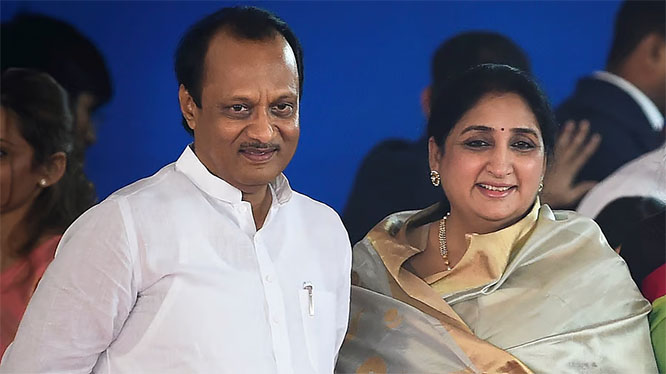
In the NCP, Praful Patel is the Working President and Raigad MP Sunil Tatkare heads the state unit. Ajit Pawar’s wife, Sunetra Pawar, is a Rajya Sabha MP, while their sons Parth and Jay are not actively involved in day-to-day politics. Parth Pawar briefly entered electoral politics in 2019 but lost the Lok Sabha election from Maval. Jay Pawar’s political debut was under consideration.

With Ajit Pawar gone, speculation has intensified that a member of the family may be asked to assume a larger role. For now, Sunetra Pawar is expected to play a key coordinating role in party affairs, alongside Patel and Tatkare.

The NCP continues to have several heavyweight leaders, including Chhagan Bhujbal, Hasan Mushrif, Dattatreya Bharne, Manikrao Kokate and Dhananjay Munde.

Ajit Pawar had already begun steps towards reconciliation between the two factions. While they contested the Pune and Pimpri-Chinchwad municipal elections separately, they later decided to fight the zilla parishad elections together under the ‘clock’ symbol—seen as the first formal step towards reunification.

Nagpur meet and party roadmap

Both NCP factions claim adherence to the ideology of ‘Shiv–Shahu–Phule–Ambedkar’. At the Rashtravadi Chintan Shivir held in Nagpur on September 19, 2025, the NCP reaffirmed its commitment to sarva dharma sambhav and discussed strengthening ties with the BJP “for the welfare and development of Maharashtra”.

In recent days, reports had suggested Ajit Pawar might return to the Maha Vikas Aghadi following the party’s poor performance in Pune municipal elections, but these claims were denied.

Big question for Maha Yuti

Ajit Pawar’s death also presents an immediate challenge for the Devendra Fadnavis-led Maha Yuti government. Pawar held crucial portfolios, including Finance, Planning and Excise. With the Budget Session approaching, appointing a new Finance Minister has become urgent.

Beyond numbers and portfolios, Maha Yuti has lost a swift decision-maker known for his administrative grip and political finesse—leaving a vacuum that will not be easy to fill.

Comments

Add new comment

  • Coastaldigest.com reserves the right to delete or block any comments.
  • Coastaldigset.com is not responsible for its readers’ comments.
  • Comments that are abusive, incendiary or irrelevant are strictly prohibited.
  • Please use a genuine email ID and provide your name to avoid reject.
News Network
January 20,2026

iran.jpg

Iranian security and intelligence forces have captured more than 470 individuals in three provinces, identified as key figures behind the recent wave of violent unrest and terrorist activities linked to foreign-backed networks.

The Intelligence Ministry's provincial office in Khorasan Razavi announced on Monday the arrest of 192 armed terrorists, identified as the main agents behind recent riots in the region. 

According to an official statement, the detainees were involved in the killing of several security personnel and civilians, setting fire to mosques, public service facilities, and buses, as well as attacks on military and law enforcement centers.

The seized items from the group include several bulletproof vests, Kalashnikov rifles, hunting weapons, Winchester rifles, and various cold weapons such as daggers, swords, brass knuckles, tactical knives, crossbows, and chains.

Evidence indicates that some of the individuals were tied to hostile movements and terrorist organizations, with links overseas. Others were identified as members of violent criminal gangs, actively taking part in the unrest alongside their associates.

Simultaneously, in the western province of Lorestan, the IRGC announced the arrest of 134 individuals as the main leaders and influential field agents of a US-Israeli terrorist network.

The IRGC statement stated that these individuals formed terrorist cells during the recent unrest, committing "Daesh-like" acts.

They wounded security forces with firearms and cold weapons, and burned and destroyed public and private properties, including mosques, shops, banks, and private and public vehicles.

In the northwestern province of Zanjan, the police reported detaining 150 people identified as principal leaders and agents behind recent riots.

Authorities noted that these individuals were responsible for destroying public and private property and intentionally setting fire to vehicles in the province's squares.

Their crimes include shedding the blood of innocent people, destroying public and private property, attempting to enter military sites, disrupting public order, and spreading terror among citizens.

A variety of cold weapons were reportedly seized from the detainees.

What began late last month as peaceful protests over economic hardship across Iran turned violent after public statements by US and Israeli regime figures encouraged vandalism and disorder.

During the unrest, foreign-backed mercenaries rampaged through cities, killing security forces and civilians and damaging public property.

Comments

Add new comment

  • Coastaldigest.com reserves the right to delete or block any comments.
  • Coastaldigset.com is not responsible for its readers’ comments.
  • Comments that are abusive, incendiary or irrelevant are strictly prohibited.
  • Please use a genuine email ID and provide your name to avoid reject.
News Network
January 31,2026

Roy.jpg

Bengaluru: The shooting incident involving CJ Roy, founder of the Confident Group, has once again put the spotlight on a businessman whose life has swung between flamboyant global success and persistent controversy at home.

Though Roy’s business interests extended across continents, his roots lay firmly in Karnataka. An alumnus of Christ School in Bengaluru, he later moved to Tumakuru to pursue an engineering degree. Those familiar with his early years describe him as intensely ambitious, beginning his career as a salesman at a small electronics firm dealing in computers.

Roy’s entry into large-scale real estate came through the Crystal Group, where he worked closely with Latha Namboothiri and rose from manager to director. However, the launch of the Confident Group in 2005 was clouded by industry speculation. Insiders speak of a fallout involving alleged “benami” properties and claims of deception that ultimately led to his independent venture—an episode Roy spent years trying to distance himself from, according to associates.

A tale of two cities

Roy’s professional trajectory diverged sharply across geographies.

In Dubai, he built a reputation as a bold and efficient developer, completing massive luxury residential projects in record time—some reportedly within 11 months. His rapid project delivery and lavish lifestyle in the Emirates earned him admiration and visibility in the real estate sector.

In Bengaluru, however, his image remained far more fractured. Sources say Roy stayed away from the city for several years amid disputes over unpaid dues to vendors and suppliers. Several projects were allegedly stalled, with accusations of unfulfilled commitments to cement and steel suppliers continuing to follow him.

Roy’s return to Bengaluru’s business and social circles began around 2018, marked by a conscious attempt at rebranding. His appointment as Honorary Consul of the Slovak Republic added diplomatic legitimacy, which he complemented with visible CSR initiatives, including ambulance donations and high-profile charity events.

Heavy police presence in Langford Town

Following the incident, police personnel from the Central division were deployed outside the Confident Group building in Langford Town, which also houses the Slovak Honorary Consulate in Bengaluru.

The otherwise busy premises near Hosur Road wore a deserted look on Friday, reflecting the shock and uncertainty that followed the tragedy.

Comments

Add new comment

  • Coastaldigest.com reserves the right to delete or block any comments.
  • Coastaldigset.com is not responsible for its readers’ comments.
  • Comments that are abusive, incendiary or irrelevant are strictly prohibited.
  • Please use a genuine email ID and provide your name to avoid reject.