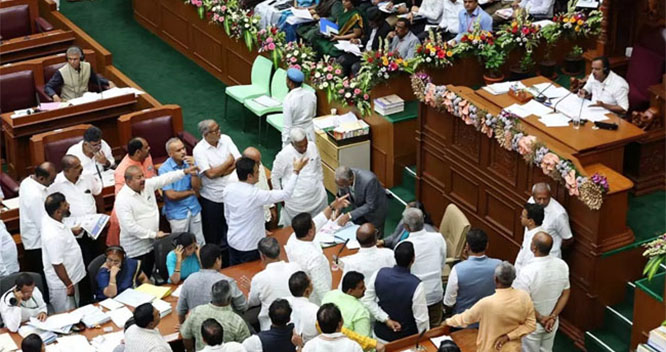
BJP-JDS stage protest in Karnataka Assembly over passage of resolutions against Centre’s step motherly treatment

News Network
February 23, 2024

assemblyprotest.jpg

Bengaluru, Feb 23: The opposition BJP and JD(S) staged a protest against the Congress government in Karnataka over passing of resolutions against Narendra Modi-led administration’s step motherly treatment, which rocked the Legislative Assembly proceedings on Friday, forcing adjournments.

The Business Advisory Committee (BAC) of the Assembly, meanwhile, at its meeting Chaired by Speaker U T Khader decided to extend the session by a day to Monday, which was otherwise scheduled to conclude today, for passage of the finance bill and Chief Minister’s reply to discussion on the Budget.

The Opposition demanded that the government withdraw the resolutions.

Leader of Opposition R Ashoka even read out a “counter resolution” condemning the resolutions moved and passed by the government on Thursday as “false, imaginary and politically motivated”, and accused the government of blaming the Centre to hide its failures.

As the opposition’s resolution was read without following due procedures and without the consent of the Speaker, it was not considered or put to vote.

The state government had on Thursday moved and ensured passage of resolutions urging the union government to make sure that no injustice is done to the state in allocation of financial resources, and to frame a legislation regarding fixation of MSP for all crops of farmers.

As the House met for the day on Friday, BJP and JD(S) members trooped into the well of the House.

Ashoka said resolutions were brought against the central government all of a sudden and unilaterally, without bringing it to their notice or discussing it at the BAC meeting; it was also not mentioned in the agenda.

“Why did the government bring the resolution in a hush hush manner, despite having a majority in the House? They could have mentioned it in the agenda and introduced the resolution openly as per procedure and we too would have put forward our stand and objections against the resolutions.

Assembly and its rules have been insulted,” he said while demanding that the resolutions be withdrawn.

Law and Parliamentary Affairs Minister H K Patil, who had moved the resolution on Thursday, defended the government’s action and said the resolution was passed keeping the interest of Karnataka and its people in mind. It was against the injustice meted out to the state and was with facts and figures.

“We had moved the resolution and it was brought by the large number of members of this House. It is the unanimous voice of the people of Karnataka and I condemn the opposition’s objections to this unanimous voice of seven crore people of the state,” he said.

Noting that the government doesn’t need opposition’s consent to bring any resolution in the interest of the people of the state, Patil said resolutions have been moved and passed as per law and there is no question of withdrawing it. “You (opposition) introspect whether you are for Karnataka’s interest or want to do politics.” This elicited a sharp reaction from Ashoka, who asked what Congress MPs from Karnataka were doing in the Parliament, instead of raising the issue there, to which Minister Krishna Byre Gowda retorted by saying that BJP’s 25 MPs in Lok Sabha from the State never raised any issue in the interest of the state. This led to heated arguments between both sides.

Former Chief Minister Basavaraj Bommai said the Congress which ruled the country for about 55 years in 75 years of independent India, had kept the devolution of funds to states at 20 per cent for a long time; it took 30 years to raise it to 30 per cent after protests and struggle by several states.

The UPA government for 10 years did not heed to the demand of raising it to 40 per cent, but the Modi government soon after coming to power raised it to 42 per cent.

This led to a strong counter from the Congress side, forcing the Speaker to adjourn the House for some time.

As the House met again, BJP continued to protest from the well of the House, even as Minister Krinsha Byre Gowda requested them to allow the proceedings to go on normally.

To this, Ashoka said, they will withdraw the protest if the government withdraws the resolution.

The state government wants confrontation with the Centre, he further claimed. “If you (govt) don’t want to withdraw your resolution, the chair should allow us to move a resolution in favour of the central government, and let’s discuss it.” With both sides refusing to budge and BJP-JD(S) continuing to protest from the well of the House, the Speaker tried to transact some business amid sloganeering by opposition members.

Amidst the din, the Speaker allowed tabling of certain reports and passage of two bills without any discussion. Even as the Speaker was putting the bills to vote for its passage, Ashoka read out the opposition’s counter resolution, which was neither considered by the Chair, nor it was put to vote.

As the chaos continued, the Speaker adjourned the House to Monday. 

Comments

Add new comment

  • Coastaldigest.com reserves the right to delete or block any comments.
  • Coastaldigset.com is not responsible for its readers’ comments.
  • Comments that are abusive, incendiary or irrelevant are strictly prohibited.
  • Please use a genuine email ID and provide your name to avoid reject.
News Network
February 1,2026

Bengaluru, Feb 1: For travelers landing at Kempegowda International Airport (KIA), the sleek, wood-paneled curves of Terminal 2 promise a world-class welcome. But the famed “Garden City” charm quickly withers at the curb. As India’s aviation sector swells to record numbers—handling over 43 million passengers in Bengaluru alone this past year—the “last mile” has turned into a marathon of frustration.

The Bengaluru Logjam: Rules vs Reality

While the city awaits the 2027 completion of the Namma Metro Blue Line, the interim has been chaotic. Recent “decongestion” rules at Terminal 1 have pushed app-based cab pickups to distant parking zones, forcing weary passengers into a 20-minute walk with luggage.

“I landed after ten months away and felt like a stranger in my own city,” says Ruchitha Jain, a Koramangala resident. “My driver couldn’t find me, staff couldn’t guide me, and the so-called ‘Premium’ lane is just a fancy tax on convenience.”

•    The Cost of Distance: A 40-km cab ride can now easily cross ₹1,500, driven by demand pricing and airport surcharges.

•    The Bus Gap: While Vayu Vajra remains a lifeline, its ₹300–₹400 fare is often cited as the most expensive airport bus service in the country.

A National Pattern of Disconnect

The struggle is not unique to Karnataka. From Chennai’s coast to Hyderabad’s plateau, India’s airports tell a familiar story: brilliant runways, broken exits.

City:    Primary Issue   |    Recent Development

Bengaluru:    Cab pickup restrictions & distance  |    App-based taxis shifted to far parking zones; long walks and fare spikes reported

Chennai:    Multi-Level Parking (MLCP) hike  |    Passengers report 40-minute walks to reach cab pickup points

Hyderabad:    “Taxi mafia” & touting  |    Over 440 touting cases reported; security presence intensified

Mumbai:    Fare scams  |     Tourists charged ₹18,000 for just 400 metres, triggering police action

In Hyderabad, travelers continue to battle entrenched local groups that intimidate Uber and Ola drivers, pushing passengers toward overpriced private taxis. Chennai flyers, meanwhile, complain that reaching the designated pickup zones now takes longer than short-haul flights from cities like Coimbatore.

The ‘Budget Day’ Hope

As Finance Minister Nirmala Sitharaman presents the Union Budget 2026 today, the aviation sector is watching closely. With the government’s renewed emphasis on multimodal integration, there is cautious hope for funding toward seamless airport-metro-bus hubs.

The vision is clear: a future where planes, trains, and metros speak the same language. Until then, passengers at KIA—and airports across India—will continue to discover that the hardest part of flying isn’t the thousands of kilometres in the air, but the last few on the ground.

Comments

Add new comment

  • Coastaldigest.com reserves the right to delete or block any comments.
  • Coastaldigset.com is not responsible for its readers’ comments.
  • Comments that are abusive, incendiary or irrelevant are strictly prohibited.
  • Please use a genuine email ID and provide your name to avoid reject.
News Network
January 20,2026

KCFabudhabi.jpg

KCF, a global socio-cultural organisation of Karnataka expatriates, is actively involved in education, humanitarian initiatives and community well-being across several countries. The awardees were selected following a structured evaluation of nominations by the Annual Council Program Committee, based on the depth, consistency and long-term impact of their social service.

One of the award recipients, Abdul Razak Haji, a prominent UAE-based entrepreneur from the Qamcon Group of Companies, was honoured for his significant contributions to society. Through both his professional journey and personal initiatives, he has supported numerous employees and families, while also extending assistance in education, housing for the underprivileged and various charitable causes, largely carried out quietly over the years. His award was presented earlier during the Annual Council Program held at the KCF Abu Dhabi office.

The second award was conferred on Latheef Kakkinje, a young social worker based in Abu Dhabi, in recognition of his active involvement in community engagement programmes, sports initiatives, talent festivals and family-oriented social activities. His consistent volunteering efforts and commitment to humanitarian causes were highly appreciated by the selection committee.

The award presentation ceremony for Latheef Kakkinje was held at the Zayed Cricket Stadium (Astro Turf Ground) in the presence of Kedumbady Ibrahim Saqafi, President of KCF UAE; Ibrahim, General Secretary; Kabeer Bayambady, President of KCF Abu Dhabi; Ummer Ishwaramangila, General Secretary; along with other members of the KCF Abu Dhabi cabinet.

Congratulating both awardees, KCF leaders reiterated the organisation’s commitment to recognising individuals who selflessly work for social upliftment and community service.

KCFabudhabi1.jpg

Comments

Add new comment

  • Coastaldigest.com reserves the right to delete or block any comments.
  • Coastaldigset.com is not responsible for its readers’ comments.
  • Comments that are abusive, incendiary or irrelevant are strictly prohibited.
  • Please use a genuine email ID and provide your name to avoid reject.
News Network
January 23,2026

Karnataka Governor Thaawarchand Gehlot read only three lines from the 122-paragraph address prepared by the Congress-led state government while addressing the joint session of the Legislature on Thursday, effectively bypassing large sections critical of the BJP-led Union government.

The omitted portions of the customary Governor’s address outlined what the state government described as a “suppressive situation in economic and policy matters” under India’s federal framework. The speech also sharply criticised the Centre’s move to replace the Mahatma Gandhi National Rural Employment Guarantee Act (MGNREGA) with the Viksit Bharat–Guarantee for Rozgar and Ajeevika Mission (Gramin) Act, commonly referred to as the VB-GRAM (G) Act.

Governor Gehlot had earlier conveyed his objection to several paragraphs that were explicitly critical of the Union government. On Thursday, he confined himself to the opening lines — “I extend a warm welcome to all of you to the joint session of the State legislature. I am extremely pleased to address this august House” — before jumping directly to the concluding sentence of the final paragraph.

He ended the address by reading the last line of paragraph 122: “Overall, my government is firmly committed to doubling the pace of the State’s economic, social and physical development. Jai Hind — Jai Karnataka.”

According to the prepared speech, the Karnataka government demanded the scrapping of the VB-GRAM (G) Act, describing it as “contractor-centric” and detrimental to rural livelihoods, and called for the full restoration of MGNREGA. The state government argued that the new law undermines decentralisation, weakens labour protections, and centralises decision-making in violation of constitutional norms.

Key points from the unread sections of the speech:

•    Karnataka facing a “suppressive” economic and policy environment within the federal system

•    Repeal of MGNREGA described as a blow to rural livelihoods

•    VB-GRAM (G) Act accused of protecting corporate and contractor interests

•    New law alleged to weaken decentralised governance

•    Decision-making said to be imposed by the Centre without consulting states

•    Rights of Adivasis, women, backward classes and agrarian communities curtailed

•    Labourers allegedly placed under contractor control

•    States facing mounting fiscal stress due to central policies

•    VB-GRAM (G) Act accused of enabling large-scale corruption

Comments

Add new comment

  • Coastaldigest.com reserves the right to delete or block any comments.
  • Coastaldigset.com is not responsible for its readers’ comments.
  • Comments that are abusive, incendiary or irrelevant are strictly prohibited.
  • Please use a genuine email ID and provide your name to avoid reject.