



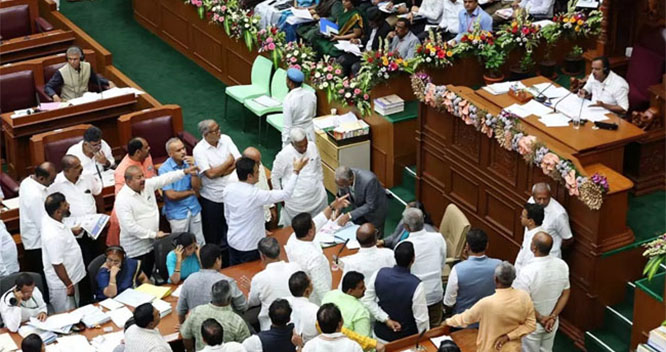
BJP-JDS stage protest in Karnataka Assembly over passage of resolutions against Centre’s step motherly treatment

News Network
February 23, 2024

assemblyprotest.jpg

Bengaluru, Feb 23: The opposition BJP and JD(S) staged a protest against the Congress government in Karnataka over passing of resolutions against Narendra Modi-led administration’s step motherly treatment, which rocked the Legislative Assembly proceedings on Friday, forcing adjournments.

The Business Advisory Committee (BAC) of the Assembly, meanwhile, at its meeting Chaired by Speaker U T Khader decided to extend the session by a day to Monday, which was otherwise scheduled to conclude today, for passage of the finance bill and Chief Minister’s reply to discussion on the Budget.

The Opposition demanded that the government withdraw the resolutions.

Leader of Opposition R Ashoka even read out a “counter resolution” condemning the resolutions moved and passed by the government on Thursday as “false, imaginary and politically motivated”, and accused the government of blaming the Centre to hide its failures.

As the opposition’s resolution was read without following due procedures and without the consent of the Speaker, it was not considered or put to vote.

The state government had on Thursday moved and ensured passage of resolutions urging the union government to make sure that no injustice is done to the state in allocation of financial resources, and to frame a legislation regarding fixation of MSP for all crops of farmers.

As the House met for the day on Friday, BJP and JD(S) members trooped into the well of the House.

Ashoka said resolutions were brought against the central government all of a sudden and unilaterally, without bringing it to their notice or discussing it at the BAC meeting; it was also not mentioned in the agenda.

“Why did the government bring the resolution in a hush hush manner, despite having a majority in the House? They could have mentioned it in the agenda and introduced the resolution openly as per procedure and we too would have put forward our stand and objections against the resolutions.

Assembly and its rules have been insulted,” he said while demanding that the resolutions be withdrawn.

Law and Parliamentary Affairs Minister H K Patil, who had moved the resolution on Thursday, defended the government’s action and said the resolution was passed keeping the interest of Karnataka and its people in mind. It was against the injustice meted out to the state and was with facts and figures.

“We had moved the resolution and it was brought by the large number of members of this House. It is the unanimous voice of the people of Karnataka and I condemn the opposition’s objections to this unanimous voice of seven crore people of the state,” he said.

Noting that the government doesn’t need opposition’s consent to bring any resolution in the interest of the people of the state, Patil said resolutions have been moved and passed as per law and there is no question of withdrawing it. “You (opposition) introspect whether you are for Karnataka’s interest or want to do politics.” This elicited a sharp reaction from Ashoka, who asked what Congress MPs from Karnataka were doing in the Parliament, instead of raising the issue there, to which Minister Krishna Byre Gowda retorted by saying that BJP’s 25 MPs in Lok Sabha from the State never raised any issue in the interest of the state. This led to heated arguments between both sides.

Former Chief Minister Basavaraj Bommai said the Congress which ruled the country for about 55 years in 75 years of independent India, had kept the devolution of funds to states at 20 per cent for a long time; it took 30 years to raise it to 30 per cent after protests and struggle by several states.

The UPA government for 10 years did not heed to the demand of raising it to 40 per cent, but the Modi government soon after coming to power raised it to 42 per cent.

This led to a strong counter from the Congress side, forcing the Speaker to adjourn the House for some time.

As the House met again, BJP continued to protest from the well of the House, even as Minister Krinsha Byre Gowda requested them to allow the proceedings to go on normally.

To this, Ashoka said, they will withdraw the protest if the government withdraws the resolution.

The state government wants confrontation with the Centre, he further claimed. “If you (govt) don’t want to withdraw your resolution, the chair should allow us to move a resolution in favour of the central government, and let’s discuss it.” With both sides refusing to budge and BJP-JD(S) continuing to protest from the well of the House, the Speaker tried to transact some business amid sloganeering by opposition members.

Amidst the din, the Speaker allowed tabling of certain reports and passage of two bills without any discussion. Even as the Speaker was putting the bills to vote for its passage, Ashoka read out the opposition’s counter resolution, which was neither considered by the Chair, nor it was put to vote.

As the chaos continued, the Speaker adjourned the House to Monday. 

Comments

Add new comment

  • Coastaldigest.com reserves the right to delete or block any comments.
  • Coastaldigset.com is not responsible for its readers’ comments.
  • Comments that are abusive, incendiary or irrelevant are strictly prohibited.
  • Please use a genuine email ID and provide your name to avoid reject.
News Network
February 1,2026

Bengaluru: The Karnataka High Court has refused to quash an investigation against a WhatsApp group administrator accused of allowing the circulation of obscene and offensive images depicting Hindutva politicians and idols in 2021.

Justice M Nagaprasanna observed that, prima facie, the ingredients of the offence under Section 295A of the Indian Penal Code were made out. “The offence under Section 295A of the IPC is met to every word of its ingredient, albeit prima facie,” the judge said.

The petitioner, Sirajuddin, a resident of Belthangady taluk in Dakshina Kannada district, had challenged the FIR registered against him at the CEN (Cyber, Economics and Narcotics) police station, Mangaluru, for offences under Section 295A of the IPC and Section 67 of the Information Technology Act. Section 295A relates to punishment for deliberate and malicious acts intended to outrage the religious feelings of any class of citizens.

According to the complaint filed by K Jayaraj Salian, also a resident of Belthangady taluk, he received a WhatsApp group link from an unknown source and was added to the group after accessing it. The group reportedly had six administrators and around 250 participants, where obscene and offensive images depicting Hindu deities and certain political figures were allegedly circulated repeatedly.

Sirajuddin was arrested in connection with the case and later released on bail on February 16, 2021. He argued before the court that he was being selectively targeted, while other administrators—including the creator of the group—were neither arrested nor investigated. He also contended that the Magistrate could not have taken cognisance of the offence under Section 295A without prior sanction under Section 196(1) of the CrPC.

Rejecting the argument, Justice Nagaprasanna held that prior sanction is required only at the stage of taking cognisance, and not at the stage of registration of the crime or during investigation.

The judge noted that the State had produced the entire investigation material before the court. “A perusal of the material reveals depictions of Hindu deities in an extraordinarily obscene, demeaning and profane manner. The content is such that its reproduction in a judicial order would itself be inappropriate,” the court said, adding that the material, on its face, had the tendency to outrage religious feelings and disturb communal harmony.

Observing that the case was still at the investigation stage, the court said it could not interdict the probe at this juncture. However, it expressed concern that the investigating officer appeared to have not proceeded uniformly against all administrators. The court clarified that if the investigation revealed the active involvement of any member in permitting the circulation of such content, they must also be proceeded against.

“At this investigative stage, any further observation by this Court would be unnecessary,” the order concluded.

Comments

Add new comment

  • Coastaldigest.com reserves the right to delete or block any comments.
  • Coastaldigset.com is not responsible for its readers’ comments.
  • Comments that are abusive, incendiary or irrelevant are strictly prohibited.
  • Please use a genuine email ID and provide your name to avoid reject.
News Network
January 20,2026

Mangaluru: In a major step towards strengthening rural innovation, the Office of the Principal Scientific Adviser (PSA) to the Government of India is supporting the establishment of RuTAGe Smart Village Centres (RSVCs) across the country through collaborations with academic institutions, civil society organisations and philanthropic partners.

As part of this national initiative, Nitte (Deemed to be University) will set up the first RSVCs in the region at Nitte GP in Udupi district and at the Nitte Health Centre, Sevanjali Trust, Farangipete, in Dakshina Kannada district. The centres will be inaugurated on January 21. In South India, the programme is being implemented by the Section Infin-8 Foundation (SI-8).

Speaking to reporters on Monday, SI-8 founder-director Vishwas US said experts from Nitte University and SI-8 would work closely with farmers, students, youth and local entrepreneurs to adapt and deploy technologies tailored to local needs.

Project head Prof Iddya Karunasagar, representing Nitte DU, said the RSVCs at Nitte and Farangipete would serve as demonstration hubs for a wide range of agriculture, energy, skill-development and assistive technologies. These include solar dryers for fruits, vegetables and crops; soil-testing solutions; power weeders and women-friendly farm tools; wind-powered devices for rural artisans; grain storage systems; grass-cutting and tree-climbing equipment; and liquid fertiliser production using cowshed waste.

SI-8 CEO Aravind C Kumar said the centres would also provide access to digital and knowledge-based platforms such as ISRO applications, government scheme portals, market linkage tools and gamified learning resources, along with assistive technologies for persons with visual impairments.

Highlighting the broader impact of the initiative, Principal Scientific Adviser Prof Ajay Kumar Sood said it demonstrated how applied research could bridge the rural–urban divide and help create self-reliant, technology-enabled villages.

The initiative has been made possible through philanthropic support from Dr NC Murthy of ACM Business Solutions, LLC, USA. Dr Sapna Poti, Director (Strategic Alliances) at the Office of the Principal Scientific Adviser, said the long-term objective is to build self-sufficient, technology-driven communities capable of generating sustainable livelihoods on their own.

Comments

Add new comment

  • Coastaldigest.com reserves the right to delete or block any comments.
  • Coastaldigset.com is not responsible for its readers’ comments.
  • Comments that are abusive, incendiary or irrelevant are strictly prohibited.
  • Please use a genuine email ID and provide your name to avoid reject.
News Network
January 31,2026

Roy.jpg

Bengaluru: The shooting incident involving CJ Roy, founder of the Confident Group, has once again put the spotlight on a businessman whose life has swung between flamboyant global success and persistent controversy at home.

Though Roy’s business interests extended across continents, his roots lay firmly in Karnataka. An alumnus of Christ School in Bengaluru, he later moved to Tumakuru to pursue an engineering degree. Those familiar with his early years describe him as intensely ambitious, beginning his career as a salesman at a small electronics firm dealing in computers.

Roy’s entry into large-scale real estate came through the Crystal Group, where he worked closely with Latha Namboothiri and rose from manager to director. However, the launch of the Confident Group in 2005 was clouded by industry speculation. Insiders speak of a fallout involving alleged “benami” properties and claims of deception that ultimately led to his independent venture—an episode Roy spent years trying to distance himself from, according to associates.

A tale of two cities

Roy’s professional trajectory diverged sharply across geographies.

In Dubai, he built a reputation as a bold and efficient developer, completing massive luxury residential projects in record time—some reportedly within 11 months. His rapid project delivery and lavish lifestyle in the Emirates earned him admiration and visibility in the real estate sector.

In Bengaluru, however, his image remained far more fractured. Sources say Roy stayed away from the city for several years amid disputes over unpaid dues to vendors and suppliers. Several projects were allegedly stalled, with accusations of unfulfilled commitments to cement and steel suppliers continuing to follow him.

Roy’s return to Bengaluru’s business and social circles began around 2018, marked by a conscious attempt at rebranding. His appointment as Honorary Consul of the Slovak Republic added diplomatic legitimacy, which he complemented with visible CSR initiatives, including ambulance donations and high-profile charity events.

Heavy police presence in Langford Town

Following the incident, police personnel from the Central division were deployed outside the Confident Group building in Langford Town, which also houses the Slovak Honorary Consulate in Bengaluru.

The otherwise busy premises near Hosur Road wore a deserted look on Friday, reflecting the shock and uncertainty that followed the tragedy.

Comments

Add new comment

  • Coastaldigest.com reserves the right to delete or block any comments.
  • Coastaldigset.com is not responsible for its readers’ comments.
  • Comments that are abusive, incendiary or irrelevant are strictly prohibited.
  • Please use a genuine email ID and provide your name to avoid reject.
