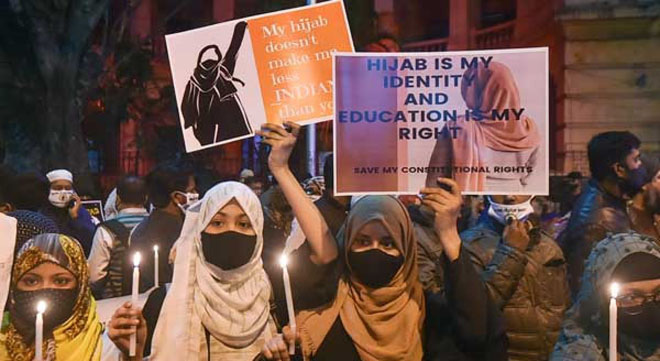
Hijab row: Comments by United States, others not welcome, says govt of India

News Network
February 12, 2022

hijabb.jpg

A day after the United States waded into the controversy over ban on Hijabs in the schools in Karnataka, the government of India said that the “motivated comments” on its “internal issues” were not welcome.

New Delhi apparently reacted to a tweet by Rashad Hussain, the US Ambassador-at-Large for International Religious Freedom. Hussain had argued in the tweet that the ban on Hijab in schools in Karnataka had violated religious freedom.

The Ministry of External Affairs (MEA) in New Delhi stated on Saturday that the matter regarding dress code in some educational institutions in Karnataka was under judicial examination by the High Court. “Our constitutional framework and mechanisms, as well as our democratic ethos and polity, are the context in which issues are considered and resolved,” Arindam Bagchi, the spokesperson of the MEA, said. “Those who know India well would have a proper appreciation of these realities.”

Hussain tweeted on the Hijab controversy in Karnataka late on Friday.

“Religious freedom includes the ability to choose one's religious attire,” Rashad Hussain, the US Ambassador-at-Large for International Religious Freedom, tweeted. “The Indian state of Karnataka should not determine permissibility of religious clothing. Hijab bans in schools violate religious freedom and stigmatize and marginalize women and girls.”

Hussain, an Indian-American attorney and diplomat, was appointed by President Joe Biden’s administration last year as the US Ambassador-at-Large for International Religious Freedom.

He was the first US Government official to publicly make a comment on the controversy that erupted in Karnataka.

Hussain’s comment on the controversy over Hijab in India came on a day External Affairs Minister S Jaishankar had a bilateral meeting with the US Secretary of State, Anthony Blinken, on the sideline of a meeting of the a Quad Foreign Ministers at Melbourne in Australia.

Pakistan Foreign Minister Shah Mahmood Qureshi had earlier hit out at the Government of India for depriving Muslim girls of education and called it a “grave violation of fundamental human rights”. “To deny anyone this fundamental right & (and) terrorise them for wearing a hijab is absolutely oppressive. The world must realise this is part of Indian state plan of ghettoisation of Muslims,” Qureshi had posted on Twitter on Wednesday.

The Biden Administration has been tacitly conveying to the Modi Government concerns in the US over the perception that India was backsliding on human rights and freedom of speech and religion. The US President as well as his Vice President Kamala Harris subtly nudged the Prime Minister to protect democratic principles of India, when they had hosted him in Washington DC on September 24 last year.

The US has been nudging India on the issue of declining religious freedom even during Biden’s predecessor Donald Trump’s four-year term in the White House.

Hussain’s predecessor Samuel Brownback had in June 2020 expressed concern over violence and discrimination against religious and ethnic minorities in India.

The US Commission for International Religious Freedom – an independent, bipartisan US federal government commission – on November 5 last year reiterated its plea to the Biden Administration to designate India – along with Russia, Lebanon and Vietnam – as a 'Country of Particular Concern' in view of the impact of the policies implemented by the Bharatiya Janata Party’s government in New Delhi on religious freedom of the minority Muslims, Sikhs and Christians as well as of the Dalits and the Adivasis.

The Modi Government, however, has been defending its track record in protecting democratic principles, human rights and religious freedom.

Comments

Add new comment

  • Coastaldigest.com reserves the right to delete or block any comments.
  • Coastaldigset.com is not responsible for its readers’ comments.
  • Comments that are abusive, incendiary or irrelevant are strictly prohibited.
  • Please use a genuine email ID and provide your name to avoid reject.
News Network
January 23,2026

modIKERALA.jpg

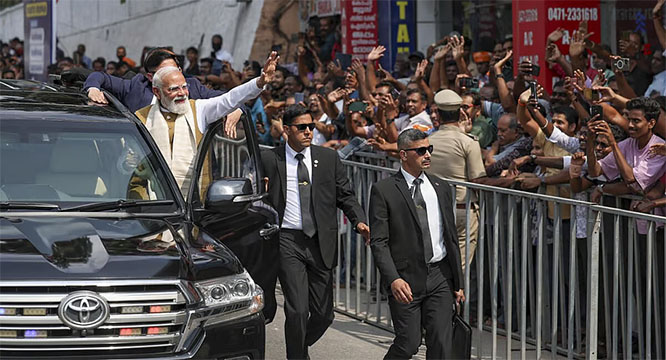
Prime Minister Narendra Modi, during his visit to Thiruvananthapuram on Friday, January 23, indicated that the Bharatiya Janata Party (BJP) is aiming to expand its political footprint in Kerala ahead of the Assembly elections scheduled in the coming months.

Speaking at a BJP-organised public meeting, Modi drew parallels between the party’s early electoral gains in Gujarat and its recent victory in the Thiruvananthapuram Municipal Corporation. The civic body win, which ended decades of Left control, was cited by the Prime Minister as a possible starting point for the party’s broader ambitions in the state.

Recalling BJP’s political trajectory in Gujarat, Modi said the party was largely insignificant before 1987 and received little media attention. He pointed out that the BJP’s first major breakthrough came with its victory in the Ahmedabad Municipal Corporation that year.

“Just as our journey in Gujarat began with one city, Kerala’s journey has also started with a single city,” Modi said, suggesting that the party’s municipal-level success could translate into wider electoral acceptance.

The Prime Minister alleged that successive governments led by the Left Democratic Front (LDF) and the United Democratic Front (UDF) had failed to adequately develop Thiruvananthapuram. He accused both fronts of corruption and neglect, claiming that basic infrastructure and facilities were denied to the capital city for decades.

According to Modi, the BJP’s control of the civic body represents a shift driven by public dissatisfaction with the existing political alternatives. He asserted that the BJP administration in Thiruvananthapuram had begun working towards development, though no specific details or timelines were outlined.

Addressing the gathering at Putharikandam Maidan, Modi said the BJP intended to project Thiruvananthapuram as a “model city,” reiterating his party’s commitment to governance-led change.

The Prime Minister’s visit to Kerala also included the inauguration of several development projects and the flagging off of new train services, as the BJP intensifies its political outreach in the poll-bound state.

Comments

Add new comment

  • Coastaldigest.com reserves the right to delete or block any comments.
  • Coastaldigset.com is not responsible for its readers’ comments.
  • Comments that are abusive, incendiary or irrelevant are strictly prohibited.
  • Please use a genuine email ID and provide your name to avoid reject.
News Network
February 3,2026

wind.jpg

Dakshina Kannada MP Capt Brijesh Chowta has urged the Centre to give high priority to offshore wind energy generation along the Mangaluru coast, citing its strategic importance to India’s green energy and port-led development goals.

Raising the issue in the Lok Sabha under Rule 377, Chowta said studies by the National Institute of Oceanography have identified the Mangaluru coastline as part of India’s promising offshore wind ‘Zone-2’, covering nearly 6,490 sq km. He noted that the region’s relatively low exposure to cyclones and earthquakes makes it suitable for long-term offshore wind projects and called for its development as a dedicated offshore wind energy zone.

Highlighting the role of New Mangalore Port, Chowta said its modern infrastructure, multiple berths and heavy cargo-handling capacity position it well as a logistics hub for transporting and assembling large wind energy equipment.

He also pointed to the presence of major industrial units such as MRPL, OMPL, UPCL and the Mangaluru SEZ, which could serve as direct buyers of green power through power purchase agreements, improving project viability and speeding up execution.

With Karnataka’s peak power demand crossing 18,000 MW in early 2025, Chowta stressed the need to diversify renewable energy sources. He added that offshore wind projects in the Arabian Sea are strategically safer compared to the cyclone-prone Bay of Bengal.

Calling the project vital to India’s target of 500 GW of renewable energy by 2030, Chowta urged the Ministry of New and Renewable Energy to initiate resource assessments, pilot projects and stakeholder consultations at the earliest.

Comments

Add new comment

  • Coastaldigest.com reserves the right to delete or block any comments.
  • Coastaldigset.com is not responsible for its readers’ comments.
  • Comments that are abusive, incendiary or irrelevant are strictly prohibited.
  • Please use a genuine email ID and provide your name to avoid reject.
News Network
February 1,2026

Bengaluru: The Karnataka High Court has refused to quash an investigation against a WhatsApp group administrator accused of allowing the circulation of obscene and offensive images depicting Hindutva politicians and idols in 2021.

Justice M Nagaprasanna observed that, prima facie, the ingredients of the offence under Section 295A of the Indian Penal Code were made out. “The offence under Section 295A of the IPC is met to every word of its ingredient, albeit prima facie,” the judge said.

The petitioner, Sirajuddin, a resident of Belthangady taluk in Dakshina Kannada district, had challenged the FIR registered against him at the CEN (Cyber, Economics and Narcotics) police station, Mangaluru, for offences under Section 295A of the IPC and Section 67 of the Information Technology Act. Section 295A relates to punishment for deliberate and malicious acts intended to outrage the religious feelings of any class of citizens.

According to the complaint filed by K Jayaraj Salian, also a resident of Belthangady taluk, he received a WhatsApp group link from an unknown source and was added to the group after accessing it. The group reportedly had six administrators and around 250 participants, where obscene and offensive images depicting Hindu deities and certain political figures were allegedly circulated repeatedly.

Sirajuddin was arrested in connection with the case and later released on bail on February 16, 2021. He argued before the court that he was being selectively targeted, while other administrators—including the creator of the group—were neither arrested nor investigated. He also contended that the Magistrate could not have taken cognisance of the offence under Section 295A without prior sanction under Section 196(1) of the CrPC.

Rejecting the argument, Justice Nagaprasanna held that prior sanction is required only at the stage of taking cognisance, and not at the stage of registration of the crime or during investigation.

The judge noted that the State had produced the entire investigation material before the court. “A perusal of the material reveals depictions of Hindu deities in an extraordinarily obscene, demeaning and profane manner. The content is such that its reproduction in a judicial order would itself be inappropriate,” the court said, adding that the material, on its face, had the tendency to outrage religious feelings and disturb communal harmony.

Observing that the case was still at the investigation stage, the court said it could not interdict the probe at this juncture. However, it expressed concern that the investigating officer appeared to have not proceeded uniformly against all administrators. The court clarified that if the investigation revealed the active involvement of any member in permitting the circulation of such content, they must also be proceeded against.

“At this investigative stage, any further observation by this Court would be unnecessary,” the order concluded.

Comments

Add new comment

  • Coastaldigest.com reserves the right to delete or block any comments.
  • Coastaldigset.com is not responsible for its readers’ comments.
  • Comments that are abusive, incendiary or irrelevant are strictly prohibited.
  • Please use a genuine email ID and provide your name to avoid reject.