



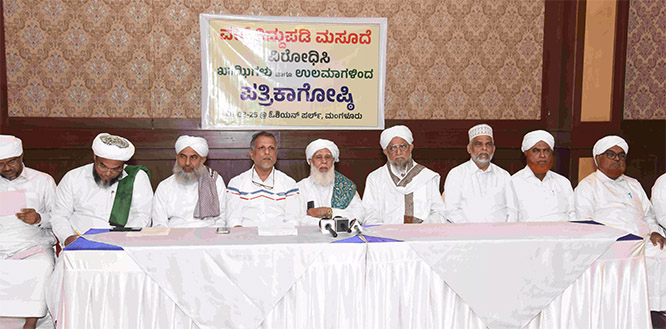
Mangaluru, Mar 1: Muslim religious and community leaders have strongly opposed the Wakf Amendment Bill 2024, calling it a threat to religious freedom. They have urged the government to uphold constitutional values and withdraw the bill immediately.
Speaking at a press conference on Saturday, March 1, they stated that the bill, introduced in August last year, has faced widespread resistance. Critics argue that it undermines the rights of Muslims and disregards constitutional protections. The bill was referred to a Joint Parliamentary Committee, but reports suggest that the committee rejected opposition-proposed changes and introduced even more controversial provisions, deepening concerns.
Leaders emphasized that Wakf properties are sacred donations meant for religious and social welfare purposes within the community. The Wakf Act, first established in 1913 and amended multiple times, safeguards these properties. The Indian Constitution guarantees religious freedom under Articles 25-28, and Article 26 specifically grants religious communities the right to manage their institutions and properties.
The BJP-led government has proposed a new bill titled United Wakf - Management, Empowerment, Efficiency, Development (UMEED) Act. Community leaders fear that the amendments will reduce Muslim control over Wakf assets. One of the most contentious changes requires all Wakf properties to have documented proof within six months, failing which they will lose their Wakf status. Previously, an independent Islamic law expert surveyed Wakf properties, but the amendment shifts this responsibility to district collectors, raising concerns about impartiality. Additionally, the bill removes the requirement for only Muslim officials to be appointed to the Wakf Tribunal and mandates at least two non-Muslim members in the Wakf Board. Critics question why such changes apply only to Wakf institutions while other religious trusts remain self-governed.
The Joint Parliamentary Committee received 9.8 million public objections, the majority opposing the amendments. However, reports suggest that the government ignored these concerns and proceeded with the bill in both Houses of Parliament.
Opponents argue that this amendment aims to bring Wakf assets under government control, eroding the religious and cultural identity of the Muslim community. They view it as a divisive political move that threatens the rights of India’s largest minority.
Religious leaders have urged all citizens who support constitutional values and secularism to voice their opposition to the bill.
Prominent scholars and community leaders at the press conference included Khazi Ahmad Musliyar Takha Ustad, Khazi Zainul Ulama Mani Ustad, Sayyid Ismail Thangal Ujire, Usmanul Faizi Thodaru, U K Muhammad Sadi Valavoor, U K Abdul Aziz Darimi Chokkabetu, S P Hamza Sakhafi Bantwal, N K M Shafi Sadi Bengaluru, Abdul Hameed Darimi Sampya, P P Ahmad Sakhafi Kashipatna, K I Abdul Khader Darimi Kukkil, P M Usman Sadi Pattori, K L Umar Darimi Pattori, T M Muhiyuddin Kamil Sakhafi Toke, Dr M S M Zaini Kamil, Anees Kausari, Umar Darimi Salmar, Qasim Darimi Savanoor, M Y Abdul Hafeez Sadi Kodagu, Abu Bakr Siddiq Darimi Kadaba, K K M Kamil Sakhafi Suribail, Rafiq Hudavi Kolar, K M Abu Bakr Siddiq Montugoli, Hussain Darimi Renjaladi, M P M Ashraf Sadi Malluru, Abu Saleh Faizi Tumbe, Muhammad Ali Turkalike, and Muhammad Musliyar Mundol.
The meeting was led by B A Abdul Nasir Lakki Star, president of the Dakshina Kannada Wakf Advisory Committee, and Ashraf Kinar, vice president of the committee.

Comments
Add new comment