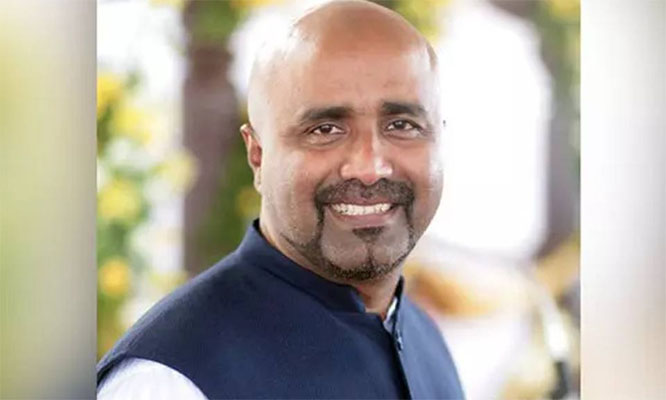
Strict measures inevitable in Karnataka to control covid: Health Minister

News Network
April 3, 2021

Bengaluru, Mar 3: Hinting at no relaxation in the new set of guidelines issued by the state government, amid pressure from various sectors, Karnataka Health Minister K Sudhakar on Saturday said it was inevitable to take certain strict measures so that things don't go out of control. 

He said the guidelines have been issued on the advice of the technical advisory committee consisting of experts, after examining the situation, and if things are under control by April 20, activities will be allowed to resume.

"The government is not happy by restricting activities. I have been requesting through the media for the last one month that a second wave is at our doorstep and if we don't understand and take precautionary measures, the government will have no other options and may have to take serious measures," Sudhakar said.

Speaking to reporters here, he said Karnataka was the first state to resume all the business activities, but the state is today reporting about 5,000 cases per day and 3,500 of them are from Bengaluru alone. "The technical advisory committee has said this will be there for another two months, till the May end and the graph will start declining from June first week. If we don't take measures and something untoward happens, won't it be the government's responsibility?" he asked.

Aimed at curbing Covid-19 with the spike in cases, the government on Friday in a new set of guidelines had ordered the closure of gyms and swimming pools while capping the seating capacity in theatres at 50 per cent in certain districts. It has also ordered apartment complexes to shut common facilities such as party halls and clubhouses.

The new restrictions imposed by the government through the guidelines will be in force till April 20. Noting that the government has issued guidelines after getting several reports from the technical advisory committee, and after consulting senior officials and ministers, Sudhakar said it was not done at one go.

"People from several sectors are saying their activities should not be restricted and should go on freely. Yes, we (govt) too understand, but things should not go out of our control, so it was inevitable for the government to take certain strict measures. We request for cooperation from everyone," he said.

The Karnataka Film Chamber of Commerce has decided to meet Chief Minister B S Yediyurappa to bring to his notice about the impact of capping the seating capacity in theatres at 50 per cent, on the industry, and is likely to seek relaxation so that it doesn't impact films that have just been released.

Also, gym owners have demanded the government to reconsider the decision or allow them to operate with 50 per cent capacity or announce a package so that they can make payment for staff and use it for maintenance. There is pressure from some private schools to allow them to function, similar is the demand from gym, swimming pool and club owners, also people want to hold marriages with large gatherings, the Minister said.

"These measures are not permanent, let's follow these temporary measures for some days... I'm not saying it (Covid- 19 spread) can be controlled 100 per cent by these measures, but we can try to bring things under control," he said. Responding to a question, the Minister said there are guidelines for elections, and religious places too, there is no concession for any sector or activities.

"The government is only trying to control this pandemic that's all, there is no politics or any malicious intent behind this," he said, as he evaded questions on night curfew or weekend lockdown stating that he doesn't want to speak on what measures will be taken in the future. 

Comments

Add new comment

  • Coastaldigest.com reserves the right to delete or block any comments.
  • Coastaldigset.com is not responsible for its readers’ comments.
  • Comments that are abusive, incendiary or irrelevant are strictly prohibited.
  • Please use a genuine email ID and provide your name to avoid reject.
News Network
January 14,2026

utifti.jpg

The National Commission for Allied and Healthcare Professions (NCAHP) has announced that admissions to undergraduate programmes in physiotherapy and occupational therapy will henceforth be conducted exclusively through the National Eligibility-cum-Entrance Test (NEET).

In a press release issued by Prof. U. T. Iftikhar Ali Fareed, Chairman of the Karnataka State Allied and Healthcare Council, stated that the NCAHP has clarified the category-wise degree nomenclature and admission criteria for allied and healthcare undergraduate programmes, effective from the academic year 2026–27.

According to the notification, admissions to the Bachelor of Physiotherapy (BPT) – Category 3 and Bachelor of Occupational Therapy (BOT) – Category 6 will be conducted only through NEET, in accordance with the National Commission for Allied and Healthcare Professions Act, 2021.

All Vice-Chancellors of public, private, and deemed-to-be universities in Karnataka have been asked to ensure strict compliance with the NCAHP guidelines and to disseminate the information widely among affiliated colleges, faculty, and students.

Prof. Ifthikar Ali emphasized that universities must take necessary steps to implement the admission procedure for the academic year 2026–27 and subsequent years.
 

Comments

Add new comment

  • Coastaldigest.com reserves the right to delete or block any comments.
  • Coastaldigset.com is not responsible for its readers’ comments.
  • Comments that are abusive, incendiary or irrelevant are strictly prohibited.
  • Please use a genuine email ID and provide your name to avoid reject.
News Network
January 23,2026

Karnataka Governor Thaawarchand Gehlot read only three lines from the 122-paragraph address prepared by the Congress-led state government while addressing the joint session of the Legislature on Thursday, effectively bypassing large sections critical of the BJP-led Union government.

The omitted portions of the customary Governor’s address outlined what the state government described as a “suppressive situation in economic and policy matters” under India’s federal framework. The speech also sharply criticised the Centre’s move to replace the Mahatma Gandhi National Rural Employment Guarantee Act (MGNREGA) with the Viksit Bharat–Guarantee for Rozgar and Ajeevika Mission (Gramin) Act, commonly referred to as the VB-GRAM (G) Act.

Governor Gehlot had earlier conveyed his objection to several paragraphs that were explicitly critical of the Union government. On Thursday, he confined himself to the opening lines — “I extend a warm welcome to all of you to the joint session of the State legislature. I am extremely pleased to address this august House” — before jumping directly to the concluding sentence of the final paragraph.

He ended the address by reading the last line of paragraph 122: “Overall, my government is firmly committed to doubling the pace of the State’s economic, social and physical development. Jai Hind — Jai Karnataka.”

According to the prepared speech, the Karnataka government demanded the scrapping of the VB-GRAM (G) Act, describing it as “contractor-centric” and detrimental to rural livelihoods, and called for the full restoration of MGNREGA. The state government argued that the new law undermines decentralisation, weakens labour protections, and centralises decision-making in violation of constitutional norms.

Key points from the unread sections of the speech:

•    Karnataka facing a “suppressive” economic and policy environment within the federal system

•    Repeal of MGNREGA described as a blow to rural livelihoods

•    VB-GRAM (G) Act accused of protecting corporate and contractor interests

•    New law alleged to weaken decentralised governance

•    Decision-making said to be imposed by the Centre without consulting states

•    Rights of Adivasis, women, backward classes and agrarian communities curtailed

•    Labourers allegedly placed under contractor control

•    States facing mounting fiscal stress due to central policies

•    VB-GRAM (G) Act accused of enabling large-scale corruption

Comments

Add new comment

  • Coastaldigest.com reserves the right to delete or block any comments.
  • Coastaldigset.com is not responsible for its readers’ comments.
  • Comments that are abusive, incendiary or irrelevant are strictly prohibited.
  • Please use a genuine email ID and provide your name to avoid reject.
News Network
January 20,2026

Mangaluru: In a major step towards strengthening rural innovation, the Office of the Principal Scientific Adviser (PSA) to the Government of India is supporting the establishment of RuTAGe Smart Village Centres (RSVCs) across the country through collaborations with academic institutions, civil society organisations and philanthropic partners.

As part of this national initiative, Nitte (Deemed to be University) will set up the first RSVCs in the region at Nitte GP in Udupi district and at the Nitte Health Centre, Sevanjali Trust, Farangipete, in Dakshina Kannada district. The centres will be inaugurated on January 21. In South India, the programme is being implemented by the Section Infin-8 Foundation (SI-8).

Speaking to reporters on Monday, SI-8 founder-director Vishwas US said experts from Nitte University and SI-8 would work closely with farmers, students, youth and local entrepreneurs to adapt and deploy technologies tailored to local needs.

Project head Prof Iddya Karunasagar, representing Nitte DU, said the RSVCs at Nitte and Farangipete would serve as demonstration hubs for a wide range of agriculture, energy, skill-development and assistive technologies. These include solar dryers for fruits, vegetables and crops; soil-testing solutions; power weeders and women-friendly farm tools; wind-powered devices for rural artisans; grain storage systems; grass-cutting and tree-climbing equipment; and liquid fertiliser production using cowshed waste.

SI-8 CEO Aravind C Kumar said the centres would also provide access to digital and knowledge-based platforms such as ISRO applications, government scheme portals, market linkage tools and gamified learning resources, along with assistive technologies for persons with visual impairments.

Highlighting the broader impact of the initiative, Principal Scientific Adviser Prof Ajay Kumar Sood said it demonstrated how applied research could bridge the rural–urban divide and help create self-reliant, technology-enabled villages.

The initiative has been made possible through philanthropic support from Dr NC Murthy of ACM Business Solutions, LLC, USA. Dr Sapna Poti, Director (Strategic Alliances) at the Office of the Principal Scientific Adviser, said the long-term objective is to build self-sufficient, technology-driven communities capable of generating sustainable livelihoods on their own.

Comments

Add new comment

  • Coastaldigest.com reserves the right to delete or block any comments.
  • Coastaldigset.com is not responsible for its readers’ comments.
  • Comments that are abusive, incendiary or irrelevant are strictly prohibited.
  • Please use a genuine email ID and provide your name to avoid reject.