



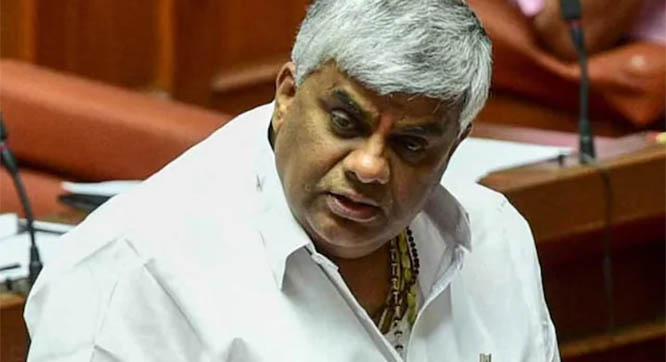
'Won’t interfere', say Siddaramaiah, DKS after SIT arrests Revanna in sex scandal

News Network
May 5, 2024

revannaarrest.jpg

Bengaluru, May 5: In a major development, the Special Investigation Team (SIT) probing the sex video scandal involving JD-S MP Prajwal Revann on Saturday arrested his father and JD-S MLA H.D. Revanna following the rejection of his anticipatory bail plea in a victim kidnapping case by the People’s Representative Court in Bengaluru.

H.D. Revanna was taken into custody from the residence of his father and former Prime Minister H.D. Deve Gowda in Bengaluru’s Padmanabhanagar locality.

First, he was taken to the SIT office on the premises of the Criminal Investigation Department (CID). After preliminary questioning, the former JD-S minister was taken to the Bowring Hospital for a medical check-up.

Sources said he will be produced before the magistrate at the latter's residence later.

Commenting on the development, Chief Minister Siddaramaiah told mediapersons that he won’t interfere in the matter.

“Action should be initiated as per the law,” he said.

Deputy Chief Minister D.K. Shivakumar said, “We will not interfere in anything related to this matter. Let them get protection from the court under the law."

Shivakumar also said that let the proceedings follow the manner suggested by former CM H.D. Kumaraswamy.

Quoting a Kannada proverb, Kumaraswamy had said that those who commit crime must be punished.

The SIT officers reached the former PM’s residence soon after the court turned down his anticipatory bail plea in a case related to the kidnapping of a woman who was allegedly sexually assaulted by his son Prajwal Revanna, the sources said.

Earlier on Saturday, the SIT traced the kidnapped woman to the farmhouse of Rajashekar, the personal assistant (PA) to H.D. Revanna, at Kalenahalli village in Mysuru district.

In the court, Special Public Prosecutor B.N. Jagadish submitted that the case is about saving the life of a poor woman.

Jagadish argued that H.D. Revanna did not turn up before the authorities even after being served three notices.

Senior counsel Muthy D. Naik, appearing for H.D. Revanna, argued that the only allegation against his client is a statement that he had called the victim to his residence.

Barring this, there is nothing to prove the role of H.D. Revanna in this case, he argued, adding that the statement was made by an accused in the case, with whom his client has no connections.

He also claimed that the SIT has deliberately added IPC Section 364A, which attracts life imprisonment and capital punishment, to ensure that his client’s bail plea is rejected.

The other IPC Sections invoked in the case — 363 and 365 — attract imprisonment of less than seven years. Therefore, to prove the innocence of H.D. Revanna, he should be granted bail, Naik submitted.

Meanwhile, the woman, who had gone missing on April 29, was found locked up in the farmhouse when the SIT officers reached there following a tip-off.

Sources said Rajashekar is absconding ever since the SIT traced the missing woman to his farmhouse.

The woman is being brought to Bengaluru where her statement will be recorded.

On Friday, Karnataka Police registered an FIR against H.D. Revanna in connection with the kidnapping of the woman, believed to be one of the victims of the sex video scandal involving his son Prajwal Revanna.

The woman’s son had registered a kidnap case naming H.D. Revanna as the prime accused in the case.

His relative Satish Babu was named as the second accused in the FIR, whom the police arrested from Mysuru district on Friday.

The woman’s son alleged that his mother went missing after the surfacing of a purported sex video in which Prajwal Revanna could be seen sexually assaulting her.

He also alleged that his mother was locked up in an undisclosed location, as he pleaded with the police to initiate legal action against H.D. Revanna and Satish Babu.

Prajwal Revanna, the sitting JD-S MP from Hassan, has reportedly fled from the country.

Comments

Add new comment

  • Coastaldigest.com reserves the right to delete or block any comments.
  • Coastaldigset.com is not responsible for its readers’ comments.
  • Comments that are abusive, incendiary or irrelevant are strictly prohibited.
  • Please use a genuine email ID and provide your name to avoid reject.
News Network
January 23,2026

Mangaluru: The Karnataka Government Polytechnic (KPT), Mangaluru, has achieved autonomous status from the All India Council for Technical Education (AICTE), becoming the first government polytechnic in the country to receive such recognition in its 78-year history. The status was granted by AICTE, New Delhi, and subsequently approved by the Karnataka Board of Technical Education in October last year.

Officials said the autonomy was conferred a few months ago. Until recently, AICTE extended autonomous status only to engineering colleges, excluding diploma institutions. However, with a renewed national focus on skill development, several government polytechnics across India have now been granted autonomy.

KPT, the second-largest polytechnic in Karnataka, was established in 1946 with four branches and has since expanded to offer eight diploma programmes, including computer science and polymer technology. The institution is spread across a 19-acre campus.

Ravindra M Keni, the first dean of the institution, told The Times of India that AICTE had proposed autonomous status for polytechnic institutions that are over 25 years old. “Many colleges applied. In the first round, 100 institutions were shortlisted, which was further narrowed down to 15 in the second round. We have already completed one semester after becoming an autonomous institution,” he said. He added that nearly 500 students are admitted annually across eight three-year diploma courses.

Explaining the factors that helped KPT secure autonomy, Keni said the institution has consistently recorded 100 per cent admissions and placements for its graduates. He also noted its strong performance in sports, with the college emerging champions for 12 consecutive years, along with active student participation in NCC and NSS activities.

Autonomous status allows KPT to design industry-oriented curricula, conduct examinations, prepare question papers, and manage academic documentation independently. The institution can also directly collaborate with industries and receive priority funding from AICTE or the Ministry of Education. While academic autonomy has been granted, financial control will continue to rest with the state government.

“There will be separate committees for examinations, question paper setting, boards of studies, and boards of examiners. The institution will now have the freedom to conduct admissions without government notifications and issue its own marks cards,” Keni said, adding that new academic initiatives would be planned after a year of functioning under the autonomous framework.

Comments

Add new comment

  • Coastaldigest.com reserves the right to delete or block any comments.
  • Coastaldigset.com is not responsible for its readers’ comments.
  • Comments that are abusive, incendiary or irrelevant are strictly prohibited.
  • Please use a genuine email ID and provide your name to avoid reject.
News Network
February 3,2026

Bengaluru: Following reports of fresh Nipah virus (NiV) cases in West Bengal and heightened vigilance across parts of Southeast Asia, the Karnataka Health Department has placed the state on high alert and activated emergency preparedness protocols.

Health officials said enhanced surveillance measures have been initiated after two healthcare workers in Barasat, West Bengal, tested positive for the virus earlier this month. While no cases have been reported in Karnataka so far, authorities said the state’s past exposure to Nipah outbreaks and high inter-state mobility warranted preventive action.

Officials have directed district health teams to intensify monitoring, particularly at hospitals and points of entry, and to ensure early detection and isolation of suspected cases.

High Mortality Virus with Multiple Transmission Routes

Nipah virus is a zoonotic disease that can spread from animals to humans and has a reported fatality rate ranging between 60 and 75 per cent. Fruit bats, also known as flying foxes, are the natural reservoirs of the virus and can transmit it by contaminating food sources with saliva or urine.

Known modes of transmission include:

•    Contaminated food: Consumption of fruits partially eaten by bats or raw date-palm sap
•    Animal contact: Exposure to infected pigs or other animals
•    Human-to-human transmission: Close contact with body fluids of infected persons, particularly in healthcare settings

Symptoms and Disease Progression

The incubation period typically ranges from 4 to 14 days, though delayed onset has also been reported. Early symptoms often resemble common viral infections, making prompt clinical suspicion critical.

•    Initial symptoms: Fever, headache, body aches, fatigue, sore throat
•    Progressive symptoms: Drowsiness, disorientation, altered mental state
•    Severe stage: Seizures, neck stiffness and acute encephalitis, which can rapidly progress to coma

Public Health Advisory

The Health Department has issued precautionary guidelines urging the public to adopt risk-avoidance practices to prevent any local spillover.

Do’s
•    Wash fruits thoroughly before consumption
•    Drink boiled and cooled water
•    Use protective equipment while handling livestock
•    Maintain strict hand hygiene

Don’ts
•    Avoid fruits found on the ground or showing bite marks
•    Do not consume beverages made from raw tree sap, including toddy
•    Avoid areas with dense bat populations
•    Do not handle sick or dead animals

Preparedness Measures

Officials confirmed that isolation wards are being readied in major government hospitals and that medical staff are being sensitised to identify early warning signs.

“There is no cause for panic, but there is a need for heightened vigilance,” a senior health official said, adding that there is currently no approved vaccine or specific antiviral treatment for Nipah, and care remains largely supportive.

Comments

Add new comment

  • Coastaldigest.com reserves the right to delete or block any comments.
  • Coastaldigset.com is not responsible for its readers’ comments.
  • Comments that are abusive, incendiary or irrelevant are strictly prohibited.
  • Please use a genuine email ID and provide your name to avoid reject.
News Network
February 1,2026

Bengaluru, Feb 1: For travelers landing at Kempegowda International Airport (KIA), the sleek, wood-paneled curves of Terminal 2 promise a world-class welcome. But the famed “Garden City” charm quickly withers at the curb. As India’s aviation sector swells to record numbers—handling over 43 million passengers in Bengaluru alone this past year—the “last mile” has turned into a marathon of frustration.

The Bengaluru Logjam: Rules vs Reality

While the city awaits the 2027 completion of the Namma Metro Blue Line, the interim has been chaotic. Recent “decongestion” rules at Terminal 1 have pushed app-based cab pickups to distant parking zones, forcing weary passengers into a 20-minute walk with luggage.

“I landed after ten months away and felt like a stranger in my own city,” says Ruchitha Jain, a Koramangala resident. “My driver couldn’t find me, staff couldn’t guide me, and the so-called ‘Premium’ lane is just a fancy tax on convenience.”

•    The Cost of Distance: A 40-km cab ride can now easily cross ₹1,500, driven by demand pricing and airport surcharges.

•    The Bus Gap: While Vayu Vajra remains a lifeline, its ₹300–₹400 fare is often cited as the most expensive airport bus service in the country.

A National Pattern of Disconnect

The struggle is not unique to Karnataka. From Chennai’s coast to Hyderabad’s plateau, India’s airports tell a familiar story: brilliant runways, broken exits.

City:    Primary Issue   |    Recent Development

Bengaluru:    Cab pickup restrictions & distance  |    App-based taxis shifted to far parking zones; long walks and fare spikes reported

Chennai:    Multi-Level Parking (MLCP) hike  |    Passengers report 40-minute walks to reach cab pickup points

Hyderabad:    “Taxi mafia” & touting  |    Over 440 touting cases reported; security presence intensified

Mumbai:    Fare scams  |     Tourists charged ₹18,000 for just 400 metres, triggering police action

In Hyderabad, travelers continue to battle entrenched local groups that intimidate Uber and Ola drivers, pushing passengers toward overpriced private taxis. Chennai flyers, meanwhile, complain that reaching the designated pickup zones now takes longer than short-haul flights from cities like Coimbatore.

The ‘Budget Day’ Hope

As Finance Minister Nirmala Sitharaman presents the Union Budget 2026 today, the aviation sector is watching closely. With the government’s renewed emphasis on multimodal integration, there is cautious hope for funding toward seamless airport-metro-bus hubs.

The vision is clear: a future where planes, trains, and metros speak the same language. Until then, passengers at KIA—and airports across India—will continue to discover that the hardest part of flying isn’t the thousands of kilometres in the air, but the last few on the ground.

Comments

Add new comment

  • Coastaldigest.com reserves the right to delete or block any comments.
  • Coastaldigset.com is not responsible for its readers’ comments.
  • Comments that are abusive, incendiary or irrelevant are strictly prohibited.
  • Please use a genuine email ID and provide your name to avoid reject.