



Pak expels Indian envoy; downgrades diplomatic ties

Agencies
August 8, 2019

Islamabad, Aug 8: Pakistan on Wednesday expelled Indian High Commissioner Ajay Bisaria, minutes after it decided to downgrade the diplomatic ties with India over what it called New Delhi's "unilateral and illegal" move to revoke the special status of Jammu and Kashmir.
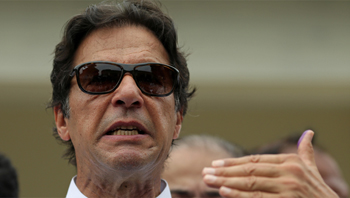
This was announced after Pakistan Prime Minister Imran Khan chaired a crucial meeting of the National Security Committee (NSC), attended by top civil and military leadership, during which it was also decided to suspend the bilateral trade and review the "bilateral arrangements".

"Our ambassadors will no longer be in New Delhi and their counterparts here will also be sent back," Foreign Minister Shah Mehmood Qureshi said in televised comments soon after the NSC meeting.

Later, the Foreign Office in a statement said that "Pursuant to the decision of the National Security Committee today, the Government of India has been told to withdraw its High Commissioner to Pakistan."

It, however, did not give any time line for India to pull back its envoy.

"The Indian Government has also been informed that Pakistan will not be sending its High Commissioner-designate to India," the statement said.

Pakistan's new High Commissioner Moin-ul-Haq was expected to leave for India this month to take up his responsibilities.

India on Monday revoked Article 370 of the Constitution to withdraw the special status given to Jammu and Kashmir and bifurcated the state into two Union Territories -- Jammu and Kashmir, and Ladakh.

A statement issued after the NSC meeting read that the Committee discussed situation "arising out of unilateral and illegal actions" by the Indian government, situation inside Jammu and Kashmir and along the Line of Control.

The Committee decided "downgrading of diplomatic relations with India" and "suspension of bilateral trade with India," the statement said.

Pakistan will also take the matter (abolition of the Article 370 by India) to the United Nations, including the Security Council, the statement said.

India has said Jammu and Kashmir is an integral part of India and the issue is strictly internal to the country.

The statement said that the country will observe this Independence Day on August 14 in solidarity with Kashmiris. "August 15 will be observed as Black Day," it added.

Prime Minister Khan also directed that all diplomatic channels be activated to highlight the alleged human rights violations in the Valley. He directed the military to continue vigilance, the statement said.

The Foreign Minister, Defense Minister, Interior Minister, Advisor on finance, Kashmir Affairs Minister as well as Joint Chiefs of Staff Committee Chairman, three services chiefs, ISI chief, and other top officials attended the meeting.

The NSC met after the meeting of top military generals and and a rare joint session of parliament on the Kashmir issue on Tuesday. It was the second meeting of Pakistan's top decision making body this week.

On Sunday, Prime Minister Khan convened the NSC meeting to discuss issues pertaining to national security in the wake of developments in the region. The NSC is the highest forum of civil and military top leadership to come together and discuss important matters of national security.

On Tuesday, Khan expressed apprehension that Pulwama-like attacks can follow the revocation of the special status for Jammu and Kashmir, which could trigger a conventional war between Pakistan and India.

"This will be a war that no one will win and the implications will be global," he warned while addressing a rare joint sitting of Parliament that was convened to discuss the Kashmir situation.

Khan said that his government would approach the world leaders and apprise them of situation in Kashmir. "We will fight it at every forum including the UN Security Council," he said, adding that Pakistan also plans to take the matter to the International Court of Justice.

Speaking in Parliament, Foreign Minister Qureshi said on Wednesday that India has only harmed itself by revoking the special status of Kashmir.

"History will prove that this action of India will badly impact its union," he said.

Qureshi said all bilateral agreements with India would be reviewed by a special committee already setup by Prime Minister Khan to suggest measures against Indian actions.

The foreign minister said that he might dash to China for consultations over the issue.

Pakistan lawmakers unanimously passed a resolution condemning "Indian action in Kashmir and pledging support for Kashmiris."

The resolution was adopted by the joint session of parliament after the lawmakers discussed the situation in Kashmir for two days.

The resolution reiterated the "strong conviction of Pakistan that the Jammu and Kashmir dispute would be resolved only through dialogue and diplomacy and in accordance with international law."

India has not been engaging with Pakistan since an attack on the Air Force base at Pathankot in January of 2016 by Pakistan-based terrorists, maintaining that talks and terror cannot go together.

Early this year, tensions flared up between India and Pakistan after a suicide bomber of Pakistan-based Jaish-e-Muhammed (JeM) killed 40 CRPF personnel in Kashmir's Pulwama district.

Amid mounting outrage, the Indian Air Force carried out a counter-terror operation, hitting the biggest JeM training camp in Balakot, deep inside Pakistan on February 26.

The next day, Pakistan Air Force retaliated and downed a MiG-21 in an aerial combat and captured Indian pilot, who was handed over to India on March 1.


Comments

Add new comment

  • Coastaldigest.com reserves the right to delete or block any comments.
  • Coastaldigset.com is not responsible for its readers’ comments.
  • Comments that are abusive, incendiary or irrelevant are strictly prohibited.
  • Please use a genuine email ID and provide your name to avoid reject.
News Network
January 31,2026

Roy.jpg

Bengaluru: The shooting incident involving CJ Roy, founder of the Confident Group, has once again put the spotlight on a businessman whose life has swung between flamboyant global success and persistent controversy at home.

Though Roy’s business interests extended across continents, his roots lay firmly in Karnataka. An alumnus of Christ School in Bengaluru, he later moved to Tumakuru to pursue an engineering degree. Those familiar with his early years describe him as intensely ambitious, beginning his career as a salesman at a small electronics firm dealing in computers.

Roy’s entry into large-scale real estate came through the Crystal Group, where he worked closely with Latha Namboothiri and rose from manager to director. However, the launch of the Confident Group in 2005 was clouded by industry speculation. Insiders speak of a fallout involving alleged “benami” properties and claims of deception that ultimately led to his independent venture—an episode Roy spent years trying to distance himself from, according to associates.

A tale of two cities

Roy’s professional trajectory diverged sharply across geographies.

In Dubai, he built a reputation as a bold and efficient developer, completing massive luxury residential projects in record time—some reportedly within 11 months. His rapid project delivery and lavish lifestyle in the Emirates earned him admiration and visibility in the real estate sector.

In Bengaluru, however, his image remained far more fractured. Sources say Roy stayed away from the city for several years amid disputes over unpaid dues to vendors and suppliers. Several projects were allegedly stalled, with accusations of unfulfilled commitments to cement and steel suppliers continuing to follow him.

Roy’s return to Bengaluru’s business and social circles began around 2018, marked by a conscious attempt at rebranding. His appointment as Honorary Consul of the Slovak Republic added diplomatic legitimacy, which he complemented with visible CSR initiatives, including ambulance donations and high-profile charity events.

Heavy police presence in Langford Town

Following the incident, police personnel from the Central division were deployed outside the Confident Group building in Langford Town, which also houses the Slovak Honorary Consulate in Bengaluru.

The otherwise busy premises near Hosur Road wore a deserted look on Friday, reflecting the shock and uncertainty that followed the tragedy.

Comments

Add new comment

  • Coastaldigest.com reserves the right to delete or block any comments.
  • Coastaldigset.com is not responsible for its readers’ comments.
  • Comments that are abusive, incendiary or irrelevant are strictly prohibited.
  • Please use a genuine email ID and provide your name to avoid reject.
News Network
January 23,2026

Mangaluru: The Karnataka Government Polytechnic (KPT), Mangaluru, has achieved autonomous status from the All India Council for Technical Education (AICTE), becoming the first government polytechnic in the country to receive such recognition in its 78-year history. The status was granted by AICTE, New Delhi, and subsequently approved by the Karnataka Board of Technical Education in October last year.

Officials said the autonomy was conferred a few months ago. Until recently, AICTE extended autonomous status only to engineering colleges, excluding diploma institutions. However, with a renewed national focus on skill development, several government polytechnics across India have now been granted autonomy.

KPT, the second-largest polytechnic in Karnataka, was established in 1946 with four branches and has since expanded to offer eight diploma programmes, including computer science and polymer technology. The institution is spread across a 19-acre campus.

Ravindra M Keni, the first dean of the institution, told The Times of India that AICTE had proposed autonomous status for polytechnic institutions that are over 25 years old. “Many colleges applied. In the first round, 100 institutions were shortlisted, which was further narrowed down to 15 in the second round. We have already completed one semester after becoming an autonomous institution,” he said. He added that nearly 500 students are admitted annually across eight three-year diploma courses.

Explaining the factors that helped KPT secure autonomy, Keni said the institution has consistently recorded 100 per cent admissions and placements for its graduates. He also noted its strong performance in sports, with the college emerging champions for 12 consecutive years, along with active student participation in NCC and NSS activities.

Autonomous status allows KPT to design industry-oriented curricula, conduct examinations, prepare question papers, and manage academic documentation independently. The institution can also directly collaborate with industries and receive priority funding from AICTE or the Ministry of Education. While academic autonomy has been granted, financial control will continue to rest with the state government.

“There will be separate committees for examinations, question paper setting, boards of studies, and boards of examiners. The institution will now have the freedom to conduct admissions without government notifications and issue its own marks cards,” Keni said, adding that new academic initiatives would be planned after a year of functioning under the autonomous framework.

Comments

Add new comment

  • Coastaldigest.com reserves the right to delete or block any comments.
  • Coastaldigset.com is not responsible for its readers’ comments.
  • Comments that are abusive, incendiary or irrelevant are strictly prohibited.
  • Please use a genuine email ID and provide your name to avoid reject.
News Network
February 1,2026

Bengaluru: Karnataka Deputy Chief Minister D K Shivakumar on Sunday criticised the Union Budget presented by Finance Minister Nirmala Sitharaman, claiming it offered no tangible benefit to the state.

Though he said he was yet to study the budget in detail, Shivakumar asserted that Karnataka had gained little from it. “There is no benefit for our state from the central budget. I was observing it. They have now named a programme after Mahatma Gandhi, after repealing the MGNREGA Act that was named after him,” he said.

Speaking to reporters here, the Deputy Chief Minister demanded the restoration of MGNREGA, and made it clear that the newly enacted rural employment scheme — VB-G RAM G — which proposes a 60:40 fund-sharing formula between the Centre and the states, would not be implemented in Karnataka.

“I don’t see any major share for our state in this budget,” he added.

Shivakumar, who also holds charge of Bengaluru development, said there were high expectations for the city from the Union Budget. “The Prime Minister calls Bengaluru a ‘global city’, but what has the Centre done for it?” he asked.

He also drew attention to the problems faced by sugar factories, particularly those in the cooperative sector, alleging a lack of timely decisions and support from the central government.

Noting that the Centre has the authority to fix the minimum support price (MSP) for agricultural produce, Shivakumar said the Union government must take concrete steps to protect farmers’ interests.

Comments

Add new comment

  • Coastaldigest.com reserves the right to delete or block any comments.
  • Coastaldigset.com is not responsible for its readers’ comments.
  • Comments that are abusive, incendiary or irrelevant are strictly prohibited.
  • Please use a genuine email ID and provide your name to avoid reject.