Pakistan denies militant camp hit after India launches airstrike

Agencies
February 26, 2019

Islamabad, Feb 26: India said its warplanes struck a militant training camp inside Pakistan on Tuesday, killing “a very large number” of fighters, raising risk of conflict between the nuclear armed neighbors, though Pakistan officials denied there had been any casualties.

The airstrike near the town of Balakot, some 50 kilometers (31 miles) from the frontier was the deepest cross-border raid launched by India since the last of its three wars with Pakistan in 1971.

Pakistan condemned the Indian action and said it would respond at a time and place of its choice.

The airstrikes, according to the Indian government, hit a training camp of Jaish-e-Mohammed (JeM), the group that claimed credit for a suicide car bomb attack killed at least 40 Indian paramilitary police in Kashmir on Feb. 14. The action was ordered as India said it had intelligence that Jaish was planning more attacks.

“In the face of imminent danger, a preemptive strike became absolutely necessary,” Foreign Secretary Vijay Gokhale told reporters.

“The existence of such training facilities, capable of training hundreds of jihadis could not have functioned without the knowledge of the Pakistani authorities,” Gokhale said.

Pakistan denies harboring JeM, a primarily anti-India group that forged ties with al Qaeda and has been on a UN terror list since 2001. In December 2001, Jaish fighters, along with members of another Pakistan-based militant group, Lashkar-e-Taiba, launched an attack on India’s parliament, which almost led to a fourth war.

China, Pakistan’s long-time ally, urged both countries to exercise restraint as tensions rose to the highest in years.

“We hope that India and Pakistan can exercise restraint, and take steps that are conducive to stabilizing the regional situation and improving bilateral ties, rather than the opposite,” Foreign Ministry spokesman Lu Kang told a daily news briefing in Beijing.

Gokhale said “a very large number” of militants were killed in the strikes by French-made Mirage 2000 jets on a Jaish training camp near Balakot, a town in Pakistan’s Khyber Pakhtunkhwa province.

The commander of the camp was Maulana Yusuf Azhar, a brother-in-law of JeM leader Masood Azhar, Gokhale said.

A senior Indian government source said that 300 militants had been killed in the strikes and that the warplanes had ventured as far as 80 km (50 miles) inside Pakistan. But no evidence was immediately provided to back up the claims of militant casualties.

“I want to assure you our country is in safe hands,” Prime Minister Narendra Modi told a cheering political rally in western India hours after the raid.

“I won’t let the country down,” said Modi, who faces a tight election in coming months.

There has been mounting impatience in India to avenge the Feb.14 attack, which was the most deadly seen in Kashmir during an insurgency that has last three decades, and as news of the raid broke, celebrations erupted across the country.

No terror camps

Pakistan’s top civilian and military leaders rejected India’s comments that it had struck “terror camps” inside Pakistan, vowing to prove wrong India’s claims and warning that it would retaliate against Indian aggression.

Pakistan’s National Security Committee (NSC), comprising top officials including Prime Minister Imran Khan and army chief Qamar Javed Bajwa, said in a statement that it “strongly rejected Indian claim of targeting an alleged terrorist camp near Balakot and the claim of heavy casualties.”

The statement said Khan would “engage with global leadership to expose irresponsible Indian policy”. It also warned that “Pakistan shall respond at the time and place of its choosing” to Indian aggression.

Earlier the Pakistan military said its own warplanes had chased off the Indian aircraft before they could inflict any real harm. A spokesman said the Indian warplanes dropped their “payload” in a forested area, causing no casualties and no serious material damage.

“Indian aircraft intruded from Muzaffarabad sector,” Pakistani military spokesman Major General Asif Ghafoor said on Twitter, referring to an area in the Pakistan-held part of Kashmir.

Ghafoor said the intruders faced a “timely and effective response from Pakistan Air Force”, and “released payload in haste, while escaping, which fell near Balakot.”

“No casualties or damage,” he tweeted.

Ghafoor also posted four pictures of the alleged site, purportedly showing a bomb crater in a forest area but no serious damage.

Pakistani villagers in the area where the Indian jets struck said they heard four loud bangs in the early hours of Tuesday but reported only one person was wounded.

“We saw fallen trees and one damaged house, and four craters where the bombs had fallen,” said Mohammad Ajmal, a 25-year-old who visited the site.

Indian television networks reported the airstrikes took place at 3.30 am and involved a dozen Mirage fighter planes backed up by Israeli-equipped Airborne Warning and Control Systems (AWACS) aircraft that patrolled on India’s side of the border.

Balakot is about 50 km (30 miles) from Line of Control (LoC), the ceasefire line that is the de facto border in Kashmir, a Himalayan region that has been the cause of two of the three wars India and Pakistan have fought since the end of British colonial rule in 1947.

Analysts have alleged Pakistani militants have their training camps in the area, although Pakistan has always denied the presence of any such camps.

Mohammed Iqbal, a resident of Mendhar, a long way further south on the Indian side of the LoC, told Reuters that he heard jets flying through the night.

Shelling across the LoC has occurred frequently over the past few years but airspace violations by jets are extremely rare.

Following another large attack on Indian security forces in Kashmir in 2016, India said its troops crossed the LoC to carry out a “surgical strike” on suspected militant camps in Pakistan Kashmir. Islamabad denied anything serious occurred.

Indian markets slipped amid concerns over the risk of conflict. The rupee weakened to 71.16 per dollar compared with Monday’s close of 70.9850.

The 10-year benchmark bond yield rose to 7.61 percent compared with 7.58 percent on Monday, while the broader NSE stock index declined 1.17 percent.

Comments

Add new comment

  • Coastaldigest.com reserves the right to delete or block any comments.
  • Coastaldigset.com is not responsible for its readers’ comments.
  • Comments that are abusive, incendiary or irrelevant are strictly prohibited.
  • Please use a genuine email ID and provide your name to avoid reject.
News Network
January 28,2026

ajit.jpg

Mumbai: The sudden death of Maharashtra Deputy Chief Minister Ajit Pawar in a plane crash in his hometown of Baramati has plunged the state into political uncertainty, raising a pressing question for both the Nationalist Congress Party (NCP) and its rival faction, the Nationalist Congress Party (Sharadchandra Pawar): what next?

For the two factions that emerged after the dramatic split of June–July 2023, the moment marks their gravest challenge yet. Many believe the answer now rests with party founder Sharad Pawar.

Sharad Pawar, who founded the NCP in 1999 after parting ways with the Congress over Sonia Gandhi’s foreign origin, has already indicated his intention to step away from electoral politics once his Rajya Sabha term ends in April 2026.

Speaking at a public event in Baramati ahead of his 85th birthday on December 12, 2025, Pawar said he would not contest any further elections. “I have contested 14 elections. The younger generation needs to be given an opportunity,” he said, adding that he would decide later whether to seek another Rajya Sabha term.

Often described as the Bhishma Pitamah of Indian politics, Pawar also spoke of his gradual withdrawal from active leadership. “For the first 30 years, I handled everything. For the next 25–30 years, Ajit Dada handled responsibilities. Now, arrangements must be made for new leadership,” he said.

Ajit Pawar’s death has dramatically altered that transition, especially as he was working towards reunifying the two NCP factions.

“After the developments of June–July 2023 and the 2024 Lok Sabha and Vidhan Sabha elections, there were deep changes within the family and the party. In the last six months, serious efforts were made to reunite. Even workers from both sides wanted unity. This is a massive blow,” a Pawar family insider told DH over phone from Baramati.

Electoral outcomes over the past year reflected the split. In the 2024 Lok Sabha elections, NCP (SP) recorded the best strike rate in Maharashtra, winning eight of the 10 seats it contested. The NCP, by contrast, won just one seat out of four.

However, the trend reversed in the subsequent Vidhan Sabha elections, where the NCP emerged stronger, securing 41 of the 288 seats, while NCP (SP) managed only 10.

Within NCP (SP), Sharad Pawar’s daughter Supriya Sule serves as Working President, followed by leaders such as Rohit Pawar, state president Shashikant Shinde and former state chief Jayant Patil.

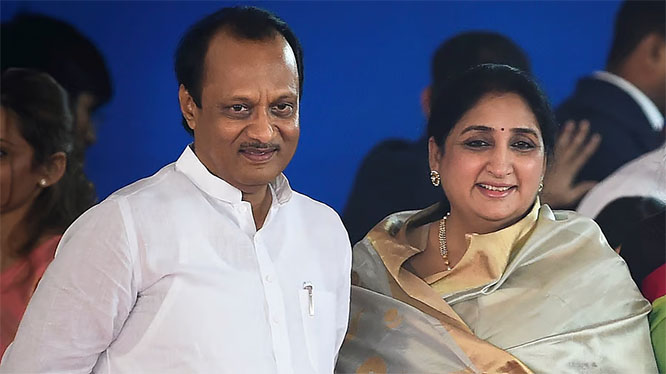
In the NCP, Praful Patel is the Working President and Raigad MP Sunil Tatkare heads the state unit. Ajit Pawar’s wife, Sunetra Pawar, is a Rajya Sabha MP, while their sons Parth and Jay are not actively involved in day-to-day politics. Parth Pawar briefly entered electoral politics in 2019 but lost the Lok Sabha election from Maval. Jay Pawar’s political debut was under consideration.

With Ajit Pawar gone, speculation has intensified that a member of the family may be asked to assume a larger role. For now, Sunetra Pawar is expected to play a key coordinating role in party affairs, alongside Patel and Tatkare.

The NCP continues to have several heavyweight leaders, including Chhagan Bhujbal, Hasan Mushrif, Dattatreya Bharne, Manikrao Kokate and Dhananjay Munde.

Ajit Pawar had already begun steps towards reconciliation between the two factions. While they contested the Pune and Pimpri-Chinchwad municipal elections separately, they later decided to fight the zilla parishad elections together under the ‘clock’ symbol—seen as the first formal step towards reunification.

Nagpur meet and party roadmap

Both NCP factions claim adherence to the ideology of ‘Shiv–Shahu–Phule–Ambedkar’. At the Rashtravadi Chintan Shivir held in Nagpur on September 19, 2025, the NCP reaffirmed its commitment to sarva dharma sambhav and discussed strengthening ties with the BJP “for the welfare and development of Maharashtra”.

In recent days, reports had suggested Ajit Pawar might return to the Maha Vikas Aghadi following the party’s poor performance in Pune municipal elections, but these claims were denied.

Big question for Maha Yuti

Ajit Pawar’s death also presents an immediate challenge for the Devendra Fadnavis-led Maha Yuti government. Pawar held crucial portfolios, including Finance, Planning and Excise. With the Budget Session approaching, appointing a new Finance Minister has become urgent.

Beyond numbers and portfolios, Maha Yuti has lost a swift decision-maker known for his administrative grip and political finesse—leaving a vacuum that will not be easy to fill.

Comments

Add new comment

  • Coastaldigest.com reserves the right to delete or block any comments.
  • Coastaldigset.com is not responsible for its readers’ comments.
  • Comments that are abusive, incendiary or irrelevant are strictly prohibited.
  • Please use a genuine email ID and provide your name to avoid reject.
News Network
January 23,2026

Mangaluru: The Karnataka Government Polytechnic (KPT), Mangaluru, has achieved autonomous status from the All India Council for Technical Education (AICTE), becoming the first government polytechnic in the country to receive such recognition in its 78-year history. The status was granted by AICTE, New Delhi, and subsequently approved by the Karnataka Board of Technical Education in October last year.

Officials said the autonomy was conferred a few months ago. Until recently, AICTE extended autonomous status only to engineering colleges, excluding diploma institutions. However, with a renewed national focus on skill development, several government polytechnics across India have now been granted autonomy.

KPT, the second-largest polytechnic in Karnataka, was established in 1946 with four branches and has since expanded to offer eight diploma programmes, including computer science and polymer technology. The institution is spread across a 19-acre campus.

Ravindra M Keni, the first dean of the institution, told The Times of India that AICTE had proposed autonomous status for polytechnic institutions that are over 25 years old. “Many colleges applied. In the first round, 100 institutions were shortlisted, which was further narrowed down to 15 in the second round. We have already completed one semester after becoming an autonomous institution,” he said. He added that nearly 500 students are admitted annually across eight three-year diploma courses.

Explaining the factors that helped KPT secure autonomy, Keni said the institution has consistently recorded 100 per cent admissions and placements for its graduates. He also noted its strong performance in sports, with the college emerging champions for 12 consecutive years, along with active student participation in NCC and NSS activities.

Autonomous status allows KPT to design industry-oriented curricula, conduct examinations, prepare question papers, and manage academic documentation independently. The institution can also directly collaborate with industries and receive priority funding from AICTE or the Ministry of Education. While academic autonomy has been granted, financial control will continue to rest with the state government.

“There will be separate committees for examinations, question paper setting, boards of studies, and boards of examiners. The institution will now have the freedom to conduct admissions without government notifications and issue its own marks cards,” Keni said, adding that new academic initiatives would be planned after a year of functioning under the autonomous framework.

Comments

Add new comment

  • Coastaldigest.com reserves the right to delete or block any comments.
  • Coastaldigset.com is not responsible for its readers’ comments.
  • Comments that are abusive, incendiary or irrelevant are strictly prohibited.
  • Please use a genuine email ID and provide your name to avoid reject.
News Network
January 31,2026

Roy.jpg

Bengaluru: The shooting incident involving CJ Roy, founder of the Confident Group, has once again put the spotlight on a businessman whose life has swung between flamboyant global success and persistent controversy at home.

Though Roy’s business interests extended across continents, his roots lay firmly in Karnataka. An alumnus of Christ School in Bengaluru, he later moved to Tumakuru to pursue an engineering degree. Those familiar with his early years describe him as intensely ambitious, beginning his career as a salesman at a small electronics firm dealing in computers.

Roy’s entry into large-scale real estate came through the Crystal Group, where he worked closely with Latha Namboothiri and rose from manager to director. However, the launch of the Confident Group in 2005 was clouded by industry speculation. Insiders speak of a fallout involving alleged “benami” properties and claims of deception that ultimately led to his independent venture—an episode Roy spent years trying to distance himself from, according to associates.

A tale of two cities

Roy’s professional trajectory diverged sharply across geographies.

In Dubai, he built a reputation as a bold and efficient developer, completing massive luxury residential projects in record time—some reportedly within 11 months. His rapid project delivery and lavish lifestyle in the Emirates earned him admiration and visibility in the real estate sector.

In Bengaluru, however, his image remained far more fractured. Sources say Roy stayed away from the city for several years amid disputes over unpaid dues to vendors and suppliers. Several projects were allegedly stalled, with accusations of unfulfilled commitments to cement and steel suppliers continuing to follow him.

Roy’s return to Bengaluru’s business and social circles began around 2018, marked by a conscious attempt at rebranding. His appointment as Honorary Consul of the Slovak Republic added diplomatic legitimacy, which he complemented with visible CSR initiatives, including ambulance donations and high-profile charity events.

Heavy police presence in Langford Town

Following the incident, police personnel from the Central division were deployed outside the Confident Group building in Langford Town, which also houses the Slovak Honorary Consulate in Bengaluru.

The otherwise busy premises near Hosur Road wore a deserted look on Friday, reflecting the shock and uncertainty that followed the tragedy.

Comments

Add new comment

  • Coastaldigest.com reserves the right to delete or block any comments.
  • Coastaldigset.com is not responsible for its readers’ comments.
  • Comments that are abusive, incendiary or irrelevant are strictly prohibited.
  • Please use a genuine email ID and provide your name to avoid reject.