



Saudi Arabia to invest $30-50bn in renewable energy by 2032

January 17, 2017

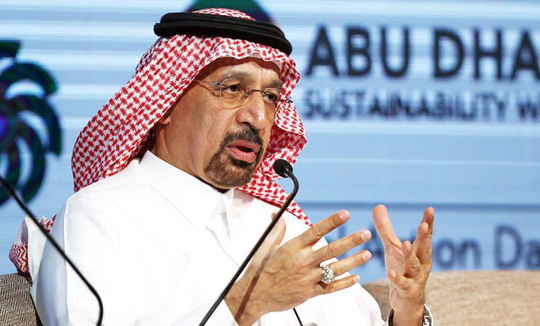
Jeddah, Jan 17: Saudi Arabia is launching a renewable energy program in the next few weeks that is expected to invest $30-$50 billion by 2032, Energy, Industry and Mineral Recourses Minister Khalid Al-Falih announced Monday.
Saudi2

Al-Falih said at the World Future Energy Summit in Abu Dhabi that the Kingdom would start the first round of bidding for projects under the program, which would produce 10GW of power.

He also said that Saudi Arabia is in the early stages of studying its first two commercial nuclear reactors with a total of 2.8GW. Al-Falih told Reuters that, “there will be significant investment in nuclear energy.”

The minister also said Saudi Arabia was working on ways to connect its renewable energy projects with Yemen, Jordan and Egypt.

“We will connect to Africa to exchange non-fossil sources of energy,” he said.

The step falls into the country’s targets set in Vision 2030, launched last year to prepare for a post-oil era following a plunge in oil prices. Saudi Arabia, the world’s largest oil exporter, plans to reduce its reliance on oil and diversify the economy by moving toward sustainable sources rather than depending on fossil oil.

Renewable energy is listed among the sectors to be launched, as the Vision reads: “In the manufacturing sector, we will work toward localizing renewable energy and industrial equipment sectors.”

John Sfakianakis, director of economic research at the Riyadh-based Gulf Research Center, told Arab News that Saudi Arabia has a “considerable solar power potential” that can reduce its reliance on fossil fuels.

“Saudi Arabia wants to balance economic needs against environmental goals as it has considerable solar power potential and is eager to reduce its use of fossil fuels,” Sfakianakis said. “The country ranks high in per capita greenhouse gas CO2 emissions.”

Achieving the ambitious renewable energy program by 2032 needs time, technical knowledge and capacity, and above all coordination between various stakeholders, according to energy expert Mohamed Ramady.

“The fact that there are many stakeholders in Saudi Arabia involved in the renewable energy program, such as KACST, KACARE, KAPSARC and KAUST among others ensures some duplication of effort and above all lack of specific focus for renewables,” said Ramady, a former professor at King Fahd University of Petroleum and Minerals.

He told Arab News that whether the focus would be on solar or nuclear energy would determine the policy and would lead to different paths and options in terms of domestic and international cooperation.

“If nuclear energy option is the preferred option, then Saudi Arabia has to assess whether current leaders using such energy like France, South Korea and Finland are still committed to this renewable energy source in the long term and whether their technology transfer and nuclear waste programs can be safely transferred,” Ramady said.

Achieving a viable large-scale renewable energy application is not as easy as it sounds, according to Ramady.

“The United Arab Emirates’ (UAE) MASDAR renewable energy model city initiative was a path breaker with mixed success, but from which valuable lessons can be learned by Saudi Arabia,” he said. “However, in the meantime starting off by installing smart electricity household meters coupled with incentives to save energy could help to reduce pressure on the government in the face of potential lower oil prices and revenues.”

The Riyadh-based King Abdullah Center for Atomic and Renewable Energy (KACARE) stated that hydrocarbons would remain a prime element in the energy mix in 2032, by an estimation of 60GW. This will also be supported with nuclear energy at 17.6GW, solar at 41GW, of which 16GW will be generated through the use of photovoltaic cells and the balance of 25GW by concentrated solar power, wind at 9GW, waste-to-energy at 3GW and geothermal at 1GW.

Renewable energy is increasingly becoming a new sector in the country and is expected to expand until the new renewable energy program can reach its target by 2032.

“By creating an entirely new sector for the economy, jobs will be generated as it moves into more advanced areas of the production chain. Job creation for Saudis and a cleaner environment are important goals of Vision 2030 for better quality of life values,” said Sfakianakis.

According to the International Renewable Energy Agency (IRENA) report on renewable energy market analysis in the Gulf Council Countries (GCC) region, Saudi Arabia is the world’s seventh largest oil consumer. Domestic consumption of oil witnessed a surge in the 2000s rising from 17 percent in 2000 to 28 percent in 2014. The report, published in 2016, estimated that achieving the GCC renewable energy targets could create an average of 140,000 direct jobs per year.

Comments

Add new comment

  • Coastaldigest.com reserves the right to delete or block any comments.
  • Coastaldigset.com is not responsible for its readers’ comments.
  • Comments that are abusive, incendiary or irrelevant are strictly prohibited.
  • Please use a genuine email ID and provide your name to avoid reject.
News Network
November 24,2025

lebanon.jpg

Israel has launched a new act of aggression on a residential neighborhood in Lebanon's capital, Beirut, killing and injuring about two dozen civilians.

The Israeli regime's military said in a statement that its forces carried out a so-called precise strike in a residential apartment in Dahiyeh in the southern suburbs of Beirut on Sunday.

The aggression targeted residential areas, killing at least five people and injuring more than 28 people, Lebanon's Health Ministry said. 

Hezbollah announced the martyrdom of senior Hezbollah commander Haytham Ali Tabatabai and four resistance fighters.

Lebanese President Michel Aoun condemned the airstrike, calling it a clear demonstration of Tel Aviv’s disregard for repeated international calls to halt violations on Lebanese soil.

“Israel refuses to implement international resolutions and all efforts aimed at ending the escalation and restoring stability,” Aoun said, urging the international community to take action to prevent further aggression.

The Palestinian Islamic Jihad movement also condemned the attack, holding the international community accountable. 

“The international community bears responsibility and continues to provide cover for these attacks as long as it does not restrain the occupiers,” said Ali Abu Shahin, a member of the group’s political bureau.

Israeli prime minister Benjamin Netanyahu’s office announced that the Israeli army carried out a strike “in the heart of Beirut."

Netanyahu reportedly approved the operation following recommendations from top Israeli security officials.

Two senior US officials commented on the Israeli strike.

The first official said that Israel did not notify Americans in advance about the attack. "We were informed immediately after the strike was carried out."

The second senior official said that the "US knew for several days that Israel was planning to escalate its strikes in Lebanon, but did not know in advance the timing, location, or target of the strike."

Speaking from the site of the Israeli strike, Lebanese MP Ali Ammar condemned the attack as part of a broader campaign of aggression that has targeted "all of Lebanon since the Washington-sponsored ceasefire."

He stated that "any attack on Lebanon is a violation of red lines; this aggression is part and parcel of the entity that targets Lebanon's dignity, sovereignty, and security of citizens."

Ammar went on to say the resistance is responding with "utmost wisdom, patience, and will confront the enemy at the appropriate time."

"Unfortunately, the enemy is emboldened to commit its aggression by voices within Lebanon that have turned themselves into tools that support its aggression," he added.

The Israeli attack on the southern suburbs of the Lebanese capital is the latest blatant violation of the ceasefire Israel signed with Hezbollah in November 2024, which was intended to end hostilities that had escalated into full-scale war.

An Israeli strike on the Ain al-Hilweh camp near Sidon in southern Lebanon late Tuesday killed at least 14 people. It wounded several others, including young students, according to the Lebanese health ministry.

The military claimed the attack targeted “a Hamas training compound” used to plan and carry out attacks against the regime -- a claim that has frequently been made without evidence.

Hamas rejected the allegations as “a blatant lie aimed at justifying the massacre,” stating it had “no military installations in the Palestinian camps in Lebanon” and that the targeted site was merely “an open sports field.”

According to Lebanese authorities, Israeli attacks have killed approximately 4,000 people and displaced more than 1.2 million residents across the country since October 2023.

Comments

Add new comment

  • Coastaldigest.com reserves the right to delete or block any comments.
  • Coastaldigset.com is not responsible for its readers’ comments.
  • Comments that are abusive, incendiary or irrelevant are strictly prohibited.
  • Please use a genuine email ID and provide your name to avoid reject.
News Network
November 28,2025

fire.jpg

Several Syrians were killed and more than two dozen others injured in Israeli strikes on the outskirts of Damascus, amid intensified incursions by the occupying regime since the fall of former president Bashar al-Assad and the rise of Hayat Tahrir al-Sham (HTS) rule.

Syrian state TV reported that the casualties occurred during an overnight Israeli assault involving helicopters and drones on the town of Beit Jinn in the Damascus countryside. The attack followed an Israeli military unit’s entry into the town, where they were surrounded by local residents, leading to gunfire and direct confrontations.

According to the report, “The occupation army’s helicopters and artillery shelled Beit Jinn, located at the foothills of Mount Hermon, resulting in 13 martyrs and 25 injured civilians.” The broadcaster did not specify the full extent of damage.

Al-Ikhbariyah Syria confirmed that the shelling coincided with Israeli soldiers entering Beit Jinn, while artillery pounded surrounding areas. The broadcaster stated that the escalation began after local residents clashed with an Israeli patrol that had infiltrated the southern town and “kidnapped” three young men.

Following a two-hour exchange of heavy fire, Israeli forces withdrew and repositioned on the hill of Butt al-Warda at the town’s outskirts.

Israeli media acknowledged that six soldiers were wounded in the clashes—three of them seriously—describing the confrontation as a “sudden ambush” that forced the deployment of reserve units and air support to secure an exit route. No further details were provided.

The aggression has fueled renewed displacement from Beit Jinn, with residents fleeing to nearby villages amid increasingly frequent Israeli attacks.

The raid came just a day after Israeli troops carried out another ground incursion into Umm al-Luqas village in Quneitra province. According to SANA, an Israeli unit in four vehicles entered the village, raided several homes, and later withdrew.

Syria condemned the repeated incursions as violations of the 1974 Disengagement Agreement and UN resolutions, urging the international community to enforce compliance and pressure Israel to halt its operations and withdraw fully.

Israel has expanded its attacks across Syrian territory following the collapse of the Assad government last year. Prime Minister Benjamin Netanyahu has reportedly instructed his forces to push deeper into Syrian territory and seize strategic positions.

Meanwhile, critics say the HTS-led interim government’s inaction and growing normalization gestures toward Israel have emboldened Tel Aviv to intensify its military operations. HTS, formerly linked to al-Qaeda, seized control of Damascus last December, formally ending Assad’s rule.

Comments

Add new comment

  • Coastaldigest.com reserves the right to delete or block any comments.
  • Coastaldigset.com is not responsible for its readers’ comments.
  • Comments that are abusive, incendiary or irrelevant are strictly prohibited.
  • Please use a genuine email ID and provide your name to avoid reject.
News Network
November 30,2025

The United Nations Committee against Torture (CAT) has condemned the Israeli regime for enforcing a policy of “organized torture” against Palestinians.

In a report published on Friday, CAT stated that the occupying regime enforces a deliberate policy of “organized and widespread torture and ill-treatment” against Palestinian abductees, particularly since October 7, 2023, when Israel launched its genocidal war on Gaza.

The committee expressed “deep concern over repeated severe beatings, dog attacks, electrocution, water-boarding, use of prolonged stress positions [and] sexual violence” inflicted on Palestinians.

Palestinian prisoners were degraded by “being made to act like animals or being urinated on,” systematically denied medical care, and subjected to excessive restraints, “in some cases resulting in amputation,” the report added.

CAT also condemned the routine application of “unlawful combatants law” to justify the prolonged detention without trial of thousands of Palestinian men, women, and children.

More than 10,000 Palestinians, including women and children, are currently held in Israeli prisons, according to Palestinian and international human rights groups, with 3,474 Palestinians in “administrative detention,” meaning they are imprisoned without trial for indefinite periods.

The report highlighted the “high proportion of children who are currently detained without charge or on remand,” noting that while Israel sets the age of criminal responsibility at 12, even younger children have been abducted.

Children designated as security prisoners face severe restrictions on family contact, may be subjected to solitary confinement, and are denied access to education, in clear violation of international law.

The committee further suggested that Israel’s policies across the Occupied Territories constitute collective torture against the Palestinian population.

“A range of policies adopted by Israel in the course of its continued unlawful presence in the Occupied Palestinian Territory amounts to cruel, inhuman or degrading living conditions for the Palestinian population,” the report said.

On Thursday, the Palestinian resistance movement Hamas condemned the systematic killing and torture of Palestinian abductees in Israeli prisons, urging international action to halt these abuses.

Citing human rights data, Hamas stated that 94 Palestinians have been killed in Israeli prisons since the start of Tel Aviv’s genocidal war on Gaza.

“This reflects an organized criminal approach that has turned these prisons into direct killing grounds to eliminate our people,” the resistance movement said.

Hamas called on the international community, the UN, and human rights organizations to immediately pressure Israel to end crimes against prisoners and uphold their rights as guaranteed by all international conventions and norms.

Comments

Add new comment

  • Coastaldigest.com reserves the right to delete or block any comments.
  • Coastaldigset.com is not responsible for its readers’ comments.
  • Comments that are abusive, incendiary or irrelevant are strictly prohibited.
  • Please use a genuine email ID and provide your name to avoid reject.