



Saudi king's visit highlights China's Middle East engagement

March 16, 2017

Beijing, Mar 16: Saudi Arabia's King Salman began a visit to Beijing Thursday that highlights growing ties underpinned by China's thirst for Saudi oil and the kingdom's status as a key link in Beijing's bid to connect China to Europe through infrastructure development.
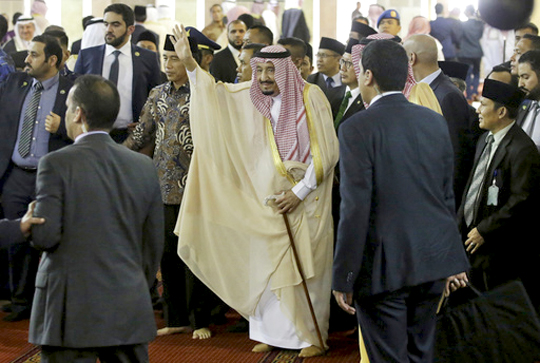
Saudi

Salman went immediately into talks with President Xi Jinping following a formal welcoming ceremony at the Great Hall of the People, the seat of China's legislature. The 81-year-old monarch's visit is part of a monthlong swing through Asia in a push to develop a less oil-dependent growth strategy.

During Salman's visit to Tokyo earlier this week, the Saudi sovereign wealth fund announced a new $25 billion technology fund with telecom giant Softbank.

Beijing for its part is rolling out a trade and investment initiative across Central Asia and the Middle East called "One Belt, One Road," and sees the desert kingdom as a regional linchpin.

In opening remarks at their meeting, Xi said he looked forward to discussing projects under development, and said results so far "have surpassed our expectations."

Security ties between the two have also grown significantly, with the Saudi air force deploying Chinese unmanned attack drones and the two militaries holding joint counter-terrorism exercises in western China. Chinese navy vessels have also visited the Saudi port of Jeddah as part of increasingly active maneuvers in the Gulf of Aden.

Chinese officials say their overriding security interest in the Middle East is to prevent ethnic Uighur fighters who have left western China and joined militant groups in Syria and Iraq from returning to strike at China.

"China's Uighur ethnic minority is a key if sometimes under-appreciated factor in Beijing's Middle East strategy," said Andrew Scobell, a political scientist at the RAND Corporation.

Xi has signaled his desire to play a bigger role in the region as part of China's quest for resources, markets and increased global influence on a par with its economic heft. In a major speech before the Arab League in Cairo last year, Xi indirectly alluded to how the U.S. presence had waned and how China hoped to present an alternative.

"Instead of looking for a proxy in the Middle East, we promote peace talks," Xi said. "Instead of attempting to fill the vacuum, we build a cooperative partnership network for win-win outcomes."

A relative newcomer to the Middle East's complicated politics, China has tried to maintain friendly ties with all sides, despite sometimes conflicting geopolitical interests.

Beijing has backed President Bashar al-Assad in the Syrian conflict, while Saudi Arabia has insisted on Assad's ouster and has supported the Syrian opposition, including Islamic militant groups unfriendly to China over Beijing's sometimes harsh treatment of its Muslim minority.

China has also maintained close ties to Saudi Arabia's bitter enemy Iran.

Salman, who is traveling with a 1,500-strong company of businessmen, princes and support staff in close to a dozen aircraft, is next due to visit the Indian Ocean island nation of the Maldives. Along with Japan, he earlier visited Indonesia, Malaysia and Brunei.

Comments

Add new comment

  • Coastaldigest.com reserves the right to delete or block any comments.
  • Coastaldigset.com is not responsible for its readers’ comments.
  • Comments that are abusive, incendiary or irrelevant are strictly prohibited.
  • Please use a genuine email ID and provide your name to avoid reject.
News Network
November 28,2025

fire.jpg

Several Syrians were killed and more than two dozen others injured in Israeli strikes on the outskirts of Damascus, amid intensified incursions by the occupying regime since the fall of former president Bashar al-Assad and the rise of Hayat Tahrir al-Sham (HTS) rule.

Syrian state TV reported that the casualties occurred during an overnight Israeli assault involving helicopters and drones on the town of Beit Jinn in the Damascus countryside. The attack followed an Israeli military unit’s entry into the town, where they were surrounded by local residents, leading to gunfire and direct confrontations.

According to the report, “The occupation army’s helicopters and artillery shelled Beit Jinn, located at the foothills of Mount Hermon, resulting in 13 martyrs and 25 injured civilians.” The broadcaster did not specify the full extent of damage.

Al-Ikhbariyah Syria confirmed that the shelling coincided with Israeli soldiers entering Beit Jinn, while artillery pounded surrounding areas. The broadcaster stated that the escalation began after local residents clashed with an Israeli patrol that had infiltrated the southern town and “kidnapped” three young men.

Following a two-hour exchange of heavy fire, Israeli forces withdrew and repositioned on the hill of Butt al-Warda at the town’s outskirts.

Israeli media acknowledged that six soldiers were wounded in the clashes—three of them seriously—describing the confrontation as a “sudden ambush” that forced the deployment of reserve units and air support to secure an exit route. No further details were provided.

The aggression has fueled renewed displacement from Beit Jinn, with residents fleeing to nearby villages amid increasingly frequent Israeli attacks.

The raid came just a day after Israeli troops carried out another ground incursion into Umm al-Luqas village in Quneitra province. According to SANA, an Israeli unit in four vehicles entered the village, raided several homes, and later withdrew.

Syria condemned the repeated incursions as violations of the 1974 Disengagement Agreement and UN resolutions, urging the international community to enforce compliance and pressure Israel to halt its operations and withdraw fully.

Israel has expanded its attacks across Syrian territory following the collapse of the Assad government last year. Prime Minister Benjamin Netanyahu has reportedly instructed his forces to push deeper into Syrian territory and seize strategic positions.

Meanwhile, critics say the HTS-led interim government’s inaction and growing normalization gestures toward Israel have emboldened Tel Aviv to intensify its military operations. HTS, formerly linked to al-Qaeda, seized control of Damascus last December, formally ending Assad’s rule.

Comments

Add new comment

  • Coastaldigest.com reserves the right to delete or block any comments.
  • Coastaldigset.com is not responsible for its readers’ comments.
  • Comments that are abusive, incendiary or irrelevant are strictly prohibited.
  • Please use a genuine email ID and provide your name to avoid reject.