



Trump tells Modi India ‘a true friend and partner’, invites PM to US ‘later this year’

January 25, 2017

Washington, Jan 25: In a phone call with Prime Minister Narendra Modi on Tuesday, President Donald Trump said the US considers India a “true friend and partner in addressing challenges around the world”, according to a White House statement.
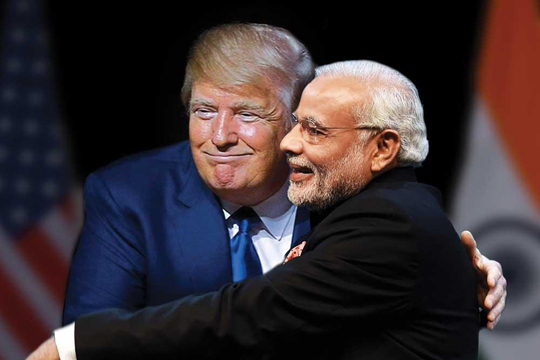
Modifriend

The two leaders also discussed opportunities to “strengthen the partnership between the United States and India in broad areas such as the economy and defense”, the statement said without citing specific areas, sectors or goals.

Modi and Trump, who were speaking for the first time after the new US president took charge last Friday, also discussed “security in the region of South and Central Asia” and, once again the statement left out details.

South and Central Asia cover many areas of mutual interest to both India and the United States including Pakistan and Afghanistan and it could not be immediately confirmed if they discussed the drawdown of US troops in Afghanistan.

But the two leaders resolved, according to the White House statement, “that the United States and India stand shoulder to shoulder in the global fight against terrorism”, which has been a priority for both of them and both countries.

Trump is hosting Modi later in the year, but it was, once again, not immediately clear if that will be in September-October when the Indian prime minister comes to the US for the UN general assembly meeting, or some other time.

But the two, who first spoke in November when Modi was among the first foreign leaders to call Trump on his election, are likely to meet during the next meeting of the G-20, which is scheduled to take place in Hamburg, Germany in July.

Since that first call, India engaged with Trump on two separate occasions: The first was a meeting between Indian foreign secretary S Jaishankar and then Vice-President-elect Mike Pence, and the second on December 19 when Ajit Doval, national security adviser to PM Modi, met Trump’s NSA Michael Flynn.

And now the call. The US statement contained no details and it was not known if trade in services, read H-1B, came up during their phone call, as many had expected, since it being the one issue that had agitated New Delhi the most about Trump.

The fate of the temporary US visa programme for high-skilled foreign workers, which is at the heart to India’s burgeoning IT exports to the US, seemed uncertain, given the president’s own reservations about it, and those of leading members of his team.

They believe the H-1B programme is being abused by the US companies to outsource American jobs to temporary foreign workers, a large number of them from India, and they have been considering ways to make it harder for that to happen.

“There is no other area of potential dispute or differences with the United States under President Trump,” said an Indian official, who spoke strictly on background. He added, “H-1B is the only problem for us as of now.”

In response to a question about India-US relations, White House press secretary Sean Spicer had said Monday that as with other countries, the Trump administration is focussed on access to markets in manufacturing and services.

Since being sworn-in last Friday, the new president has begun engaging with world leaders and has spoken to prime minister and president of neighboring Canada and Mexico first — with whom he plans to renegotiate the NAFTA trade deal.

He has also talked since with Egypt’s Abdel Fattah el-Sisi and Israel’s Benjamin Netanyahu, who he has invited to to a meeting in early February. And he meets Teresa May, prime minister of America’s closest ally the United Kingdom, on Friday.

The Tuesday call with Modi, on the second day of Trump’s first week in office, is being taken as sign of the priority he is attaching to the relationship, after an unprecedented outreach to the Indian American community during election.

At an election rally in New Jersey, Trump had said on his watch as president that India and the US will be “best friends” and, added in a typically Trumpian hyperbole that “there will be no relationship more important to me”.

At the suggestion of the Republican Hindu Coalition founder Shalli Kumar, who had organised the rally, Trump recorded a campaign call modeled on Modi’s election slogan “Abki baar Modi sarkar”, replacing Modi with Trump.

Also, Prime Minister Modi appears to have an admirer in Steve Bannon, chief strategist and senior counseller to the president, who had in 2014 called Modi’s election a “great victory … very much based on … Reaganesque principles”.

Bannon was then chief executive officer of Breitbart News, a stridently conservative news publication, and would become in 2016 a leading and early supporter of Trump, and later went on to head his campaign in August.


Comments

ali
 - 
Wednesday, 25 Jan 2017

Modi is happy, because after a long time after leaving his wife, he got the life partner in trump.

Add new comment

  • Coastaldigest.com reserves the right to delete or block any comments.
  • Coastaldigset.com is not responsible for its readers’ comments.
  • Comments that are abusive, incendiary or irrelevant are strictly prohibited.
  • Please use a genuine email ID and provide your name to avoid reject.
News Network
December 2,2025

A major upgrade in safety and monitoring is planned for Haj 2026, with every Indian pilgrim set to receive a Haj Suvidha smart wristband linked to the official Haj Suvidha mobile app. The initiative aims to support pilgrims—especially senior citizens—who may struggle with smartphones during the 45-day journey.

What the Smart Wristband Will Do

Officials said the device will come with:
•    Location tracking
•    Pedometer
•    SOS emergency button
•    Qibla compass
•    Prayer timings
•    Basic health monitoring

SP Tiwari, secretary of the UP State Haj Committee, said the goal is to make the pilgrimage safer and more comfortable.

“Most Hajis are elderly and not comfortable with mobile apps,” he said. “The smartwatch will help locate pilgrims who forget their way or cannot communicate their location.”

The wristbands will be monitored by the Consulate General of India in Saudi Arabia, similar to mobile tracking via the Haj Suvidha App.

Free Distribution and Training

•    Smart wristbands will be given free of cost.
•    Training for pilgrims will be conducted between January and February 2026.
•    Sample units will reach state Haj committees soon.
•    Final devices will be distributed as pilgrims begin their journey.

New Rules for Accommodation

Two major decisions have also been finalised for Haj 2026:
1.    Separate rooms for men and women – including married couples. They may stay on the same floor but must occupy different rooms, following stricter Saudi guidelines.
2.    Cooking banned – gas cylinders will not be allowed; all meals will be provided through official catering services arranged by the Haj Committee of India.

These decisions were finalised during a meeting of the Haj Committee of India and state representatives in Mumbai.

Haj Suvidha App Launched Earlier

The government launched the Haj Suvidha App in 2024, offering:

•    Training modules
•    Accommodation and flight details
•    Baggage information
•    SOS and translation tools
•    Grievance redressal

Haj 2026 Quota and Key States

•    India’s total Haj quota for 2026: 1,75,025 pilgrims
•    70% (1,25,000) allotted to the Haj Committee of India
•    30% (around 50,000) reserved for Haj Group Organisers

Uttar Pradesh has the largest allocation (around 30,000 seats), though approximately 18,000 pilgrims are expected to go this year. States with high pilgrim numbers include Kerala, Maharashtra and Gujarat.

Dates of Haj 2026

The pilgrimage is scheduled to take place from 24 May to 29 May, 2026 (tentative).
Haj is one of the five pillars of Islam and is mandatory for Muslims who meet the required conditions.

Comments

Add new comment

  • Coastaldigest.com reserves the right to delete or block any comments.
  • Coastaldigset.com is not responsible for its readers’ comments.
  • Comments that are abusive, incendiary or irrelevant are strictly prohibited.
  • Please use a genuine email ID and provide your name to avoid reject.
News Network
December 13,2025

New Delhi: School-going children are picking up drug and smoking habits and engaging in consumption of alcohol, with the average age of introduction to such harmful substances found to be around 13 years, suggesting a need for earlier interventions as early as primary school, a multi-city survey by AIIMS-Delhi said.

The findings also showed substance use increased in higher grades, with grade XI/XII students two times more likely to report use of substances when compared with grade VIII students. This emphasised the importance of continued prevention and intervention through middle and high school.

The study led by Dr Anju Dhawan of AIIMS's National Drug Dependence Treatment Centre, published in the National Medical Journal of India this month, looks at adolescent substance use across diverse regions.

The survey included 5,920 students from classes 8, 9, 11 and 12 in urban government, private and rural schools across 10 cities -- Bengaluru, Chandigarh, Delhi, Dibrugarh, Hyderabad, Imphal, Jammu, Lucknow, Mumbai, and Ranchi. The data were collected between May 2018 and June 2019.

The average age of initiation for any substance was 12.9 (2.8) years. It was lowest for inhalants (11.3 years) followed by heroin (12.3 years) and opioid pharmaceuticals (without prescription; 12.5 years).

Overall, 15.1 per cent of participants reported lifetime use, 10.3 per cent reported past year use, and 7.2 per cent reported use in the past month of any substance, the study found.

The most common substances used in the past year, after tobacco (4 per cent) and alcohol (3.8 per cent), were opioids (2.8 per cent), followed by cannabis (2 per cent) and inhalants (1.9 per cent). Use of non-prescribed pharmaceutical opioids was most common among opioid users (90.2 per cent).

On being asked, 'Do you think this substance is easily available for a person of your age' separately for each substance category, nearly half the students (46.3 per cent) endorsed that tobacco products and more than one-third of the students (36.5 per cent) agreed that a person of their age can easily procure alcohol products.

Similarly, for Bhang (21.9 per cent), ganja/charas (16.1 per cent), inhalants (15.2 per cent), sedatives (13.7 per cent), opium and heroin (10 per cent each), the students endorsed that these can be easily procured.

About 95 per cent of the children, irrespective of their grade, agreed with the statement that 'drug use is harmful'.

The rates of substance use (any) among boys were significantly higher than those of girls for substance use (ever), use in the past year and use in the past 30 days. Compared to grade VIII students, grade IX students were more likely, and grade XI/XII students were twice as likely to have used any substance (ever).

The likelihood of past-year use of any substance was also higher for grade IX students and for grade XI/XII students as compared to grade VIII students.

About 40 per cent of students mentioned that they had a family member who used tobacco or alcohol each. The use of cannabis (any product) and opioid (any product) by a family member was reported by 8.2 per cent and 3.9 per cent of students, respectively, while the use of other substances, such as inhalants/sedatives by family was 2-3 per cent, the study found.

A relatively smaller percentage of students reported use of tobacco or alcohol among peers as compared to among family members, while a higher percentage reported inhalants, sedatives, cannabis or opioid use among peers.

Children using substances (past year) compared to non-users reported significantly higher any substance use by their family members and peers.

There were 25.7 per cent students who replied 'yes' to the question 'conflicts/fights often occur in your family'. Most students also replied affirmatively to 'family members are aware of how their time is being spent' and 'damily members are aware of with whom they spend their time'.

Comments

Add new comment

  • Coastaldigest.com reserves the right to delete or block any comments.
  • Coastaldigset.com is not responsible for its readers’ comments.
  • Comments that are abusive, incendiary or irrelevant are strictly prohibited.
  • Please use a genuine email ID and provide your name to avoid reject.
News Network
December 6,2025

pilot.jpg

New Delhi: IndiGo, India’s largest airline, faced major operational turbulence this week after failing to prepare for new pilot-fatigue regulations issued by the Directorate General of Civil Aviation (DGCA). The stricter rules—designed to improve flight safety—took effect in phases through 2024, with the latest implementation on November 1. IndiGo has acknowledged that inadequate roster planning led to widespread cancellations and delays.

Below are the key DGCA rules that affected IndiGo’s operations:

1. Longer Mandatory Weekly Rest

Weekly rest for pilots has been increased from 36 hours to 48 hours.

The government says the extended break is essential to curb cumulative fatigue. This rule remains in force despite the current crisis.

2. Cap on Night Landings

Pilots can now perform only two night landings per week—a steep reduction from the earlier limit of six.

Night hours, defined as midnight to early morning, are considered the least alert period for pilots.

Given the disruptions, this rule has been temporarily relaxed for IndiGo until February 10.

3. Reduced Maximum Night Flight Duty

Flight duty that stretches into the night is now capped at 10 hours.

This measure has also been kept on hold for IndiGo until February 10 to stabilize operations.

4. Weekly Rest Cannot Be Replaced With Personal Leave

Airlines can no longer count a pilot’s personal leave as part of the mandatory 48-hour rest.

Pilots say this closes a loophole that previously reduced actual rest time.

Currently, all airlines are exempt from this rule to normalise travel.

5. Mandatory Fatigue Monitoring

Airlines must submit quarterly fatigue reports along with corrective actions to DGCA.

This system aims to create a transparent fatigue-tracking framework across the industry.

The DGCA has stressed that these rules were crafted to strengthen flight safety and align India with global fatigue-management standards. The temporary relaxations are expected to remain until February 2025, giving IndiGo time to stabilise its schedules and restore normal air travel.

Comments

Add new comment

  • Coastaldigest.com reserves the right to delete or block any comments.
  • Coastaldigset.com is not responsible for its readers’ comments.
  • Comments that are abusive, incendiary or irrelevant are strictly prohibited.
  • Please use a genuine email ID and provide your name to avoid reject.