



Two habitable planets that could support life discovered

Agencies
June 19, 2019

Two exoplanets that have been discovered, which are warm similar to Earth and may have water, could be alternatives to support life, according to a study on Tuesday.

Scientists have been searching for planets close to nearby stars since 2016 using a 3.5-meter telescope.

Images captured at the Calar Alto Observatory in Almeria, southern Spain, and two other Spanish telescopes allowed researchers to analyse, in great detail, the Teegarden star—a cold red dwarf only around 12.5 light years away from our solar system, Efe news reported.

"Teegarden only has eight per cent of our sun's mass," said Ignasi Ribas, co-author of the study. "It is much smaller and much less brighter than the Sun. In fact, despite being very close to the Earth it was not discovered until 2003," Ribas said.

The temperature of the star is around 2,600C (the Sun's temperature is 5,500C) and because it is 10 times smaller, it's 1,500 times weaker and radiates mostly infrared waves.

Once the star was found, scientists used the Doppler technique, also known as the wobble method, which uses radial-velocity measurements of the parent star to detect planets around it.

The Doppler technique detected at least two signals, which have now been identified as planets Teegarden b and Teegarden c.

Teegarden b has the mass similar to Earth and orbits the star every 4.9 days. The second planet takes 11.4 days to complete the orbit, which is the length of its year.

"In other words, they are much closer to their (parent) star than the Earth is to the Sun," Ribas said.

"Teegarden, the more internal one, receives 10 per cent more light than we do from the Sun, that's why we think it may be too hot and may not have water. But this is just speculation because there are elements of its climate that we don't know and that could mean there could be liquid water," he continued.

Teegarden hovers in the midst of a habitable zone, which means the temperature on its surface is between 0 degree Celsius and 100 degree Celsius, meaning it could very well have water on surface.

What scientists are excited about is that both exoplanets are excellent candidates to support life, alongside Proxima, which to date was the planet that presented the best conditions for habitability.

Experts believe between the closest star to our solar system -- Proxima Centauri that is four light years away, and Teegarden (the 24th furthest away at 12 light years) -- there are dozens of stars, some with planets orbiting them, but "apart from Proxima, none of them present ideal conditions (for life)," Ribas said.

Researchers have not ruled out the possibility of there being more planets orbiting Teegarden, but the system would have to be observed in more detail. "These planets are of great interest in order to search for life in the mid-term," Ribas said.

Without doubt, for the scientist, the forthcoming decade will be thrilling and key in space exploration and the search for suitable terrestrial exoplanets.

Comments

Add new comment

  • Coastaldigest.com reserves the right to delete or block any comments.
  • Coastaldigset.com is not responsible for its readers’ comments.
  • Comments that are abusive, incendiary or irrelevant are strictly prohibited.
  • Please use a genuine email ID and provide your name to avoid reject.
News Network
January 16,2026

gaurimurder.jpg

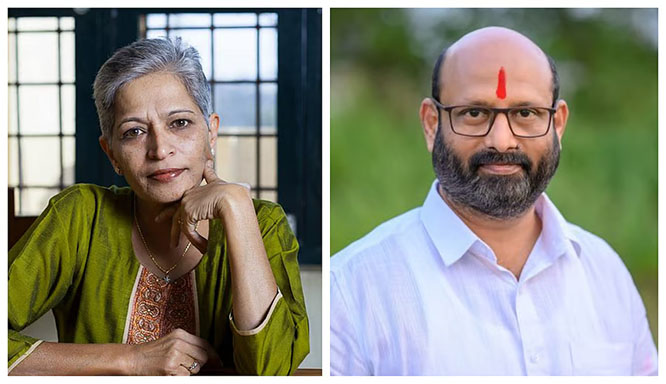
Mumbai: In a shocking development, Shrikant Pangarkar, an accused in the murder of journalist-activist Gauri Lankesh and the Nalasopara arms and ammunition haul case, has won the Jalna Municipal Corporation (JMC) elections as an independent candidate.

Pangarkar emerged victorious from Ward 13 of the JMC, where he was pitted against the BJP. Notably, the Shiv Sena led by Deputy Chief Minister Eknath Shinde, which contested the Jalna civic polls independently, did not field a candidate in the ward.

Gauri Lankesh was shot dead outside her residence in Bengaluru on September 5, 2017. A prominent journalist and activist, she edited Lankesh Patrike, a Kannada weekly founded by her father P Lankesh, and later ran her own publication, Gauri Lankesh Patrike.

Pangarkar was granted bail by the Karnataka High Court on September 4, 2024, in the Lankesh murder case. Ahead of the October 2024 Assembly elections, he was inducted into the Shiv Sena and appointed chief of the party’s Jalna campaign. However, following intense criticism, then Chief Minister Eknath Shinde revoked the appointment.

A former municipal councillor in Jalna between 2001 and 2006 from the undivided Shiv Sena under late Balasaheb Thackeray, Pangarkar later became associated with right-wing organisations.

In August 2018, he was arrested by the Maharashtra Anti-Terrorism Squad (ATS) in connection with the seizure of crude bombs and weapons in Nalasopara and booked under the Explosives Act, Explosive Substances Act, and the Unlawful Activities (Prevention) Act (UAPA). He is currently out on bail in both cases.

Soon after the election results were declared, Pangarkar’s supporters celebrated his victory.

After filing his nomination, Pangarkar had said he was returning to politics after a gap and had received an encouraging response from voters. “I have worked for the people earlier and have returned again,” he said, asserting that the cases against him had no bearing on the elections. “The matter is before the court. I stand before the nyay devta. There may be misunderstandings by agencies, but the court will decide. I am 100 per cent innocent,” he maintained, adding that the Lankesh murder case was unrelated to the civic polls and pertained to Karnataka.

Comments

Add new comment

  • Coastaldigest.com reserves the right to delete or block any comments.
  • Coastaldigset.com is not responsible for its readers’ comments.
  • Comments that are abusive, incendiary or irrelevant are strictly prohibited.
  • Please use a genuine email ID and provide your name to avoid reject.
News Network
January 23,2026

Mangaluru: The Karnataka Government Polytechnic (KPT), Mangaluru, has achieved autonomous status from the All India Council for Technical Education (AICTE), becoming the first government polytechnic in the country to receive such recognition in its 78-year history. The status was granted by AICTE, New Delhi, and subsequently approved by the Karnataka Board of Technical Education in October last year.

Officials said the autonomy was conferred a few months ago. Until recently, AICTE extended autonomous status only to engineering colleges, excluding diploma institutions. However, with a renewed national focus on skill development, several government polytechnics across India have now been granted autonomy.

KPT, the second-largest polytechnic in Karnataka, was established in 1946 with four branches and has since expanded to offer eight diploma programmes, including computer science and polymer technology. The institution is spread across a 19-acre campus.

Ravindra M Keni, the first dean of the institution, told The Times of India that AICTE had proposed autonomous status for polytechnic institutions that are over 25 years old. “Many colleges applied. In the first round, 100 institutions were shortlisted, which was further narrowed down to 15 in the second round. We have already completed one semester after becoming an autonomous institution,” he said. He added that nearly 500 students are admitted annually across eight three-year diploma courses.

Explaining the factors that helped KPT secure autonomy, Keni said the institution has consistently recorded 100 per cent admissions and placements for its graduates. He also noted its strong performance in sports, with the college emerging champions for 12 consecutive years, along with active student participation in NCC and NSS activities.

Autonomous status allows KPT to design industry-oriented curricula, conduct examinations, prepare question papers, and manage academic documentation independently. The institution can also directly collaborate with industries and receive priority funding from AICTE or the Ministry of Education. While academic autonomy has been granted, financial control will continue to rest with the state government.

“There will be separate committees for examinations, question paper setting, boards of studies, and boards of examiners. The institution will now have the freedom to conduct admissions without government notifications and issue its own marks cards,” Keni said, adding that new academic initiatives would be planned after a year of functioning under the autonomous framework.

Comments

Add new comment

  • Coastaldigest.com reserves the right to delete or block any comments.
  • Coastaldigset.com is not responsible for its readers’ comments.
  • Comments that are abusive, incendiary or irrelevant are strictly prohibited.
  • Please use a genuine email ID and provide your name to avoid reject.