



UK banks stop trading Qatari riyals as diplomatic crisis mounts

Arab News
July 1, 2017

London/Dubai, Jul 1: Several British banks said on Friday they had stopped dealing in Qatari riyals, as the diplomatic crisis surrounding the tiny Gulf country disrupted overseas trading of its currency.
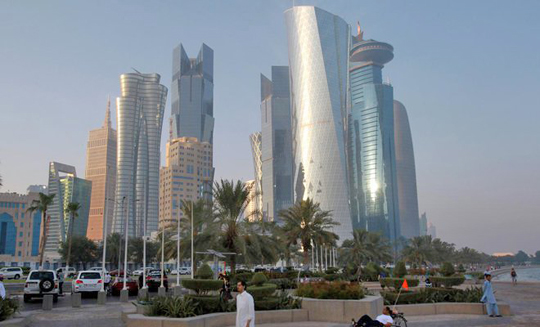
Qataririyals

Saudi Arabia, the United Arab Emirates, Bahrain and Egypt severed diplomatic and travel links with Qatar on June 5, accusing it of supporting terrorism and courting regional foe Iran, in allegations that have ignited a regional crisis between the US allies.

Offshore trade of the riyal has become increasingly volatile and illiquid as a result, raising risks for banks.

Barclays became the latest bank to announce it was no longer trading Qatari riyals for high street customers. The bank was the latest in a list making the same announcement.

A spokeswoman for Britain’s Lloyds Banking Group said a “third-party supplier” which handles its foreign exchange service had ceased trading in Qatar’s riyal as of June 21.

“This currency is no longer available for sale or buy-back across our high street banks including Lloyds Bank, Bank of Scotland and Halifax,” she said.

Tesco Bank said it had halted dealings in the riyal, while Barclays stopped trading riyals for retail customers but continued the service for corporate customers, a source said. Royal Bank of Scotland said it had stopped trading riyals for retail customers.

Banks from the four Arab states that have cut ties with Qatar reduced or halted riyal transactions earlier this month, as have some other countries.

Some big international banks have continued riyal business, however; a spokeswoman for HSBC said on Friday that the bank was still providing riyals for high street customers.

This week the riyal traded between offshore banks as low as 3.81 to the US dollar, its lowest level this decade and more than 4 percent below its peg of 3.64 to the dollar.

Most bankers in the Gulf do not think the peg will break; onshore, the Qatari central bank has continued to provide ample supplies of dollars near 3.6415 under its peg mechanism. The world’s biggest liquefied natural gas exporter has huge reserves with which it could defend its currency.

The Arab states opposing Qatar have set a deadline of around Monday next week — officials have not publicly specified the exact time — for Doha to agree to demands such as shutting television channel Al Jazeera and reducing ties to Iran.

Publicly, Doha has shown little sign of complying, and the four states have said they could impose fresh sanctions if their demands are not met. This threat pushed the cost of insuring Qatari sovereign debt against default to a 16-month high on Friday.

In an effort to reassure markets that the riyal was still widely traded overseas, the Qatari central bank declared in the early hours of Friday that it would guarantee all dealings for customers inside and outside Qatar.

“Qatari riyal’s exchange rate is absolutely stable against the US dollar, and its exchangeability inside and outside Qatar is guaranteed at any time at the official price,” the central bank said, calling reports that some exchange companies had stopped buying the riyal “baseless.”

So far, however, the central bank has not taken the step which bankers say may be necessary to stabilize the offshore currency market: massive dollar-selling intervention.

Some Gulf bankers believe the central bank thinks such radical action is unnecessary; Qatar gets most of its dollar supplies from oil and gas exports, which are controlled by the government, so it does not need to fear offshore trade will suck dollars away from onshore companies which need them.

A source at an investment manager in London, however, said intervention to drive the offshore riyal rate back to 3.64 could be dangerously expensive for the central bank.

“In a month, two months’ time, we would start to see the reserves numbers going down massively, and that could start a panic on the currency.” The alternative to intervention is “the currency grinds down weaker and weaker from here,” he added.

Exchange company Travelex said on Thursday it had resumed purchasing the Qatari riyal globally after a brief suspension “due to business challenges.”

But some exchange houses are demanding increasingly punitive rates because of the risks. Two exchange houses in Dubai told Reuters this week they would buy 1,000 Qatari riyals for only 710 or 720 UAE dirhams – far below the 970 dirhams which they offered before the crisis.

Comments

Add new comment

  • Coastaldigest.com reserves the right to delete or block any comments.
  • Coastaldigset.com is not responsible for its readers’ comments.
  • Comments that are abusive, incendiary or irrelevant are strictly prohibited.
  • Please use a genuine email ID and provide your name to avoid reject.
News Network
November 22,2025

gaza.jpg

The Israeli regime’s forces have killed two Palestinian children in the Gaza Strip every day since the ceasefire began in early October, UNICEF has warned.

The UN children’s agency said on Friday that Israeli forces continue to attack Palestinians in Gaza even though the agreement was meant to stop the killing.

“Since 11 October, while the ceasefire has been in effect, at least 67 children have been killed in conflict-related incidents in the Gaza Strip. Dozens more have been injured. That is an average of almost two children killed every day since the ceasefire took effect,” UNICEF spokesperson Ricardo Pires said in Geneva, reminding that each number in the statistics represents a child whose life had ended violently.

“These are not statistics,” he said. “Each child had a story, a family, and a future that was stolen from them.”

Data from Palestinian factions, human rights groups, and government bodies recorded since the US-brokered ceasefire deal went into effect on October 10 show that Israeli forces have carried out numerous attacks, each constituting a separate ceasefire violation.

UNICEF teams say they repeatedly continue to witness heart-wrenching scenes of fearful Palestinian children sleeping outdoors with amputated limbs, while others live as orphans in flooded, makeshift shelters.

“I saw this myself in August. There is no safe place for them. The world cannot normalize their suffering,” Pires said, lamenting that the UN could “do a lot more if the aid that is really needed was entering faster.”

The UNICEF spokesperson warned that with the advent of winter, the risks for hundreds of thousands of displaced children will increase.

He warned, “The stakes are incredibly high” for children as winter acts as a threat multiplier, where children have no heating, no insulation, and few blankets. He said respiratory infections rise.

“Too many children have already paid the highest price,” Pires said. “Too many are still paying it, even under a ceasefire. The world promised them it would stop and that we would protect them.”

“Now we must act like it,” the UNICEF spokesperson added.

Since the Israeli regime launched its genocidal war against Palestinians in Gaza in October 2023, it has killed nearly 70,000 people in the territory, most of them women and children, and injured over 170,000 more, while reducing most of the structures in the enclave to rubble.

Comments

Add new comment

  • Coastaldigest.com reserves the right to delete or block any comments.
  • Coastaldigset.com is not responsible for its readers’ comments.
  • Comments that are abusive, incendiary or irrelevant are strictly prohibited.
  • Please use a genuine email ID and provide your name to avoid reject.
News Network
November 28,2025

fire.jpg

Several Syrians were killed and more than two dozen others injured in Israeli strikes on the outskirts of Damascus, amid intensified incursions by the occupying regime since the fall of former president Bashar al-Assad and the rise of Hayat Tahrir al-Sham (HTS) rule.

Syrian state TV reported that the casualties occurred during an overnight Israeli assault involving helicopters and drones on the town of Beit Jinn in the Damascus countryside. The attack followed an Israeli military unit’s entry into the town, where they were surrounded by local residents, leading to gunfire and direct confrontations.

According to the report, “The occupation army’s helicopters and artillery shelled Beit Jinn, located at the foothills of Mount Hermon, resulting in 13 martyrs and 25 injured civilians.” The broadcaster did not specify the full extent of damage.

Al-Ikhbariyah Syria confirmed that the shelling coincided with Israeli soldiers entering Beit Jinn, while artillery pounded surrounding areas. The broadcaster stated that the escalation began after local residents clashed with an Israeli patrol that had infiltrated the southern town and “kidnapped” three young men.

Following a two-hour exchange of heavy fire, Israeli forces withdrew and repositioned on the hill of Butt al-Warda at the town’s outskirts.

Israeli media acknowledged that six soldiers were wounded in the clashes—three of them seriously—describing the confrontation as a “sudden ambush” that forced the deployment of reserve units and air support to secure an exit route. No further details were provided.

The aggression has fueled renewed displacement from Beit Jinn, with residents fleeing to nearby villages amid increasingly frequent Israeli attacks.

The raid came just a day after Israeli troops carried out another ground incursion into Umm al-Luqas village in Quneitra province. According to SANA, an Israeli unit in four vehicles entered the village, raided several homes, and later withdrew.

Syria condemned the repeated incursions as violations of the 1974 Disengagement Agreement and UN resolutions, urging the international community to enforce compliance and pressure Israel to halt its operations and withdraw fully.

Israel has expanded its attacks across Syrian territory following the collapse of the Assad government last year. Prime Minister Benjamin Netanyahu has reportedly instructed his forces to push deeper into Syrian territory and seize strategic positions.

Meanwhile, critics say the HTS-led interim government’s inaction and growing normalization gestures toward Israel have emboldened Tel Aviv to intensify its military operations. HTS, formerly linked to al-Qaeda, seized control of Damascus last December, formally ending Assad’s rule.

Comments

Add new comment

  • Coastaldigest.com reserves the right to delete or block any comments.
  • Coastaldigset.com is not responsible for its readers’ comments.
  • Comments that are abusive, incendiary or irrelevant are strictly prohibited.
  • Please use a genuine email ID and provide your name to avoid reject.
News Network
November 24,2025

israelsyra.jpg

Israeli forces have pushed over the Syrian frontier, erecting a checkpoint and stopping vehicles in the southwestern city of Quneitra, in yet another breach of the Arab country’s sovereignty.

The violation took place on Sunday, when the troops made their way across the border, setting up the outpost near the Ain al-Bayda junction in northern Quneitra, Syrian outlets reported.

According to the al-Ikhbariya paper, an Israeli detachment positioned itself at the junction, halting cars and conducting searches.

The Syrian Arab News Agency (SANA) reported that three Israeli military vehicles then moved further into the northern countryside, deploying between the town of Jubata al-Khashab and the villages of Ofaniya and Ain al-Bayda. The agency added that a separate Israeli unit mounted a new incursion in the central region, approaching the villages of Umm Batina and al-Ajraf.

Residents said such activities have surged in recent months, pointing to Israeli advances onto farmland, leveling of extensive forested areas, arrests, and spread of mobile checkpoints.

The Israeli regime began markedly increasing its military aggression against Syria last year.

The escalation coincided with increasingly ferocious onslaughts throughout the country by the so-called Hay'at Tahrir al-Sham (HTS) Takfiri terrorist group, which the government of President Bashar al-Assad had confined to northwestern Syria. The HTS, however, managed to overthrow the government as the Israeli attacks would pummel the country’s civilian and defensive infrastructure.

Various reports have shown that, during the escalation, the regime conducted more than 1,000 airstrikes on the Syrian territory and over 400 ground raids into the south.

Following the collapse of the Assad government, Tel Aviv also widened its grip over the occupied Golan Heights by taking control of a demilitarized buffer zone, in defiance of a 1974 Disengagement Agreement. Earlier this month, senior Israeli officials, including Prime Minister Benjamin Netanyahu, visited the buffer zone, prompting expressions of alarm on the part of the United Nations.

The United States, the regime’s biggest ally, has, meanwhile, been fraternizing the HTS head Abu Mohammed al-Jolani amid the widely reported prospect of rapprochement with Tel Aviv.

Comments

Add new comment

  • Coastaldigest.com reserves the right to delete or block any comments.
  • Coastaldigset.com is not responsible for its readers’ comments.
  • Comments that are abusive, incendiary or irrelevant are strictly prohibited.
  • Please use a genuine email ID and provide your name to avoid reject.