


Whither Secularism: Democratic Society and Minority Rights

Ram Puniyani
June 9, 2019

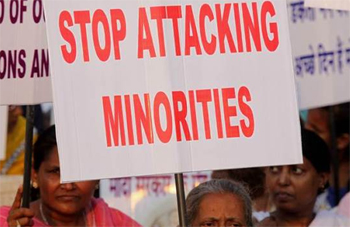
We are living in times where the social norms, the values of Constitution have been violated times and over again. The increasing atrocities on dalits, the lynchings of minorities in the name of Cow-Beef have changed the social equations in a drastic way during last few years. This in a way is part of the ascendance of a politics of communalism which believes in narrow, sectarian religious identity as its defining point. This may get further worsened with the big mandate for Modi in 2019 elections. In the aftermath of elections leading to his return to power, Modi in his victory speech made certain observations which are very disturbing on one hand and also give an idea of shape of things to come.

He stated that this election campaign has unmasked the deceitful claims of secularists and that said that now they can’t mislead the country. As per him secularism as a mask has been destroyed in these elections and that secularism was a cover for minority appeasement. He states that minorities have been deceived and cheated by the parties claiming to be secular.

This statement is not just in the euphoria of victory. For communalism it has been a deeper agenda to do away with the practice of secularism. It is true that there had been aberrations and weaknesses in the practice of this concept, with fallacies like the reversal of Shah Bano judgment or opening the gates of Babri mosque for Shilanyas. The assertion that minorities have been appeased is a total lie. The reports of Gopal Singh Commission, Rangnath Mishra Commission and Sachar Committee tell us about the worsening plight of the Muslim minorities. Some fundamentalist elements within Muslim community have been promoted but the Muslim community as a whole has on one hand been economically marginalized and on the other been subjected to social insecurity. Going beyond the obvious one need to understand as to why the shortfalls in the practice of secularism have dogged our nation?

Secularism has been defined and interpreted a various ways. In Indian context ‘Sarva Dharma Sambhave’ has been the major interpretation. Also that state will not interfere in the maters of religion and religion (clergy) will not dictate and state policy has been the major understanding of this concept, secularism, which is core and integral part of the concept of democracy. Some examples of this are in order. In the wake of demand for renovation of Somnath Temple, Gandhi said that Hindu community is capable of building its own temple. While his disciple Nehru did follow Gandhi’s path in times to come. Same Nehru later called the dams, industries and universities as temples of Modern India.

Gandhi in his own way puts it up brilliantly when he says, “Religion and state will be separate. I swear by my religion, I will die for it. But it is my personal affair. The state has nothing to with it. The state will look after your secular welfare…”

Social scientist Rajiv Bhargava points out that secularism “…combats not just discrimination and other worse forms of inter-religious domination such as exclusion, oppression and humiliation. It is equally opposed to intra-religious domination, i.e. the domination (of women, Dalits, dissenters) within every religious community”

Secularism did not have smooth march in India. It came up with the rising classes during colonial period. The classes which came up with the changes like industrialization, communication and modern education. They called the process of comprehensive change as ‘India as a nation in the making’. The streams like those represented by Bhagat Singh, Ambedkar and Gandhi made it the foundation of their political ideology and struggle for better society. They stood for Indian nationalism. While the declining classes of Landlords and kings shaken by the changes in social fabric and loss of their earlier hegemony came up with communal politics. This communal politics in turn had a bifurcation, Muslim communalism and Hindu communalism. They dreamt of Muslim Nation and Hindu nation respectively. As Professor Bipan Chandra points out Communalism regards a community of one religion as a nation. In India it went through different phases of mild, moderate and extreme communalism. Its understanding is that people of one religion have similar interests, which in turn are different from those of other religion, and so the religious communities are made to pitch against each other. This politics regards the ‘other’ community as a threat to its’ own self. At the same time the intra societal hierarchies are put under the carpet, as the deeper agenda of these groups is to maintain those hierarchies of caste and gender.

One of the weaknesses of practice of secularism in India has been the tremendous opposition from communalism which has been on a rise. While in Pakistan, Muslim communalism was strong right from the beginning; in India it has become stronger during last four decades or so. Its strength has been founded on the polarization, which is an outcome of communal violence. Its issues are those of identity issues like Ram Temple, Love Jihad, Ghar wapsi and Holy cow-beef. It is this communalism which has stood as a counter to the secular ethos of the country; it is this which is the major obstacle for secularism being properly implemented. There are many factors which have been conducive to and helping in the promotion of divisive politics of communalism, one of them being the non completion of secularization process, the process whereby the power of landlord-clergy duo is abolished in a society marching towards democracy.

In India, due to colonial rule, the national movement had to direct its energy primarily against the colonial rulers, while the landlords-kings, to be later joined by some elite-middle classes, continued on the margins, giving the life breath to communalism, leading to partition of the country among other negative phenomenon in the society. Surely India’s plurality and diversity, though currently under cloud, will not let the secular values being eclipsed by the sectarian politics, which is currently on the prowl.


Comments

Add new comment

  • Coastaldigest.com reserves the right to delete or block any comments.
  • Coastaldigset.com is not responsible for its readers’ comments.
  • Comments that are abusive, incendiary or irrelevant are strictly prohibited.
  • Please use a genuine email ID and provide your name to avoid reject.
News Network
November 27,2025

Bengaluru, Nov 27: Karnataka Chief Minister Siddaramaiah’s camp is reportedly on alert as the Congress leadership tussle in the state intensifies, particularly amid speculation over the potential promotion of Deputy Chief Minister D.K. Shivakumar. Siddaramaiah is said to be in a “wait-and-watch” mode after admitting to “confusion” earlier this week and urging the party to “put a full stop” to it.

Sources say his supporters are ready to act if senior leaders — including party chief Mallikarjun Kharge, Sonia Gandhi, and Rahul Gandhi — give any indication of backing Shivakumar. If the party insists on a leadership change, Siddaramaiah’s camp has a list of alternatives, underscoring the deep rift between the two leaders. One possible candidate is Home Minister G. Parameshwara, a Siddaramaiah loyalist and influential Dalit leader.

The strategy was reportedly finalized at a meeting led by PWD Minister Satish Jarkiholi, another Siddaramaiah supporter, who stressed that Delhi leaders need to resolve the issue. Kharge and the Gandhis are expected to meet soon, after which Siddaramaiah and Shivakumar may be summoned to Delhi.

Shivakumar has largely stayed non-confrontational, publicly endorsing Siddaramaiah and downplaying speculation about his own ambitions. However, he has made pointed comments emphasizing the importance of honoring promises, directed at Siddaramaiah.

The feud traces back to the 2023 state election, when Siddaramaiah was chosen as Chief Minister while Shivakumar, who led the party’s campaign, was made Deputy CM and state party chief — a departure from the Congress’ usual “one post per person” rule.

There were also hints of a prior understanding that Siddaramaiah would step down midway through the term. As the halfway mark passed last week, Shivakumar-aligned lawmakers have ramped up pressure on the party for a leadership change, with Shivakumar himself hinting at stepping down as state party chief to pursue the top job.

Comments

Add new comment

  • Coastaldigest.com reserves the right to delete or block any comments.
  • Coastaldigset.com is not responsible for its readers’ comments.
  • Comments that are abusive, incendiary or irrelevant are strictly prohibited.
  • Please use a genuine email ID and provide your name to avoid reject.
News Network
November 21,2025

Bengaluru, Nov 21: The Karnataka government is facing pressure to overhaul its employment system after a high-level Cabinet sub-committee recommended the complete phase-out of job outsourcing in government offices, boards, and corporations by March 2028. The move is aimed at tackling a systemic issue that has led to the potential violation of constitutional reservation policies and the exploitation of workers.

The Call for Systemic Change

With over three lakh vacant posts currently being filled through private agencies on an outsource, insource, or daily wage basis, the sub-committee highlighted a significant lapse. "As a result, reservations are not being followed as per the Constitution and state laws. It’s an urgent need to take serious steps to change the system. It has been recommended to completely stop the system of outsourcing by March 2028," the panel stated in a document.

The practice of outsourcing involves private companies hiring workers to perform duties for a government agency. Critics argue this model results in lesser salaries, a lack of social security benefits (otherwise available to permanent government employees), and a failure to adhere to the provisions of Articles 14 and 15 of the Constitution, which guarantee equality before the law and prohibit discrimination.

The 'Bidar Model' as a Stop-Gap Solution

To regulate the current mode of employment and reduce worker exploitation until the 2028 deadline, the government plans to establish workers’ services multi-purpose cooperative societies across all districts, following the successful "Bidar Model."

The Bidar District Services of Labour Multi-purpose Cooperative Society Ltd., which operates under the District Commissioner, is cited as a successful example of providing a measure of social security to outsourced staff. Labour Department officials argue this society ensures workers receive their due wages and statutory facilities like ESI (Employees' State Insurance) and PF (Provident Fund), in exchange for a 1% service fee collected from the employees.

legislative push and Priority Insourcing

The recommendations, led by the sub-committee headed by Law and Parliamentary Affairs Minister H K Patil, are set to be discussed at the next Cabinet meeting. The committee has proposed the introduction of the Karnataka Outsourced Employees (Regulation, Placement and Welfare) Bill 2025.

In a move addressing immediate concerns, Labour Minister Santosh Lad, a member of the sub-committee, has reportedly assured that steps will be taken over the next 2-3 years to insource workers in "life-threatening services" on a priority basis. This includes essential personnel like pourakarmikas (sanitation workers), drivers, electrical staff in the Energy Department, and Health Department staff handling contagious diseases. The transition aims to grant these workers the long-term security and benefits they currently lack under the outsourcing system. 

Comments

Add new comment

  • Coastaldigest.com reserves the right to delete or block any comments.
  • Coastaldigset.com is not responsible for its readers’ comments.
  • Comments that are abusive, incendiary or irrelevant are strictly prohibited.
  • Please use a genuine email ID and provide your name to avoid reject.
News Network
November 30,2025

airportmetro.jpg

Udupi: The pontiffs of Sri Paryaya Puttige Mutt, the sacred seat of Jagadguru Shrimad Madhvacharya Moola Samsthanam, have submitted a proposal to the Prime Minister seeking comprehensive development for Udupi district. 

Proposal for International Airport

A key request is the establishment of an international airport. Highlighting that around 1,000 acres of land are available and suitable, the pontiffs noted that the existing Mangalore Airport provides limited international connectivity. They suggested the airport be developed under a Public-Private Partnership (PPP) or as a Greenfield Airport to boost trade, education, healthcare, and spiritual tourism.

Metro and Rapid Transit Connectivity

The proposal also calls for Metro Rail or Rapid Transit between Mangaluru and Udupi. The 55 km coastal stretch experiences heavy daily commuter traffic, causing congestion. The district administration is ready to prepare an initial project report for a Mass Rapid Transit corridor and requested inclusion under national urban mobility programmes to ensure safe, green, and time-efficient regional transport.

Port and Coastal Development

The pontiffs urged the development of an international-standard port with a cruise terminal along Udupi’s coast. They also requested fast-tracking of pending coastal tourism projects and revising Coastal Regulation Zone (CRZ) norms to encourage sustainable infrastructure and hospitality investment.

IT, AI and Technological Infrastructure

Support was sought for an IT and AI Innovation Park with incubation facilities under Digital India and Startup India initiatives. The proposal also emphasized the need for strengthened data security and cloud computing infrastructure to boost India’s technological independence.

Sports and Education Initiatives

The pontiffs requested national sports status for Kambala, along with financial and infrastructure support. They also sought the establishment of an AIIMS in Udupi, a new IIT campus, and approval for an IIM to promote higher education in the district.

Representation to the Prime Minister

Sri Sugunendra Tirtha Pontiff and Sri Sushrendra Tirtha Swamiji represented the pontiffs in submitting the comprehensive development proposal to the Prime Minister during his recent visit.

Comments

Add new comment

  • Coastaldigest.com reserves the right to delete or block any comments.
  • Coastaldigset.com is not responsible for its readers’ comments.
  • Comments that are abusive, incendiary or irrelevant are strictly prohibited.
  • Please use a genuine email ID and provide your name to avoid reject.