



Will not hesitate to hit US, Israel targets if attacked: Iran

Agencies
August 23, 2018

London/Jerusalem, Aug 23: Iran warned on Wednesday it would hit U.S. and Israeli targets if it were attacked by the United States after President Donald Trump's security adviser said Washington would exert maximum pressure on Tehran going beyond economic sanctions.

A U.S.-Iranian war of words has escalated since Trump withdrew Washington from the world powers' nuclear deal with Iran in May, blasting it as flawed and reimposing sanctions to choke Iran's economy and force it to renegotiate or change direction.

The U.S. turnaround, which scrapped a wary detente between Iran and the United States after decades of hostility, has drawn defiance from Tehran despite renewed unrest over economic privations, and has unnerved other big powers where businesses have been debating whether to divest from Iran.

U.S. National Security Adviser John Bolton told Reuters the return of U.S. sanctions was having a strong effect on Iran's economy and popular opinion.

"There should not be any doubt that the United States wants this resolved peacefully, but we are fully prepared for any contingency that Iran creates," Bolton said during a visit to Israel, Iran's enemy in the Middle East.

U.S. sanctions dusted off this month targeted Iran's car industry, trade in gold and other precious metals, and purchases of U.S. dollars crucial to international financing and investment and trade relations. Farther-reaching sanctions are to follow in November on Iran's banking sector and oil exports.

European powers have been scrambling to ensure Iran secures enough economic benefits to persuade it to stay in the deal. This has proven difficult, with many European firms keen to avoid financial penalties by the Trump administration.

"We expect that Europeans will see, as businesses all over Europe are seeing, that the choice between doing business with Iran or doing business with the United States is very clear to them," Bolton said.

"So we will see what plays out in November. But (Trump) has made it very clear - his words - he wants maximum pressure on Iran, maximum pressure, and that is what is going on."

Asked at a news conference later whether the United States had discussed any plans with ally Israel on how to capitalise on economic protests in Iran and if these posed any tangible threat to the Tehran government, Bolton said:

"Just to be clear, regime change in Iran is not American policy. But what we want is massive change in the regime's behaviour ... We are going to do other things to put pressure on Iran as well, beyond economic sanctions." He did not elaborate.

"Price of war"

A senior Iranian cleric seen as close to Supreme Leader Ayatollah Ali Khamenei told worshippers at Eid holiday prayers in Tehran: "The price of a war with Iran is very high for America.

"They know if they harm this country and this state in the slightest way the United States and its main ally in the region, the Zionist regime (Israel), would be targeted," Ahmad Khatami said.

Iran's Revolutionary Guards have said it could strike Israeli cities with missiles if it were threatened. Iran also has proxies in the region including Lebanon's Hezbollah.

The Revolutionary Guards said on Wednesday they would continue increasing Iran's defensive capabilities not surrender to U.S. pressure to scrap its ballistic missile programme.

Last week, Khamenei - who has the ultimate say on Iranian policy - said the United States would avoid outright conflict because of Iranian military might.

"There will be no war...We have never started a war and they will not confront Iran militarily," he said.

Trump's campaign to isolate Iran and cripple its economy has put the old adversaries back on a collision course that European signatories to the nuclear accord fear will raise the risk of a broader Middle East war.

Deal 'soft on Iran'

Under the 2015 deal, Iran curbed its contested uranium enrichment programme under U.N. monitoring and won an end to global sanctions in return.

Trump has condemned the deal as too soft on Tehran and would not stop it developing a nuclear bomb, though U.N. nuclear non-proliferation inspectors have repeatedly certified Iranian compliance with its terms.

Khatami, the prominent Iranian cleric, also said Trump's offer of talks was unacceptable as he was demanding Tehran give up its ballistic missile programme and scale back regional influence. Neither issue was covered by the 2015 agreement.

"Americans say you should accept what we say in the talks. So this is not negotiation, but dictatorship," Mizan news agency quoted Khatami as saying.

Trump has said Iran must stop meddling in wars in Syria and Yemen, part of a foreign policy supporting regional allies in conflict with proxies of U.S.-backed Gulf Arab kingdoms.

Tehran has not given an inch to Trump's pressure despite an economy beset by high unemployment and inflation and a rial currency that has lost half its value since April.

Thousands of Iranians have protested against price rises of some food items, a lack of jobs and state corruption. The protests over the cost of living have often turned into anti-government rallies.

"I think the effects, the economic effects certainly, are even stronger than we anticipated," Bolton said.

"But Iranian activity in the region has continued to be belligerent: what they are doing in Iraq, what they are doing in Syria, what they are doing with Hezbollah in Lebanon, what they are doing in Yemen, what they have threatened to do in the Strait of Hormuz."

The Strait is a strategic waterway for oil shipments which Iran's Revolutionary Guards have threatened to block in response to Trump administration calls to ban all Iranian oil exports.

Comments

Add new comment

  • Coastaldigest.com reserves the right to delete or block any comments.
  • Coastaldigset.com is not responsible for its readers’ comments.
  • Comments that are abusive, incendiary or irrelevant are strictly prohibited.
  • Please use a genuine email ID and provide your name to avoid reject.
News Network
January 23,2026

oscar.jpg

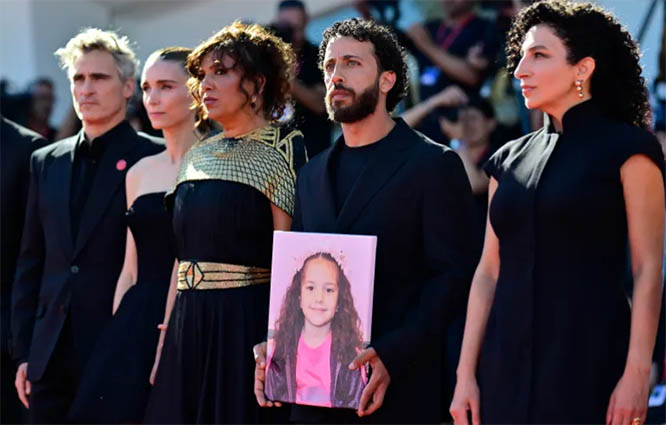
The Voice of Hind Rajab, inspired by the tragic final moments of a young Palestinian girl killed by Israeli fire in Gaza, has been nominated for an Academy Award in the Best International Feature Film category.

Directed by Tunisian filmmaker Kaouther Ben Hania, the film recounts the true story of five-year-old Hind Rajab, who lost her life in January 2024 while fleeing Israeli bombardment with her family.

The film features the real audio of Hind’s desperate call to the Palestinian Red Crescent Society, where she pleaded for help moments before the vehicle she was in was struck by 355 bullets.

The haunting narrative begins with a brief call made from the besieged Tel al-Hawa neighborhood of Gaza, where gunfire and armored vehicles drowned out every sound.

After witnessing the brutal killing of her family, she made a trembling call, her voice reduced to a whisper as she spoke of the massacre and her unbearable loneliness as the sole survivor.

Premiering at the Venice International Film Festival in September 2025, The Voice of Hind Rajab garnered widespread acclaim, receiving a record-setting 23-minute standing ovation and the Silver Lion Grand Jury Prize, the festival’s second-highest honor.

In her acceptance speech, Ben Hania dedicated the film to humanitarian workers and first responders in Gaza, emphasizing that Hind's voice symbolizes countless civilians affected by war.

She aims to give voice to victims often reduced to mere statistics, highlighting the broader suffering of civilians in war zones.

The film’s Oscar nomination underscores its powerful storytelling and ethical approach to depicting real-life tragedy, making it a crucial piece of contemporary cinema.

It serves not only as a narration of individual tragedy but also as an artistic and documentary response to the silence and censorship that often overshadow West Asian struggles and wars.

Using an innovative method she calls docufiction, Ben Hania bridges unvarnished reality and narrative structure, creating a work that is both artistically valuable and socially impactful.

Born in 1977 in Sidi Bouzid—later the epicenter of the Arab revolution—her background profoundly influenced her worldview and artistic approach.

She is a graduate of the Higher School of Audiovisual Arts of Tunis, Pantheon-Sorbonne University, and La Fémis in Paris, where her studies equipped her with the technical and theoretical tools needed to address complex subjects. 

Comments

Add new comment

  • Coastaldigest.com reserves the right to delete or block any comments.
  • Coastaldigset.com is not responsible for its readers’ comments.
  • Comments that are abusive, incendiary or irrelevant are strictly prohibited.
  • Please use a genuine email ID and provide your name to avoid reject.
News Network
February 4,2026

Mangaluru: Urban local bodies and gram panchayats should make the use of Kannada on signboards mandatory while issuing trade licences to commercial establishments, Dakshina Kannada Deputy Commissioner Darshan HV said. He also called for regular inspections to ensure compliance.

Presiding over the District Kannada Awareness Committee meeting at the deputy commissioner’s office, Darshan said the city corporation would be directed to ensure that shops operating in malls prominently display their names in Kannada. “All commercial establishments, including shops, companies, offices and hotels, must mandatorily display their names in Kannada on signboards,” he said.

The deputy commissioner added that the National Highways Authority of India (NHAI) would be instructed to include Kannada on signboards along national highways. Banks, he said, would be directed through committee meetings to provide application forms in Kannada.

“Even if English-medium schools and colleges impart education in English, their signboards must display the institution’s name in Kannada. Steps will also be taken to ensure that private buses display place names in Kannada,” Darshan said.

During the meeting, committee members raised concerns over the closure of Kannada-medium schools in rural areas due to a shortage of teachers and stressed the need for immediate corrective measures. They also pointed out that several industries employ workers from other states while overlooking local candidates.

Members further demanded that nationalised banks provide deposit and withdrawal slips in Kannada. It was brought to the deputy commissioner’s notice that the presence of staff without knowledge of Kannada in rural branches of nationalised banks is causing hardship to local customers.

Meanwhile, MP Srinath, president of the District Kannada Sahitya Parishat, urged the district administration to allot land for the construction of a district Kannada Bhavana in Mangaluru.

Comments

Add new comment

  • Coastaldigest.com reserves the right to delete or block any comments.
  • Coastaldigset.com is not responsible for its readers’ comments.
  • Comments that are abusive, incendiary or irrelevant are strictly prohibited.
  • Please use a genuine email ID and provide your name to avoid reject.
News Network
February 1,2026

Bengaluru: Karnataka Deputy Chief Minister D K Shivakumar on Sunday criticised the Union Budget presented by Finance Minister Nirmala Sitharaman, claiming it offered no tangible benefit to the state.

Though he said he was yet to study the budget in detail, Shivakumar asserted that Karnataka had gained little from it. “There is no benefit for our state from the central budget. I was observing it. They have now named a programme after Mahatma Gandhi, after repealing the MGNREGA Act that was named after him,” he said.

Speaking to reporters here, the Deputy Chief Minister demanded the restoration of MGNREGA, and made it clear that the newly enacted rural employment scheme — VB-G RAM G — which proposes a 60:40 fund-sharing formula between the Centre and the states, would not be implemented in Karnataka.

“I don’t see any major share for our state in this budget,” he added.

Shivakumar, who also holds charge of Bengaluru development, said there were high expectations for the city from the Union Budget. “The Prime Minister calls Bengaluru a ‘global city’, but what has the Centre done for it?” he asked.

He also drew attention to the problems faced by sugar factories, particularly those in the cooperative sector, alleging a lack of timely decisions and support from the central government.

Noting that the Centre has the authority to fix the minimum support price (MSP) for agricultural produce, Shivakumar said the Union government must take concrete steps to protect farmers’ interests.

Comments

Add new comment

  • Coastaldigest.com reserves the right to delete or block any comments.
  • Coastaldigset.com is not responsible for its readers’ comments.
  • Comments that are abusive, incendiary or irrelevant are strictly prohibited.
  • Please use a genuine email ID and provide your name to avoid reject.