Bangladeshi police kill at least 4 civilians for protesting against Narendra Modi

News Network
March 26, 2021

bangla.jpg

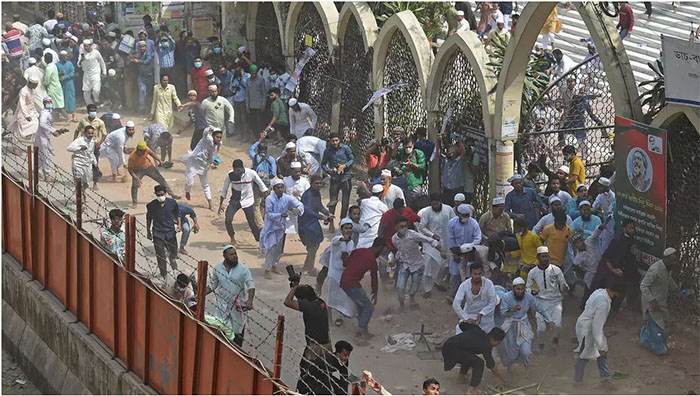
Dhaka, Mar 26: At least four people were killed in Bangladesh's Chittagong on Friday after police fired rubber bullets at protesters during a demonstration against the visit of Prime Minister Narendra Modi, a police official said.

"We had to fire teargas and rubber bullets to disperse them as they entered a police station and carried out extensive vandalism," Rafiqul Islam, the police official told media, referring to protesters

Protests against PM Modi's visit also flared in the capital Dhaka, where dozens of people, including two journalists, were injured in clashes with police, witnesses said.

The development comes as Bangladesh marks 50 years of independence from Pakistan with celebrations focused on its economic achievements, which activist groups say have been overshadowed by rights abuses.

Police said four bodies of members of Hefazat-e-Islam, a hardline group, were brought to Chittagong Medical College Hospital after violence erupted at Hathazari, a rural town where the group's main leaders are based.

"We got four bodies here. They are all hit with bullets. Three of them are madrasa students and another a tailor," Alauddin Talukder, a police inspector at the hospital, said.

He said at least four other demonstrators were critically injured but did not say who opened fire.

Ruhul Amin, the government administrator of Hathazari town, said up to 1,500 supporters of Hefazat attacked a police station chanting anti-Modi slogans.

"They attacked us all of a sudden," he said, without confirming whether any protesters were killed.

Hathazari is home to one of Bangladesh's largest madrasas and is the headquarters of the Hefazat, which was formed in 2010 and is believed to be the country's largest Muslim outfit.

Hefazat spokesman Mir Idris accused police of "opening fire" at their "peaceful" supporters.

"There were some 5,000 protesters. They were all Hefazat supporters and they were mostly madrasa students. They were protesting Modi's visit and police actions against demonstrators in Dhaka," he said.

He was referring to other smaller clashes at the compound of the country's largest mosque in central Dhaka after Friday prayers when police fired rubber bullets and tear gas at brick-throwing Islamist supporters.

Hefazat is known for its nationwide network and large-scale protests demanding blasphemy laws in Bangladesh. In 2013 police clashed with tens of thousands of Hefazat supporters in Dhaka, leaving nearly 50 people dead.

Hefazat aside, a diverse range of Bangladeshi groups -- including students, leftist and other Islamist outfits -- have been staging protests over the last few days against Modi's visit.

They accuse Modi of stoking religious tensions and inciting anti-Muslim violence in the Indian state of Gujarat in 2002, which left about 1,000 people dead. Modi was Gujarat's chief minister at the time.

On Thursday more than 40 people were injured, including four police officers, during a student demonstration. At least 33 people were detained for violence.

Clashes also occurred at the elite state-run Dhaka University Thursday evening, when pro-government student activists allegedly beat dozens of anti-Modi student protesters.

50th anniversary

The violence has overshadowed Bangladesh's celebrations for 50 years of independence from Pakistan.

The former East Pakistan emerged as a new nation in 1971 after a brutal war involving India marked by horrific abuses that Bangladesh says killed as many as three million and displaced many more.

For decades the nation was ravaged by famines, coups and natural disasters but in recent years under Prime Minister Sheikh Hasina it has boomed economically with GDP per head more than quadrupling since 2000.

But under Hasina, 73, daughter of Bangladesh's murdered "founding father" Sheikh Mujibur Rahman and premier since 2009, the human rights situation has deteriorated sharply, activists say.

"The Bangladesh government should not be enabled to use this celebratory moment to lay the groundwork for another 50 years of rights violations, or to hide its abuses by presenting itself on the world stage at variance with how it acts against its own citizens," a joint statement by nine rights groups, including Human Rights Watch, said.

Comments

Add new comment

  • Coastaldigest.com reserves the right to delete or block any comments.
  • Coastaldigset.com is not responsible for its readers’ comments.
  • Comments that are abusive, incendiary or irrelevant are strictly prohibited.
  • Please use a genuine email ID and provide your name to avoid reject.
News Network
November 26,2025

students.jpg

Bengaluru, Nov 26: Karnataka is taking its first concrete steps towards lifting a three-decade-old ban on student elections in colleges and universities. Deputy Chief Minister D.K. Shivakumar announced Wednesday that the state government will form a small committee to study the reintroduction of campus polls, a practice halted in 1989 following incidents of violence.

Speaking at a 'Constitution Day' event organised by the Karnataka Congress, Mr. Shivakumar underscored the move's aim: nurturing new political leadership from the grassroots.

"Recently, (Leader of the Opposition in Lok Sabha) Rahul Gandhi wrote a letter to me and Chief Minister (Siddaramaiah) asking us to think about restarting student elections," Shivakumar stated. "I'm announcing today that we'll form a small committee and seek a report on this."

Student elections were banned in Karnataka in 1989, largely due to concerns over violence and the infiltration of political party affiliates into campus life. The ban effectively extinguished vibrant student bodies and the pipeline of young leaders they often produced.

Mr. Shivakumar, who also serves as the Karnataka Congress president, said that former student leaders will be consulted to "study the pros and cons" of the re-introduction.

Acknowledging the history of the ban, he added, "There were many criminal activities taking place back then. We’ll see how we can conduct (student) elections by regulating such criminal activities."

The Deputy CM reminisced about his own journey, which began on campus. He recalled his political activism at Sri Jagadguru Renukacharya College leading to his first Assembly ticket in 1985 at the age of 23. "That's how student leadership was at the time. Such leadership has gone today. College elections have stopped," he lamented, adding that for many, college elections were "like a big movement" where leaders were forged.

The move, driven by the Congress high command's push to cultivate young talent, will face scrutiny from academics and university authorities who have, in the past, expressed concern that the return of polls could disrupt the peaceful academic environment and turn campuses into political battlegrounds.

Comments

Add new comment

  • Coastaldigest.com reserves the right to delete or block any comments.
  • Coastaldigset.com is not responsible for its readers’ comments.
  • Comments that are abusive, incendiary or irrelevant are strictly prohibited.
  • Please use a genuine email ID and provide your name to avoid reject.
News Network
November 27,2025

siddDKS.jpg

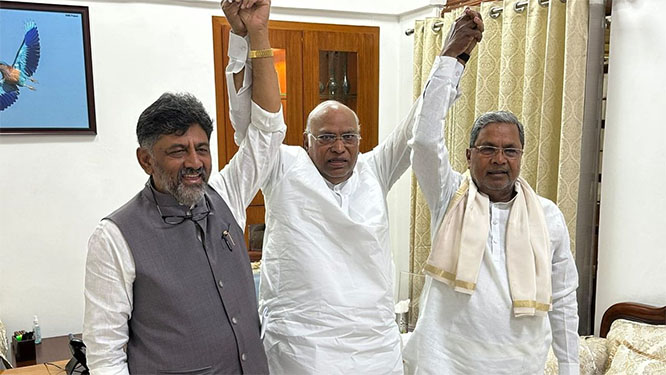
Congress president Mallikarjun Kharge on Thursday announced that he will convene a high-level meeting in New Delhi with senior leaders — including Rahul Gandhi, Karnataka Chief Minister Siddaramaiah and Deputy Chief Minister D.K. Shivakumar — to resolve the escalating leadership turmoil in Karnataka and “put an end to the confusion.”

Kharge said the discussions would focus on the way forward for the ruling party, as rumours of a possible leadership change continue to swirl. The speculation has intensified after the Congress government crossed the halfway mark of its five-year term on November 20, reviving talk of an alleged 2023 “power-sharing agreement” between Siddaramaiah and Shivakumar.

“After reaching Delhi, I will call three or four important leaders and hold discussions. Once we talk, we will decide how to move ahead and end this confusion,” Kharge told reporters in Bengaluru, according to PTI.

When asked specifically about calling Siddaramaiah and Shivakumar to Delhi, he responded: “Certainly, we should call them. We will discuss with them and settle the issue.”

He confirmed that Rahul Gandhi, the Chief Minister, the Deputy Chief Minister and other senior members would be part of the deliberations. “After discussing with everyone, a decision will be made,” he said.

Meanwhile, Siddaramaiah held a separate strategy meeting at his Bengaluru residence with ministers and leaders seen as his close confidants, including G. Parameshwara, Satish Jarkiholi, H.C. Mahadevappa, K. Venkatesh and K.N. Rajanna.
Signalling calm, the Chief Minister told reporters, “Will go to Delhi if the high command calls.”

Shivakumar echoed a similar stance, saying he too would head to the national capital if summoned by the party leadership.

Comments

Add new comment

  • Coastaldigest.com reserves the right to delete or block any comments.
  • Coastaldigset.com is not responsible for its readers’ comments.
  • Comments that are abusive, incendiary or irrelevant are strictly prohibited.
  • Please use a genuine email ID and provide your name to avoid reject.
Agencies
November 22,2025

indiapak.jpg

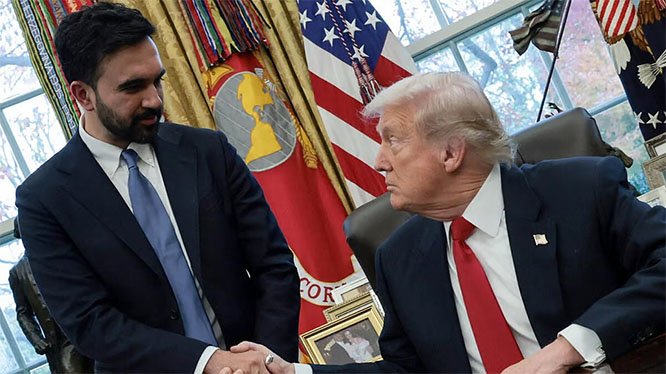
New York/Washington: US President Donald Trump has again claimed to have solved the conflict between India and Pakistan, repeating his assertion during a meeting with New York City Mayor-elect Zohran Mamdani in the Oval Office.

Mamdani flew to Washington DC for his first meeting with Trump in the White House on Friday. Trump said he “enjoyed” the meeting, which he described as “great.”

During remarks in the Oval Office, with Mamdani standing next to him, Trump repeated his claim that he solved the May conflict between India and Pakistan.

"I did eight peace deals of countries, including India and Pakistan,” he said.

On Wednesday, Trump had said he threatened to put 350 per cent tariffs on India and Pakistan if they did not end their conflict, repeating his claim that he solved the fighting between the nuclear-armed neighbours and that Prime Minister Narendra Modi had called him to say “we're not going to go to war.”

Since May 10, when Trump announced on social media that India and Pakistan had agreed to a “full and immediate” ceasefire after a “long night” of talks mediated by Washington, he has repeated his claim over 60 times that he “helped settle” the tensions between India and Pakistan.

India has consistently denied any third-party intervention. India launched Operation Sindoor on May 7, targeting terror infrastructure in Pakistan and Pakistan-occupied Kashmir in retaliation for the April 22 Pahalgam attack that killed 26 civilians. India and Pakistan reached an understanding on May 10 to end the conflict after four days of intense cross-border drone and missile strikes.

Mamdani emerged victorious in the closely-watched battle for New York City Mayor, becoming the first South Asian and Muslim to be elected to sit at the helm of the largest city in the US.

He had been the front-runner in the NYC Mayoral election for months and defeated Republican nominee Curtis Sliwa and political heavyweight former New York State Governor Andrew Cuomo, who ran as an independent candidate and was officially endorsed by Trump just hours before the elections.

Indian-descent Mamdani is the son of renowned filmmaker Mira Nair and Columbia University professor Mahmood Mamdani. He was born and raised in Kampala, Uganda and moved to New York City with his family when he was 7. Mamdani became a naturalised US citizen only recently, in 2018.

Comments

Add new comment

  • Coastaldigest.com reserves the right to delete or block any comments.
  • Coastaldigset.com is not responsible for its readers’ comments.
  • Comments that are abusive, incendiary or irrelevant are strictly prohibited.
  • Please use a genuine email ID and provide your name to avoid reject.