Covid crisis brings regime change for the world’s central banks

News Network
November 12, 2020

corona.jpg

Just eight months after they swung into action to avert a crippling depression and credit crunch, central banks are in the uncomfortable position of relying on governments to power fragile economic rebounds.

The decisions their counterparts make will affect not just the growth outlook for the next few quarters but could shape central banks’ policy options, and even their credibility, for years to come.

Monetary authorities entered the Covid-19 crisis with the least conventional policy space -- namely, interest-rate cuts -- of any postwar downturn. After pulling down borrowing costs near or even below zero and deploying massive asset-purchase programs, they are now practically begging governments to step up.

Without aggressive fiscal stimulus now, the danger is that economies develop deep scars that hobble growth over the longer term. That could then leave central banks unable to reset and prepare for the next shock or recession. Monetary policy and fiscal policy are now interdependent.

 “This is definitely a new regime -- there simply isn’t enough demand in the global economy, and monetary policy can’t generate demand,” said Torsten Slok, chief economist at Apollo Global Management Inc. in New York.

Federal Reserve Chair Jerome Powell, who along with European Central Bank President Christine Lagarde and Bank of England Governor Andrew Bailey will be addressing the ECB’s annual forum on Thursday, is among those calling attention to the risk of long-term damage.

“There is a real threat here of those things,” Powell said at a press conference last week, referring to the risk of more business bankruptcies and long, skill-eroding periods of unemployment. “We’ll have a stronger recovery if we can just get at least some more fiscal support when it’s appropriate.”

British policymakers emphasised the power of dual action on March 11, when a BOE emergency rate cut was explicitly timed hours before the government outlined its own spending plans, and stress their ongoing coordination.

Even while they encourage fiscal cooperation, central bankers have kept up their guard to preserve their independence. After all, from Europe to Japan they were granted autonomy decades ago out of recognition of the need to wall off money creation from political impulses.

Bailey was explicit in addressing the risk last week.

“It’s perfectly possible to have coordinated policy and obviously be very cognizant of the importance of the independence of the Bank of England,” the BOE chief told reporters Nov. 5.

Even so, escalating government debt burdens will make future monetary tightening all the more costly, potentially limiting central banks’ room to maneuver.

Already, an uptick in US government bond yields this week, spurred in part by investor optimism over prospects for an effective coronavirus vaccine, has strengthened expectations for further Fed asset purchases as soon as by year-end.

Lagarde, speaking to the ECB’s virtual conference Wednesday, highlighted that asset purchases along with long-term bank funding are the tools to focus on in the next wave of monetary stimulus. Fed watchers see the potential for adjustments in the quantitative easing program next month.

The Catch-22 for central banks is that the longer they keep their balance sheets bloated and interest rates near zero, the greater the risk of their being seen as having limited power.

‘Second Fiddle’

“Right now, fiscal policy is doing what it has to do and monetary policy is playing second fiddle,” said Erik Nielsen, group chief economist at UniCredit SpA. “Most central bankers now are saying, this is the right policy at this time, but boy am I uncomfortable about it.”

Every central banker knows what lies at the end of a policy response that fails to restore the economy’s longer-term growth track: Japanification.

Since it adopted a zero-rate policy two decades ago, Japan’s central bank has gone on to snap up over 40% of the country’s government bond market, blowing its balance sheet out to more than 138% of gross domestic product.

A Bloomberg survey showed last month that a majority of forecasters doesn’t expect the Bank of Japan to tighten policy even over the longer term. The cost of that widespread assumption: Japan’s central bank has effectively lost the tool of forward guidance. Its tweaks in recent years, including the adoption of a commitment to overshoot its 2% inflation target, haven’t produced notable market reactions.

Bright Lines

The BOJ’s counterparts are determined to prevent any perception that they become little more than financing agencies for fiscal authorities.

Powell drew a bright line on money-financed fiscal policy last week, even as the Fed scoops up $80 billion a month of Treasuries.

“That’s not something we do -- we have different jobs,” Powell said in response to a question at his Nov. 5 press conference. “The job of taxation and spending goes to people who have stood for election and been elected and that’s the way it should be.”

The Fed chair also underscored that the unprecedented emergency lending programs unveiled this year, which provided a backstop for everything from municipalities to mid-size businesses, is a temporary arrangement.

“That shouldn’t be a permanent thing where we’re just another federal financing agency,” Powell said.

Bundesbank President Jens Weidmann put it another way in a speech on Nov. 5. “In the current environment, monetary and fiscal policy are working in harmony,” he said. “Their respective goals are aligned. But we should not pretend that such harmony will be a permanent condition.”


Comments

Add new comment

  • Coastaldigest.com reserves the right to delete or block any comments.
  • Coastaldigset.com is not responsible for its readers’ comments.
  • Comments that are abusive, incendiary or irrelevant are strictly prohibited.
  • Please use a genuine email ID and provide your name to avoid reject.
coastaldigest.com news network
December 2,2025

karkala.jpg

Udupi, Dec 2: A wave of regional pride is sweeping through Udupi district as Shagun S Verma Hegde, a talented Class 9 student from Christ King English Medium High School, Karkala, has been named the captain of the Indian National Team for the Under-15 Girls’ Volleyball Championship.

Shagun holds the unique distinction of being the sole player from Karnataka selected to represent the country in the prestigious international tournament. The championship, organized by the School Games Federation, is scheduled to take place in Shangluo, China, from December 3 to 13, where Shagun will lead the national squad.

A Remarkable Journey to the Top

Shagun’s selection is a testament to her dedication and exceptional skill on the court. Her journey included several rigorous rounds of selection:

•    She was the only player from Udupi district to qualify for the state-level selection camp.

•    Out of eight players from Karnataka who advanced to the national selection camp in Pune, Maharashtra, Shagun was the only one to secure a place in the final national squad.

•    The national camp saw participation from approximately 200 players, which was shortlisted to 23. Shagun not only made the final cut but was also ranked as the second-best player overall, solidifying her leadership role.

Shagun, who is the daughter of Sandesh Verma and Shruthiraj of Kallotte, Karkala, has trained under experienced coaches Santosh D’Souza, Jeevan D’Silva, Jairaj Poojary, and Ramesh. Her selection as the team captain has brought profound honour to her family, school, the Udupi district, and the entire state of Karnataka.

Comments

Add new comment

  • Coastaldigest.com reserves the right to delete or block any comments.
  • Coastaldigset.com is not responsible for its readers’ comments.
  • Comments that are abusive, incendiary or irrelevant are strictly prohibited.
  • Please use a genuine email ID and provide your name to avoid reject.
News Network
November 27,2025

siddDKS.jpg

Congress president Mallikarjun Kharge on Thursday announced that he will convene a high-level meeting in New Delhi with senior leaders — including Rahul Gandhi, Karnataka Chief Minister Siddaramaiah and Deputy Chief Minister D.K. Shivakumar — to resolve the escalating leadership turmoil in Karnataka and “put an end to the confusion.”

Kharge said the discussions would focus on the way forward for the ruling party, as rumours of a possible leadership change continue to swirl. The speculation has intensified after the Congress government crossed the halfway mark of its five-year term on November 20, reviving talk of an alleged 2023 “power-sharing agreement” between Siddaramaiah and Shivakumar.

“After reaching Delhi, I will call three or four important leaders and hold discussions. Once we talk, we will decide how to move ahead and end this confusion,” Kharge told reporters in Bengaluru, according to PTI.

When asked specifically about calling Siddaramaiah and Shivakumar to Delhi, he responded: “Certainly, we should call them. We will discuss with them and settle the issue.”

He confirmed that Rahul Gandhi, the Chief Minister, the Deputy Chief Minister and other senior members would be part of the deliberations. “After discussing with everyone, a decision will be made,” he said.

Meanwhile, Siddaramaiah held a separate strategy meeting at his Bengaluru residence with ministers and leaders seen as his close confidants, including G. Parameshwara, Satish Jarkiholi, H.C. Mahadevappa, K. Venkatesh and K.N. Rajanna.
Signalling calm, the Chief Minister told reporters, “Will go to Delhi if the high command calls.”

Shivakumar echoed a similar stance, saying he too would head to the national capital if summoned by the party leadership.

Comments

Add new comment

  • Coastaldigest.com reserves the right to delete or block any comments.
  • Coastaldigset.com is not responsible for its readers’ comments.
  • Comments that are abusive, incendiary or irrelevant are strictly prohibited.
  • Please use a genuine email ID and provide your name to avoid reject.
News Network
November 21,2025

israel.jpg

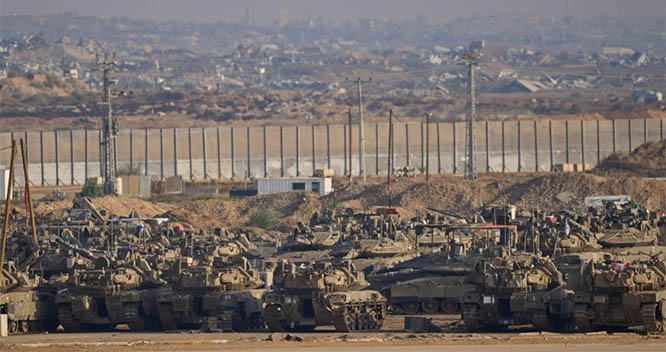
Local authorities say the Israeli military has expanded the so-called “yellow line” truce demarcation in Gaza City and repositioned its forces deeper into the territory in violation of a ceasefire agreement that came into force on October 10, besieging dozens of Palestinian families.

Gaza’s Government Media Office announced in a statement on Thursday that Israeli forces widened the boundary by shifting the markers, and advanced roughly 300 meters (984 feet) into the neighborhoods of Ash-Shaaf, An-Nazzaz and Baghdad Street.

The move pushed further into civilian areas, trapping families who were unable to flee as tanks rolled forward, it added.

“The fate of many of these families remains unknown amidst the shelling that targeted the area,” the office said, adding that the expansion of the yellow line shows a “blatant disregard” for the ceasefire deal.

On Friday, sources said the Israeli military carried out continued air and artillery strikes inside the so-called “yellow line” east of Khan Younis in the southern Gaza Strip.

According to the reports, Israeli warplanes and tanks targeted areas within the zone. One Palestinian was reported killed and several others wounded in the strikes, the sources said.

The fresh aggression came only a day after 25 Palestinians were killed in Israeli airstrikes on Gaza City and Khan Younis on Wednesday.

The media office reported that Israel has consistently violated the truce deal since its implementation last month, with near-daily attacks by air, artillery and direct shootings.

The office said over 400 violations have been documented. These breaches have resulted in the deaths of more than 300 Palestinians and left hundreds injured.

The Government Media Office in Gaza urged the guarantors of the ceasefire — the US, Egypt, Qatar and Turkey — to take swift action to halt the ongoing violations and facilitate the delivery of food, shelter materials, medical aid, and infrastructure equipment.

The so-called “yellow line,” set out in the agreement between Israel and Hamas resistance movement, refers to a non-physical partition where the Israeli military repositioned itself when the truce deal took effect.

It has allowed Israel, which routinely fires at Palestinians who approach the line, to retain control over more than half of the Gaza Strip.

International bodies, including the UN Independent International Commission of Inquiry, the International Association of Genocide Scholars, Amnesty International, Human Rights Watch, B’Tselem, and other rights groups, have concluded that the Israeli war on Gaza amounts to genocide.

In the attacks in Gaza since October 2023, Israel has killed at least 69,546 people and injured 170,833 others, leveling large swaths of the territory and displacing almost all of the population. 

Comments

Add new comment

  • Coastaldigest.com reserves the right to delete or block any comments.
  • Coastaldigset.com is not responsible for its readers’ comments.
  • Comments that are abusive, incendiary or irrelevant are strictly prohibited.
  • Please use a genuine email ID and provide your name to avoid reject.