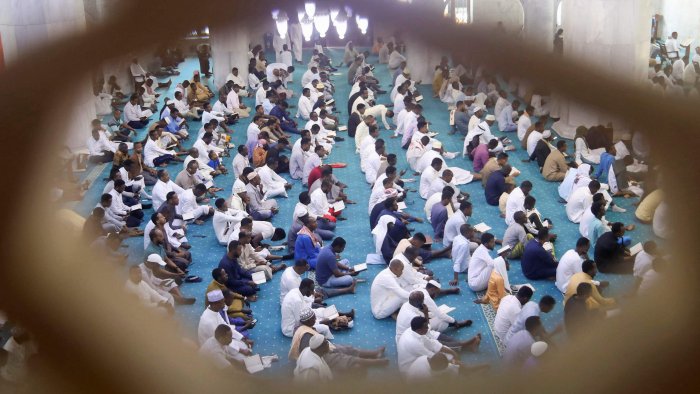
Muslims in dry Somalia break Ramadan fast with little but water

News Network
March 29, 2023

somalia.jpg

Mogadishu, Mar 29: This year's holy month of Ramadan coincides with the longest drought on record in Somalia. As the sun sets and Muslims around the world gather to break their daily fasts with generous dinners, Hadiiq Abdulle Mohamed and her family have just water and whatever food might be at hand.

Hadiiq Abdulle Mohamed is among more than 1 million Somalis who have fled their homes in search of help while an estimated 43,000 people died last year alone.

She and her husband and their six children now take refuge in one of the growing displacement camps around the capital, Mogadishu.

Ramadan brought an increase in food prices for a country already struggling with inflation caused in part by Russia's invasion of Ukraine and the withering of local crops by five consecutive failed rainy seasons. Millions of livestock that are central to people's diets have died.

Now food is even harder to come by for those displaced. For Ramadan, Mohamed and her family rely on well-wishers to provide their single meal a day. First, they break their fast with water and pieces of dates, then spoons of rice.

Finally, they eat the donated meal of rice cooked with mixed meat, bruised banana and a small plastic bag of juice, which Mohamed waits in line for hours under the searing sun to obtain.

“I recall the Ramadan fast we had in the past when we were enjoying and prospering,” she said.

“We would milk our goats, cook the ugali (maize porridge) and collard greens and drink water from our catchment. However, this year we are living in a camp, without plastic to cover us from rain, without food to eat, thirsty and experiencing drought. We have this small hot meal, but do you think that this can feed a family of six children, plus a mother and father? That is not possible.”

The family once was prosperous and owned farmland and goats in a village about 140 kilometres (87 miles) west of the capital.

Now they try to get by on the little money her husband makes by carrying goods in a wheelbarrow. But food prices have soared so much that his income is no longer enough to buy a 1 kilogram (2.2 pound) bag of rice.

The inflation in Somalia pinches the more well-off, too. The typical Ramadan fast-breaking meal includes samosas and other snacks; juice and tea and coffee; the main dish of rice or spaghetti or flatbread with camel, goat, chicken or fish; and finally, dessert.

The Horn of Africa country imports the majority of its food, from Ukraine-grown wheat to the bottles of Mountain Dew stocked in some gleaming Mogadishu shops. Meanwhile, prices of basics like rice and cooking oil continue to rise in parts of the country.

This month, World Food Program monitoring reported that supply chain resilience was generally good in Somalia, but the spike in demand for Ramadan would be “a disadvantage to vulnerable households who depend on local markets.”

“We are really experiencing a soaring price of food and another basic commodities,” said Ahmed Khadar Abdi Jama, a lecturer in economics at Somalia University.

“Whenever there is an external factor that can reduce the supply of food, such as the Russia-Ukraine conflict, it is more likely that Somalis will feel a low supply.”

For example, a kilogram of camel meat that cost about USD 4 before the holy month now costs about $6. But this inflation will subside after the month is over, Khadar said.

Ramadan is a month of alms and forgiveness throughout the Muslim world. With the growing number of Somalis displaced by the drought, the imams of the mosques in Mogadishu are leading efforts to encourage the city's wealthy and others who can afford it to sympathise with the poor and give generously.

“Some people need food to afford to break their fast," said one imam, Sheikh Abdikarim Isse Ali. "Please help them.” 

Comments

Add new comment

  • Coastaldigest.com reserves the right to delete or block any comments.
  • Coastaldigset.com is not responsible for its readers’ comments.
  • Comments that are abusive, incendiary or irrelevant are strictly prohibited.
  • Please use a genuine email ID and provide your name to avoid reject.
News Network
January 23,2026

Mangaluru: The Karnataka Government Polytechnic (KPT), Mangaluru, has achieved autonomous status from the All India Council for Technical Education (AICTE), becoming the first government polytechnic in the country to receive such recognition in its 78-year history. The status was granted by AICTE, New Delhi, and subsequently approved by the Karnataka Board of Technical Education in October last year.

Officials said the autonomy was conferred a few months ago. Until recently, AICTE extended autonomous status only to engineering colleges, excluding diploma institutions. However, with a renewed national focus on skill development, several government polytechnics across India have now been granted autonomy.

KPT, the second-largest polytechnic in Karnataka, was established in 1946 with four branches and has since expanded to offer eight diploma programmes, including computer science and polymer technology. The institution is spread across a 19-acre campus.

Ravindra M Keni, the first dean of the institution, told The Times of India that AICTE had proposed autonomous status for polytechnic institutions that are over 25 years old. “Many colleges applied. In the first round, 100 institutions were shortlisted, which was further narrowed down to 15 in the second round. We have already completed one semester after becoming an autonomous institution,” he said. He added that nearly 500 students are admitted annually across eight three-year diploma courses.

Explaining the factors that helped KPT secure autonomy, Keni said the institution has consistently recorded 100 per cent admissions and placements for its graduates. He also noted its strong performance in sports, with the college emerging champions for 12 consecutive years, along with active student participation in NCC and NSS activities.

Autonomous status allows KPT to design industry-oriented curricula, conduct examinations, prepare question papers, and manage academic documentation independently. The institution can also directly collaborate with industries and receive priority funding from AICTE or the Ministry of Education. While academic autonomy has been granted, financial control will continue to rest with the state government.

“There will be separate committees for examinations, question paper setting, boards of studies, and boards of examiners. The institution will now have the freedom to conduct admissions without government notifications and issue its own marks cards,” Keni said, adding that new academic initiatives would be planned after a year of functioning under the autonomous framework.

Comments

Add new comment

  • Coastaldigest.com reserves the right to delete or block any comments.
  • Coastaldigset.com is not responsible for its readers’ comments.
  • Comments that are abusive, incendiary or irrelevant are strictly prohibited.
  • Please use a genuine email ID and provide your name to avoid reject.
News Network
February 4,2026

shettigar.jpg

An Indian resident who won the Dh20 million (approximately Rs 50 crore) jackpot in Abu Dhabi's Big Ticket draw has told of his joy at sharing his life-changing fortune with a friend.

Shanthanu Shettigar, a shop manager in Muscat, regularly buys tickets for the monthly grand prize draw with one of his closest friends – and the pair won on February 3.

Mr Shettigar, 33, who is from Udyavar in Udupi district of the southern state of Karnataka and has lived in the Omani capital for eight years, said he was left speechless after learning of his success.

“When I first moved to Muscat, many of my colleagues were purchasing Big Ticket, which encouraged me to give it a try,” he said.

“I started buying tickets on my own, and later began sharing tickets with a close friend. The ticket that brought me this win was one we purchased together.”

“Like most people, I receive a lot of spam calls, and I was fully absorbed in my work as well. I knew the live draw was taking place tonight, but I never imagined my name would be announced,” he said.

“When I realised it was real and that I had won, I was honestly speechless. It still hasn’t fully sunk in, but I’m extremely happy.”

Mr Shettigar is not sure how he will spend his share of the money, but encouraged others to take part.

“This win was completely unexpected, so I want to take some time to think things through before deciding what to do next,” he said.

“I would definitely encourage others to participate with Big Ticket, whether with family or friends – you never know when your moment might come.”

The Big Ticket was established in 1992 with an initial first prize of Dh1 million. It is one of the most popular monthly raffles in the UAE.

It has transformed the lives of many people across the Emirates and beyond.

Entry to the Big Ticket Millionaire is Dh500. Tickets can be bought online or at counters at Zayed International Airport and Al Ain Airport.

Comments

Add new comment

  • Coastaldigest.com reserves the right to delete or block any comments.
  • Coastaldigset.com is not responsible for its readers’ comments.
  • Comments that are abusive, incendiary or irrelevant are strictly prohibited.
  • Please use a genuine email ID and provide your name to avoid reject.
News Network
February 4,2026

Mangaluru: Urban local bodies and gram panchayats should make the use of Kannada on signboards mandatory while issuing trade licences to commercial establishments, Dakshina Kannada Deputy Commissioner Darshan HV said. He also called for regular inspections to ensure compliance.

Presiding over the District Kannada Awareness Committee meeting at the deputy commissioner’s office, Darshan said the city corporation would be directed to ensure that shops operating in malls prominently display their names in Kannada. “All commercial establishments, including shops, companies, offices and hotels, must mandatorily display their names in Kannada on signboards,” he said.

The deputy commissioner added that the National Highways Authority of India (NHAI) would be instructed to include Kannada on signboards along national highways. Banks, he said, would be directed through committee meetings to provide application forms in Kannada.

“Even if English-medium schools and colleges impart education in English, their signboards must display the institution’s name in Kannada. Steps will also be taken to ensure that private buses display place names in Kannada,” Darshan said.

During the meeting, committee members raised concerns over the closure of Kannada-medium schools in rural areas due to a shortage of teachers and stressed the need for immediate corrective measures. They also pointed out that several industries employ workers from other states while overlooking local candidates.

Members further demanded that nationalised banks provide deposit and withdrawal slips in Kannada. It was brought to the deputy commissioner’s notice that the presence of staff without knowledge of Kannada in rural branches of nationalised banks is causing hardship to local customers.

Meanwhile, MP Srinath, president of the District Kannada Sahitya Parishat, urged the district administration to allot land for the construction of a district Kannada Bhavana in Mangaluru.

Comments

Add new comment

  • Coastaldigest.com reserves the right to delete or block any comments.
  • Coastaldigset.com is not responsible for its readers’ comments.
  • Comments that are abusive, incendiary or irrelevant are strictly prohibited.
  • Please use a genuine email ID and provide your name to avoid reject.