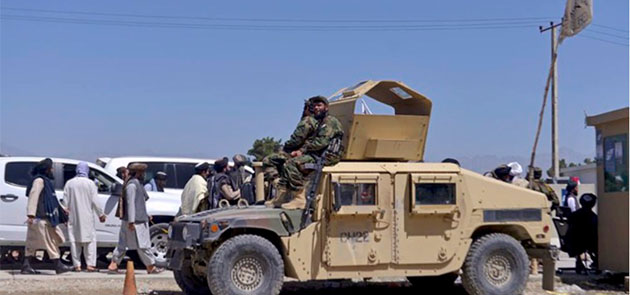
Pakistan accuses US of providing military equipment to TTP militants

News Network
September 7, 2023

pakafghan.jpg

Islamabad, Sept 7: Pakistan’s caretaker prime minister says the US military equipment left behind during the withdrawal from Afghanistan has fallen into militant hands and ultimately made its way to the militant Tehrik-e-Taliban Pakistan (TTP) group. 

Speaking to a select group of journalists at his office in the Pakistani capital of Islamabad, Prime Minister Anwaar-ul-Haq Kakar said there was a need to adopt a “coordinated approach” to tackling the challenge of the leftover equipment.

The equipment — which includes a wide variety of items, from night vision goggles to firearms — is now “emerging as a new challenge” for Islamabad as it has enhanced the fighting capabilities of the Pakistani Taliban, the premier added.

The remarks come as TTP have over the past months intensified attacks on Pakistan’s security forces. They are a separate militant group but an ally of the Afghan Taliban.

Some security sources in Islamabad say the TTP either bought the equipment from the Afghan Taliban or was given it as an ally. They say TTP fighters now target Pakistani troops from a distance, while before their only weapons were AK-47 assault rifles.

The Pakistani Taliban have also released statements and video clips in recent months, claiming they possess, for example, guns with laser and thermal sighting systems.

Still, Pakistani security forces will continue to fight militants “to defend our home, children, mosques and places of worship,” Kakar said.

Kakar, 52, was sworn in last month as Pakistan’s youngest prime minister to head a caretaker government. His Cabinet will run day-to-day affairs until the next parliamentary elections.

Elsewhere in his remarks, Kakar ruled out any talks between the government and the TTP since the militants unilaterally broke off a cease-fire last November.

The outlawed TTP has a strong presence in North Waziristan and elsewhere in the region close to the Afghan border.  It is allied with the Afghan Taliban. The 2021 Afghan Taliban takeover has emboldened the Pakistani Taliban, who have stepped up attacks since then. The military in recent weeks has also carried out multiple raids on militant hideouts in the northwest.

Over the past years, the TTP militants have been involved in multiple terrorist attacks, including targeted bombings and killings of members of religious communities and security officials across the country.

On December 16, 2014, the group attacked Peshawar’s Army School, where more than 150 people, mostly children, were killed, one of the deadliest massacres in Pakistan’s history.

In the face of the Taliban sweep, the US-backed and trained Afghan military crumbled in mid-August 2021.

The Taliban seized US-supplied firepower, recovering guns, ammunition, helicopters and other modern military equipment from Afghan forces who surrendered it.

Though no one knows the exact value, US defense officials have confirmed it is significant.

Since the Taliban takeover next door, Islamabad says TTP fighters have increasingly been given shelter by the Afghan Taliban, straining ties between Islamabad and Kabul.

Pakistan became a key ally of Washington in its war against terror after the 9/11 attacks in the United States. Some figures and studies suggest at least 80,000 Pakistanis have been killed in the so-called US-led War on Terror over the past years.


Comments

Add new comment

  • Coastaldigest.com reserves the right to delete or block any comments.
  • Coastaldigset.com is not responsible for its readers’ comments.
  • Comments that are abusive, incendiary or irrelevant are strictly prohibited.
  • Please use a genuine email ID and provide your name to avoid reject.
News Network
January 23,2026

Mangaluru: The Karnataka Government Polytechnic (KPT), Mangaluru, has achieved autonomous status from the All India Council for Technical Education (AICTE), becoming the first government polytechnic in the country to receive such recognition in its 78-year history. The status was granted by AICTE, New Delhi, and subsequently approved by the Karnataka Board of Technical Education in October last year.

Officials said the autonomy was conferred a few months ago. Until recently, AICTE extended autonomous status only to engineering colleges, excluding diploma institutions. However, with a renewed national focus on skill development, several government polytechnics across India have now been granted autonomy.

KPT, the second-largest polytechnic in Karnataka, was established in 1946 with four branches and has since expanded to offer eight diploma programmes, including computer science and polymer technology. The institution is spread across a 19-acre campus.

Ravindra M Keni, the first dean of the institution, told The Times of India that AICTE had proposed autonomous status for polytechnic institutions that are over 25 years old. “Many colleges applied. In the first round, 100 institutions were shortlisted, which was further narrowed down to 15 in the second round. We have already completed one semester after becoming an autonomous institution,” he said. He added that nearly 500 students are admitted annually across eight three-year diploma courses.

Explaining the factors that helped KPT secure autonomy, Keni said the institution has consistently recorded 100 per cent admissions and placements for its graduates. He also noted its strong performance in sports, with the college emerging champions for 12 consecutive years, along with active student participation in NCC and NSS activities.

Autonomous status allows KPT to design industry-oriented curricula, conduct examinations, prepare question papers, and manage academic documentation independently. The institution can also directly collaborate with industries and receive priority funding from AICTE or the Ministry of Education. While academic autonomy has been granted, financial control will continue to rest with the state government.

“There will be separate committees for examinations, question paper setting, boards of studies, and boards of examiners. The institution will now have the freedom to conduct admissions without government notifications and issue its own marks cards,” Keni said, adding that new academic initiatives would be planned after a year of functioning under the autonomous framework.

Comments

Add new comment

  • Coastaldigest.com reserves the right to delete or block any comments.
  • Coastaldigset.com is not responsible for its readers’ comments.
  • Comments that are abusive, incendiary or irrelevant are strictly prohibited.
  • Please use a genuine email ID and provide your name to avoid reject.
News Network
January 31,2026

Roy.jpg

Bengaluru: The shooting incident involving CJ Roy, founder of the Confident Group, has once again put the spotlight on a businessman whose life has swung between flamboyant global success and persistent controversy at home.

Though Roy’s business interests extended across continents, his roots lay firmly in Karnataka. An alumnus of Christ School in Bengaluru, he later moved to Tumakuru to pursue an engineering degree. Those familiar with his early years describe him as intensely ambitious, beginning his career as a salesman at a small electronics firm dealing in computers.

Roy’s entry into large-scale real estate came through the Crystal Group, where he worked closely with Latha Namboothiri and rose from manager to director. However, the launch of the Confident Group in 2005 was clouded by industry speculation. Insiders speak of a fallout involving alleged “benami” properties and claims of deception that ultimately led to his independent venture—an episode Roy spent years trying to distance himself from, according to associates.

A tale of two cities

Roy’s professional trajectory diverged sharply across geographies.

In Dubai, he built a reputation as a bold and efficient developer, completing massive luxury residential projects in record time—some reportedly within 11 months. His rapid project delivery and lavish lifestyle in the Emirates earned him admiration and visibility in the real estate sector.

In Bengaluru, however, his image remained far more fractured. Sources say Roy stayed away from the city for several years amid disputes over unpaid dues to vendors and suppliers. Several projects were allegedly stalled, with accusations of unfulfilled commitments to cement and steel suppliers continuing to follow him.

Roy’s return to Bengaluru’s business and social circles began around 2018, marked by a conscious attempt at rebranding. His appointment as Honorary Consul of the Slovak Republic added diplomatic legitimacy, which he complemented with visible CSR initiatives, including ambulance donations and high-profile charity events.

Heavy police presence in Langford Town

Following the incident, police personnel from the Central division were deployed outside the Confident Group building in Langford Town, which also houses the Slovak Honorary Consulate in Bengaluru.

The otherwise busy premises near Hosur Road wore a deserted look on Friday, reflecting the shock and uncertainty that followed the tragedy.

Comments

Add new comment

  • Coastaldigest.com reserves the right to delete or block any comments.
  • Coastaldigset.com is not responsible for its readers’ comments.
  • Comments that are abusive, incendiary or irrelevant are strictly prohibited.
  • Please use a genuine email ID and provide your name to avoid reject.
News Network
February 3,2026

wind.jpg

Dakshina Kannada MP Capt Brijesh Chowta has urged the Centre to give high priority to offshore wind energy generation along the Mangaluru coast, citing its strategic importance to India’s green energy and port-led development goals.

Raising the issue in the Lok Sabha under Rule 377, Chowta said studies by the National Institute of Oceanography have identified the Mangaluru coastline as part of India’s promising offshore wind ‘Zone-2’, covering nearly 6,490 sq km. He noted that the region’s relatively low exposure to cyclones and earthquakes makes it suitable for long-term offshore wind projects and called for its development as a dedicated offshore wind energy zone.

Highlighting the role of New Mangalore Port, Chowta said its modern infrastructure, multiple berths and heavy cargo-handling capacity position it well as a logistics hub for transporting and assembling large wind energy equipment.

He also pointed to the presence of major industrial units such as MRPL, OMPL, UPCL and the Mangaluru SEZ, which could serve as direct buyers of green power through power purchase agreements, improving project viability and speeding up execution.

With Karnataka’s peak power demand crossing 18,000 MW in early 2025, Chowta stressed the need to diversify renewable energy sources. He added that offshore wind projects in the Arabian Sea are strategically safer compared to the cyclone-prone Bay of Bengal.

Calling the project vital to India’s target of 500 GW of renewable energy by 2030, Chowta urged the Ministry of New and Renewable Energy to initiate resource assessments, pilot projects and stakeholder consultations at the earliest.

Comments

Add new comment

  • Coastaldigest.com reserves the right to delete or block any comments.
  • Coastaldigset.com is not responsible for its readers’ comments.
  • Comments that are abusive, incendiary or irrelevant are strictly prohibited.
  • Please use a genuine email ID and provide your name to avoid reject.