Russia-Ukraine war: 32 countries including India, China abstain from UN vote

News Network
February 24, 2023

UNvote.jpg

United Nations, Feb 24: India has abstained from voting on resolution in the United Nations General Assembly (UNGA) on the need to reach comprehensive, just and lasting peace in Ukraine.

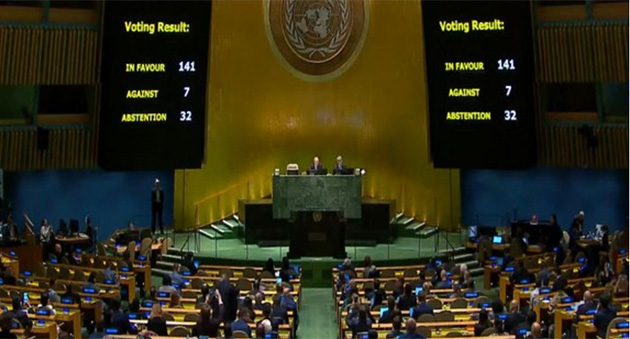
In a ‘historic voting,’ at the UNGA, on Thursday, countries condemned Russia for its invasion of Ukraine. The assembly demanded Moscow to withdraw from Kyiv “immediately,” with an appeal for the need to reach comprehensive, just and lasting peace in Ukraine.

In the assembly, 141 voted in favour of the resolution, 32 abstained, including China and India and seven voted against it.

India’s permanent representative to the UN, Ruchira Kamboj reiterated India’s position in the Russia-Ukraine war and said that dialogue and diplomacy are the only viable way out.

“India remains steadfastly committed to multilateralism and upholds the principles of the UN Charter. We will always call for dialogue and diplomacy as the only viable way out. While we take note of the stated objective of today’s Resolution, given its inherent limitations in reaching our desired goal of securing a lasting peace, we are constrained to abstain.”

India’s ambassador also quoted Prime Minister Narendra Modi’s statement: “We have consistently advocated that no solution can ever arrive at the cost of human lives. In this context, our Prime Minister’s statement that this cannot be an era of war bears reiteration. Escalation of hostilities and violence is in no one’s interest, instead, an urgent return to the path of dialogue and diplomacy is the way forward.”

She also said that international principles and jurisprudence vest responsibility on parties to the conflict to ensure that civilians and civilian infrastructure are not targeted in situations of armed conflicts.

Kamboj stated that India’s approach to the Ukraine conflict would continue to be people-centric. India is providing both humanitarian assistance to Ukraine and economic support to some of the neighbours in the Global South under economic distress, even as they stare at the escalating costs of food, of fuel, and of fertilizers – which has been a consequential fallout of the ongoing conflict.

“India continued to remain concerned over the situation in Ukraine. The conflict has resulted in the loss of countless lives and misery, particularly for women, children, and the elderly, with millions becoming homeless and forced to seek shelter in neighbouring countries. Reports of attacks on civilians and civilian infrastructure are also deeply worrying,” she said.

While addressing the UN General assembly, she asked some fundamental questions like “Are we anywhere near a possible solution acceptable to both sides? Can any process that does not involve either of the two sides, ever lead to a credible and meaningful solution? Has the UN system, and particularly its principal organ, the UN Security Council, based on a 1945-world construct, not been rendered ineffective to address contemporary challenges to global peace and security?”


Comments

Add new comment

  • Coastaldigest.com reserves the right to delete or block any comments.
  • Coastaldigset.com is not responsible for its readers’ comments.
  • Comments that are abusive, incendiary or irrelevant are strictly prohibited.
  • Please use a genuine email ID and provide your name to avoid reject.
News Network
December 7,2025

envoy.jpg

Since 1946, the United States has attempted 93 coups or “regime change” operations across the world — including two in Iran, US Special Envoy for Syria Tom Barrack has admitted.

Speaking to the UAE-based IMI Media Group, in remarks published by The National, Barrack said Washington tried twice to overthrow the Iranian government but failed both times. 

“For (Trump) then to be imputed with regime change — we had two regime changes in Iran already. Neither one worked. So I think wisely leave it to the region to solve,” said Barrack, who also serves as the US ambassador to Turkey.

His comments come six months after the US joined Israel in airstrikes against Iran during ongoing indirect nuclear negotiations between Tehran and Washington.

On June 13, Israel launched an attack on Iran that killed at least 1,064 people and hit civilian infrastructure. Days later, the United States targeted three nuclear facilities — Fordow, Natanz and Isfahan — in what Iran called a clear violation of international law. Iranian retaliation eventually forced a halt to the assault on June 24.

Barrack further claimed that US President Donald Trump and Foreign Secretary Marco Rubio are “not into regime change” and prefer a regional approach driven by Middle Eastern countries themselves. According to him, regional dialogue and non-interference by outside powers offer a more durable path forward.

He added that Washington is still open to an agreement with Tehran if Iranian authorities show “seriousness” and willingness to engage constructively.

However, Iran maintains the US has not shown readiness for meaningful talks. In an interview with Japan’s Kyodo News, Iranian Foreign Minister Abbas Araghchi said negotiations could advance only if Washington acknowledges Iran’s right to peaceful nuclear energy and lifts unilateral sanctions.

Comments

Add new comment

  • Coastaldigest.com reserves the right to delete or block any comments.
  • Coastaldigset.com is not responsible for its readers’ comments.
  • Comments that are abusive, incendiary or irrelevant are strictly prohibited.
  • Please use a genuine email ID and provide your name to avoid reject.
News Network
December 15,2025

Mangaluru, Dec 15: Air India Express has announced that it will resume direct flight services between Mangaluru and Muscat from March 2026, restoring an important international air link for passengers from the coastal region.

Airport authorities said the service will operate twice a week—on Sundays and Tuesdays—from March 1. The initial flights are scheduled on March 3, 8 and 10, followed by March 15 and 17, with the same operating pattern to continue thereafter. The flight duration is approximately three hours and 25 minutes.

The Mangaluru–Muscat route was earlier operated under the 2025 summer schedule, with services beginning on July 14. At that time, Air India Express had operated four flights a week before suspending the service.

Officials said the summer schedule will come into effect from March 29, after which changes in flight timings and departure schedules from Mangaluru are expected. Passengers have been advised to check the latest schedules while planning their travel.

The resumption of direct flights to Muscat is expected to significantly benefit expatriates, business travellers and others, further strengthening Mangaluru’s air connectivity with the Gulf region.

Comments

Add new comment

  • Coastaldigest.com reserves the right to delete or block any comments.
  • Coastaldigset.com is not responsible for its readers’ comments.
  • Comments that are abusive, incendiary or irrelevant are strictly prohibited.
  • Please use a genuine email ID and provide your name to avoid reject.
News Network
December 13,2025

New Delhi: School-going children are picking up drug and smoking habits and engaging in consumption of alcohol, with the average age of introduction to such harmful substances found to be around 13 years, suggesting a need for earlier interventions as early as primary school, a multi-city survey by AIIMS-Delhi said.

The findings also showed substance use increased in higher grades, with grade XI/XII students two times more likely to report use of substances when compared with grade VIII students. This emphasised the importance of continued prevention and intervention through middle and high school.

The study led by Dr Anju Dhawan of AIIMS's National Drug Dependence Treatment Centre, published in the National Medical Journal of India this month, looks at adolescent substance use across diverse regions.

The survey included 5,920 students from classes 8, 9, 11 and 12 in urban government, private and rural schools across 10 cities -- Bengaluru, Chandigarh, Delhi, Dibrugarh, Hyderabad, Imphal, Jammu, Lucknow, Mumbai, and Ranchi. The data were collected between May 2018 and June 2019.

The average age of initiation for any substance was 12.9 (2.8) years. It was lowest for inhalants (11.3 years) followed by heroin (12.3 years) and opioid pharmaceuticals (without prescription; 12.5 years).

Overall, 15.1 per cent of participants reported lifetime use, 10.3 per cent reported past year use, and 7.2 per cent reported use in the past month of any substance, the study found.

The most common substances used in the past year, after tobacco (4 per cent) and alcohol (3.8 per cent), were opioids (2.8 per cent), followed by cannabis (2 per cent) and inhalants (1.9 per cent). Use of non-prescribed pharmaceutical opioids was most common among opioid users (90.2 per cent).

On being asked, 'Do you think this substance is easily available for a person of your age' separately for each substance category, nearly half the students (46.3 per cent) endorsed that tobacco products and more than one-third of the students (36.5 per cent) agreed that a person of their age can easily procure alcohol products.

Similarly, for Bhang (21.9 per cent), ganja/charas (16.1 per cent), inhalants (15.2 per cent), sedatives (13.7 per cent), opium and heroin (10 per cent each), the students endorsed that these can be easily procured.

About 95 per cent of the children, irrespective of their grade, agreed with the statement that 'drug use is harmful'.

The rates of substance use (any) among boys were significantly higher than those of girls for substance use (ever), use in the past year and use in the past 30 days. Compared to grade VIII students, grade IX students were more likely, and grade XI/XII students were twice as likely to have used any substance (ever).

The likelihood of past-year use of any substance was also higher for grade IX students and for grade XI/XII students as compared to grade VIII students.

About 40 per cent of students mentioned that they had a family member who used tobacco or alcohol each. The use of cannabis (any product) and opioid (any product) by a family member was reported by 8.2 per cent and 3.9 per cent of students, respectively, while the use of other substances, such as inhalants/sedatives by family was 2-3 per cent, the study found.

A relatively smaller percentage of students reported use of tobacco or alcohol among peers as compared to among family members, while a higher percentage reported inhalants, sedatives, cannabis or opioid use among peers.

Children using substances (past year) compared to non-users reported significantly higher any substance use by their family members and peers.

There were 25.7 per cent students who replied 'yes' to the question 'conflicts/fights often occur in your family'. Most students also replied affirmatively to 'family members are aware of how their time is being spent' and 'damily members are aware of with whom they spend their time'.

Comments

Add new comment

  • Coastaldigest.com reserves the right to delete or block any comments.
  • Coastaldigset.com is not responsible for its readers’ comments.
  • Comments that are abusive, incendiary or irrelevant are strictly prohibited.
  • Please use a genuine email ID and provide your name to avoid reject.