Trudeau’s murder charge risks upending US courtship of India

Agencies
September 20, 2023

IndiaUS.jpg

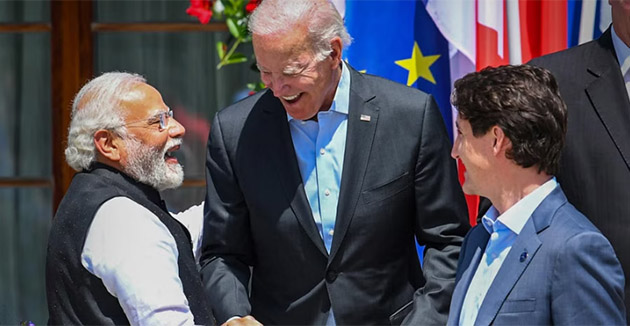
Canadian Prime Minister Justin Trudeau’s shocking allegations that India orchestrated the murder of a separatist leader leaves President Joe Biden caught between one of the US’s closest allies and an increasingly important partner in countering China.

Narendra Modi’s government on Tuesday denied that it had anything to do with the slaying of a prominent Sikh leader in Canada, calling the allegation “absurd.” Both nations expelled one of the other’s diplomats, and that’s before Canada has made any evidence public.

The White House reacted cautiously, with National Security Council spokesperson Adrienne Watson saying the administration was “deeply concerned” and called on India to cooperate with the Canadian investigation. A US official acknowledged the allegations pose a problem for Biden, who just left India with relations seemingly on track.

Now the episode threatens to upend the US’s effort to court India as a counterweight to China, which was on display at the Group of 20 summit in New Delhi earlier this month. The US and its allies had hailed Modi’s success in reaching a compromise on a joint communique, accepting softer language on Russia’s war in Ukraine to align itself more broadly with India in the battle with China for influence among major emerging economies.

“The Biden administration is in a no-win situation with this latest bombshell,” said Derek Grossman, a senior defense analyst at the RAND Corporation. “If it sides with Ottawa, then New Delhi will be up in arms and, once again, question the loyalty of Washington. If it sides with New Delhi, then the US is contradicting a NATO ally.”

The US frequently finds itself torn between its efforts to defend human rights around the world and the pragmatic need to partner with government accused of regular abuses to protect its geopolitical interests. That leads to periodic tensions, such as when agents from Saudi Arabia murdered Washington Post columnist Jamal Khashoggi in 2018.

Trudeau told lawmakers on Monday there were “credible allegations” that agents of the Indian government were behind the murder of Hardeep Singh Nijjar, a Canadian citizen, outside a Sikh temple in British Columbia in June. Nijjar, 45 at the time and the temple’s president, was outspoken in both his advocacy for the creation of an independent Khalistan in the northwest and his criticism of human rights violations in India.

“The government of India needs to take this matter with the utmost seriousness,” Trudeau said on Tuesday morning. Canada is going to “remain calm, we’re going to remain grounded in our democratic principles and values, and we’re going to follow the evidence and make sure that the work is done to hold people to account,” he added.

India has denied any involvement and blasted Canada for failing to take action against Sikh separatism. India had declared Nijjar a wanted terrorist and accused him of conspiring to murder a Hindu priest, among other allegations.

Without a resolution, the dispute threatens everything from pending talks to expand the modest $11 billion India-Canada trade relationship to communications between the two countries’ militaries, something that could create a headache for Biden as he seeks greater cohesion from partner nations.

Modi’s government sees Trudeau as politically beholden to the Sikh community, and expects relations with Canada to deteriorate, according to an Indian official with knowledge of the situation. At the same time, the person said, India-US security cooperation is on a strong footing and is unlikely to affected by Canada’s allegations.

“There is this evergreen challenge that the US and some of its allies face with India, concerns about what they regard as democratic backsliding,” said Michael Kugelman, director of the South Asia Institute at the Wilson Center. “But at the same time they want to ensure they don’t risk imperiling relations with a country that they view as strategically critical. Honestly, I think Washington will just stay quiet.”

The historical issue of Sikh separatism has troubled Canada-India relations for years, and politicians in both countries have tapped into the issue to win votes. Canada has the largest Sikh population outside of Punjab after many left following riots in 1984. They have also become an important political group, including within Trudeau’s administration. Modi’s party, meanwhile, has pushed policies appealing to voters who see India as a Hindu nation.

India has been historically prickly about public criticism from the US and its allies, and the US has said that it tries to voice concerns behind close doors. Speaking in Vietnam after his G-20 visit to India this month, Biden said he had raised rights issues in his recent meeting with Modi, though it’s unclear if they discussed Nijjar’s killing.

For its part, Canada pledged in a recently published strategy for the Indo-Pacific region to grow ties with India across a range of areas, while also acknowledging its growing strategic importance. The two sides had also previously expected to agree to a trade pact by end of this year but that was put on hold ahead of the G-20 summit. Canada last week postponed a trade mission to India that had been set for October.

As the India-Canada relationship worsens, the US will face a tough balancing act, according to Vivek Mishra, senior fellow at New Delhi based Observer Research Foundation.

“I expect there will certainly be back-channel discussion between the US and India on how to proceed further,” he said. “With Canada being a NATO ally and India being a strategic partner ally, the US will have to do the tightrope walk.”


Comments

Add new comment

  • Coastaldigest.com reserves the right to delete or block any comments.
  • Coastaldigset.com is not responsible for its readers’ comments.
  • Comments that are abusive, incendiary or irrelevant are strictly prohibited.
  • Please use a genuine email ID and provide your name to avoid reject.
News Network
February 1,2026

Bengaluru: Karnataka Deputy Chief Minister D K Shivakumar on Sunday criticised the Union Budget presented by Finance Minister Nirmala Sitharaman, claiming it offered no tangible benefit to the state.

Though he said he was yet to study the budget in detail, Shivakumar asserted that Karnataka had gained little from it. “There is no benefit for our state from the central budget. I was observing it. They have now named a programme after Mahatma Gandhi, after repealing the MGNREGA Act that was named after him,” he said.

Speaking to reporters here, the Deputy Chief Minister demanded the restoration of MGNREGA, and made it clear that the newly enacted rural employment scheme — VB-G RAM G — which proposes a 60:40 fund-sharing formula between the Centre and the states, would not be implemented in Karnataka.

“I don’t see any major share for our state in this budget,” he added.

Shivakumar, who also holds charge of Bengaluru development, said there were high expectations for the city from the Union Budget. “The Prime Minister calls Bengaluru a ‘global city’, but what has the Centre done for it?” he asked.

He also drew attention to the problems faced by sugar factories, particularly those in the cooperative sector, alleging a lack of timely decisions and support from the central government.

Noting that the Centre has the authority to fix the minimum support price (MSP) for agricultural produce, Shivakumar said the Union government must take concrete steps to protect farmers’ interests.

Comments

Add new comment

  • Coastaldigest.com reserves the right to delete or block any comments.
  • Coastaldigset.com is not responsible for its readers’ comments.
  • Comments that are abusive, incendiary or irrelevant are strictly prohibited.
  • Please use a genuine email ID and provide your name to avoid reject.
News Network
January 20,2026

KCFabudhabi.jpg

KCF, a global socio-cultural organisation of Karnataka expatriates, is actively involved in education, humanitarian initiatives and community well-being across several countries. The awardees were selected following a structured evaluation of nominations by the Annual Council Program Committee, based on the depth, consistency and long-term impact of their social service.

One of the award recipients, Abdul Razak Haji, a prominent UAE-based entrepreneur from the Qamcon Group of Companies, was honoured for his significant contributions to society. Through both his professional journey and personal initiatives, he has supported numerous employees and families, while also extending assistance in education, housing for the underprivileged and various charitable causes, largely carried out quietly over the years. His award was presented earlier during the Annual Council Program held at the KCF Abu Dhabi office.

The second award was conferred on Latheef Kakkinje, a young social worker based in Abu Dhabi, in recognition of his active involvement in community engagement programmes, sports initiatives, talent festivals and family-oriented social activities. His consistent volunteering efforts and commitment to humanitarian causes were highly appreciated by the selection committee.

The award presentation ceremony for Latheef Kakkinje was held at the Zayed Cricket Stadium (Astro Turf Ground) in the presence of Kedumbady Ibrahim Saqafi, President of KCF UAE; Ibrahim, General Secretary; Kabeer Bayambady, President of KCF Abu Dhabi; Ummer Ishwaramangila, General Secretary; along with other members of the KCF Abu Dhabi cabinet.

Congratulating both awardees, KCF leaders reiterated the organisation’s commitment to recognising individuals who selflessly work for social upliftment and community service.

KCFabudhabi1.jpg

Comments

Add new comment

  • Coastaldigest.com reserves the right to delete or block any comments.
  • Coastaldigset.com is not responsible for its readers’ comments.
  • Comments that are abusive, incendiary or irrelevant are strictly prohibited.
  • Please use a genuine email ID and provide your name to avoid reject.
News Network
January 23,2026

Mangaluru: The Karnataka Government Polytechnic (KPT), Mangaluru, has achieved autonomous status from the All India Council for Technical Education (AICTE), becoming the first government polytechnic in the country to receive such recognition in its 78-year history. The status was granted by AICTE, New Delhi, and subsequently approved by the Karnataka Board of Technical Education in October last year.

Officials said the autonomy was conferred a few months ago. Until recently, AICTE extended autonomous status only to engineering colleges, excluding diploma institutions. However, with a renewed national focus on skill development, several government polytechnics across India have now been granted autonomy.

KPT, the second-largest polytechnic in Karnataka, was established in 1946 with four branches and has since expanded to offer eight diploma programmes, including computer science and polymer technology. The institution is spread across a 19-acre campus.

Ravindra M Keni, the first dean of the institution, told The Times of India that AICTE had proposed autonomous status for polytechnic institutions that are over 25 years old. “Many colleges applied. In the first round, 100 institutions were shortlisted, which was further narrowed down to 15 in the second round. We have already completed one semester after becoming an autonomous institution,” he said. He added that nearly 500 students are admitted annually across eight three-year diploma courses.

Explaining the factors that helped KPT secure autonomy, Keni said the institution has consistently recorded 100 per cent admissions and placements for its graduates. He also noted its strong performance in sports, with the college emerging champions for 12 consecutive years, along with active student participation in NCC and NSS activities.

Autonomous status allows KPT to design industry-oriented curricula, conduct examinations, prepare question papers, and manage academic documentation independently. The institution can also directly collaborate with industries and receive priority funding from AICTE or the Ministry of Education. While academic autonomy has been granted, financial control will continue to rest with the state government.

“There will be separate committees for examinations, question paper setting, boards of studies, and boards of examiners. The institution will now have the freedom to conduct admissions without government notifications and issue its own marks cards,” Keni said, adding that new academic initiatives would be planned after a year of functioning under the autonomous framework.

Comments

Add new comment

  • Coastaldigest.com reserves the right to delete or block any comments.
  • Coastaldigset.com is not responsible for its readers’ comments.
  • Comments that are abusive, incendiary or irrelevant are strictly prohibited.
  • Please use a genuine email ID and provide your name to avoid reject.