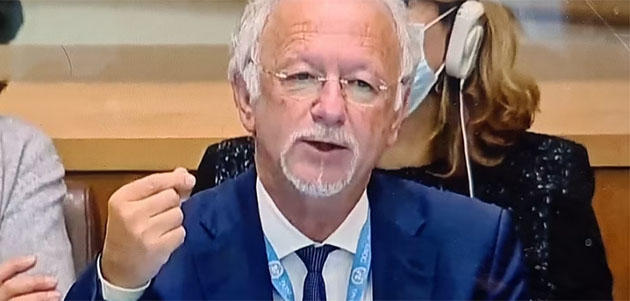
UN human rights expert flags violence against minorities in India to US govt panel

News Network
September 21, 2023

canadianrights.jpg

New Delhi, Sept 21: There is a 'steady' and 'alarming' erosion of fundamental rights, particularly of religious and other minorities in India, the United Nations Special Rapporteur on Minority Issue has told the USCIRF.

During a hearing on Wednesday, United Nations Special Rapporteur on Minority Issue Fernand de Varennes told the US Commission for International Religious Freedom (USCIRF) that the situation in India can be summarised in three words -- 'massive, systematic and dangerous'.

The USCIRF had announced that it would hold a hearing on religious freedom in India on September 20. India has previously rejected USCIRF reports that alleged violations of religious freedom in the country.

Appearing before the USCIRF for the hearing on policy options for advancing religious freedom in India, de Varennes alleged there is a 'steady' and 'alarming' erosion of fundamental rights, particularly of religious and other minorities in the country.

'India risks becoming one of the world's main generators of instability, atrocities and violence because of the massive scale and gravity of the violations and abuses targeting mainly religious and other minorities such as Muslims, Christians, Sikhs and others. It is not just individual or local, it is systematic and a reflection of religious nationalism,' he said.

The hearing comes on the heels of two successful bilateral meetings between Prime Minister Narendra Modi and President Joe Biden -- the official state visit of the Indian leader here in June and a bilateral meeting in New Delhi in September.

USCIRF chair Abraham Cooper claimed Muslims, Sikhs, Christians, Dalits and Adivasis are experiencing 'increased levels of attacks and acts of intimidation' in India.

'The national government has continued to suppress minority voices and those advocating on their behalf through surveillance, harassment, demolition of property and detention under the Unlawful Activities Prevention Act. These trends and their implication for the US foreign policy should not be ignored,' he said.

Cooper alleged that for the past several years, religious freedom conditions in India have deteriorated, capturing international attention and highlighting the need for continued discussions and engagement on policy options for advancing religious freedom in the country.

The USCIRF is an independent, bipartisan US government advisory body created by the 1998 International Religious Freedom Act (IRFA). Its recommendations are not binding on the US government.

On May 2 this year, India rejected as 'biased' and 'motivated' a report by the USCIRF that alleged 'severe violations' of religious freedom in the country.

'The US Commission on International Religious Freedom (USCIRF) continues to regurgitate biased and motivated comments about India, this time in its 2023 annual report. We reject such misrepresentation of facts, which only serves to discredit USCIRF itself,' the Ministry of External Affairs had said.

'We would urge USCIRF to desist from such efforts and develop a better understanding of India, its plurality, its democratic ethos and its constitutional mechanisms,' it had said.

Modi's state visit to Washington in June reflects the close bilateral relationship between the United States and India, the USCIRF had said last week.

'However, over the last decade, the Indian government has enacted and enforced discriminatory policies targeting religious minorities, including anti-conversion laws, cow slaughter laws, legislation granting citizenship preferences based on religion, and restrictions on foreign funding for civil society organisations,' it alleged.

'Recent trends include the eruption of violence between Hindus and Muslims in Haryana in July and targeted attacks against Christian and Jewish minorities in Manipur, highlighting the need for new strategies to mitigate violence against religious minorities in India,' it said.

Since 2020, the USCIRF has recommended that the US Department of State designate India as a Country of Particular Concern (CPC).


Comments

Add new comment

  • Coastaldigest.com reserves the right to delete or block any comments.
  • Coastaldigset.com is not responsible for its readers’ comments.
  • Comments that are abusive, incendiary or irrelevant are strictly prohibited.
  • Please use a genuine email ID and provide your name to avoid reject.
News Network
November 21,2025

malpe.jpg

Udupi: The Malpe Police have arrested two men from Uttar Pradesh for allegedly sharing classified information related to Indian Navy vessels with individuals in Pakistan, posing a serious threat to national security.

According to a complaint filed by the CEO of Udupi Cochin Shipyard, Malpe—an institution under the Union Ministry of Ports, Shipping and Waterways—the prime accused, Rohit (29), was working as an insulator through subcontractor M/S Shushma Marine Pvt Ltd. He had earlier served at Cochin Shipyard Limited in Kochi, Kerala, where naval ships are under construction.

Udupi SP Hariram Shankar said the accused had unlawfully shared, via WhatsApp, confidential identification numbers of Navy-related ships and other classified details while working in Kerala, allegedly for illegal gains.

After joining the Malpe shipyard unit, Rohit reportedly continued collecting sensitive information through a friend in Kochi and circulated it to unauthorised individuals, violating national security protocols and potentially endangering India’s sovereignty, unity, and integrity.

Based on the complaint, Malpe Police registered a case under Section 152 of the Bharatiya Nyaya Sanhita (BNS) and Sections 3 and 5 of the Official Secrets Act, 1923.

A police team led by Karkala Subdivision Assistant Superintendent of Police Harsha Priyamvada—along with PSI Anil Kumar D, ASI Harish, and PC Ravi Jadhav—conducted the investigation and arrested the two accused, identified as Rohit (29) and Santri (37), both residents of Sultanpur district, Uttar Pradesh.

The duo was produced before the court, which remanded them in judicial custody till December 3. Further investigation is in progress.

Comments

Add new comment

  • Coastaldigest.com reserves the right to delete or block any comments.
  • Coastaldigset.com is not responsible for its readers’ comments.
  • Comments that are abusive, incendiary or irrelevant are strictly prohibited.
  • Please use a genuine email ID and provide your name to avoid reject.
News Network
November 26,2025

students.jpg

Bengaluru, Nov 26: Karnataka is taking its first concrete steps towards lifting a three-decade-old ban on student elections in colleges and universities. Deputy Chief Minister D.K. Shivakumar announced Wednesday that the state government will form a small committee to study the reintroduction of campus polls, a practice halted in 1989 following incidents of violence.

Speaking at a 'Constitution Day' event organised by the Karnataka Congress, Mr. Shivakumar underscored the move's aim: nurturing new political leadership from the grassroots.

"Recently, (Leader of the Opposition in Lok Sabha) Rahul Gandhi wrote a letter to me and Chief Minister (Siddaramaiah) asking us to think about restarting student elections," Shivakumar stated. "I'm announcing today that we'll form a small committee and seek a report on this."

Student elections were banned in Karnataka in 1989, largely due to concerns over violence and the infiltration of political party affiliates into campus life. The ban effectively extinguished vibrant student bodies and the pipeline of young leaders they often produced.

Mr. Shivakumar, who also serves as the Karnataka Congress president, said that former student leaders will be consulted to "study the pros and cons" of the re-introduction.

Acknowledging the history of the ban, he added, "There were many criminal activities taking place back then. We’ll see how we can conduct (student) elections by regulating such criminal activities."

The Deputy CM reminisced about his own journey, which began on campus. He recalled his political activism at Sri Jagadguru Renukacharya College leading to his first Assembly ticket in 1985 at the age of 23. "That's how student leadership was at the time. Such leadership has gone today. College elections have stopped," he lamented, adding that for many, college elections were "like a big movement" where leaders were forged.

The move, driven by the Congress high command's push to cultivate young talent, will face scrutiny from academics and university authorities who have, in the past, expressed concern that the return of polls could disrupt the peaceful academic environment and turn campuses into political battlegrounds.

Comments

Add new comment

  • Coastaldigest.com reserves the right to delete or block any comments.
  • Coastaldigset.com is not responsible for its readers’ comments.
  • Comments that are abusive, incendiary or irrelevant are strictly prohibited.
  • Please use a genuine email ID and provide your name to avoid reject.
News Network
December 2,2025

DKSsiddu.jpg

Bengaluru: 'Nati koli saaru' (country chicken curry) considered one of Chief Minister Siddaramaiah’s favourites along with steaming hot idlis was on the breakfast menu at Deputy CM D K Shivakumar’s residence on Tuesday, according to official sources.

The spread also included 'nati koli' fry, vada and pongal, among other items, they said.

In an apparent show of unity, Siddaramaiah visited Shivakumar’s residence for breakfast, just days after the two leaders shared a meal amid a simmering power tussle in the state Congress.

Siddaramaiah drove to the Deputy CM’s residence in Sadashivanagar, where he was received by Shivakumar and his brother D K Suresh, who is a former Congress MP.

Suresh and Kunigal MLA H D Ranganath, a relative of Shivakumar, joined them for breakfast, which featured a mix of vegetarian and non-vegetarian dishes.

Speaking to reporters later, Siddaramaiah said Shivakumar had invited him during his visit to the CM’s residence for breakfast on Saturday.

Asked about the difference between the two meals, the chief minister said, "At his (Shivakumar’s) house it was non-veg, while at my house it was veg. He is a vegetarian, I am a non-vegetarian. I had not prepared non-veg. I told DK to get chicken from the village as you won’t get the original in Bengaluru."

Shivakumar said he had initially invited Siddaramaiah to his residence, but the CM had suggested visiting his place first and reciprocating later. "It was a vegetarian breakfast at the CM’s house on Saturday," he noted.

"Today, I invited him (the CM) to my house. He enjoyed the breakfast, which had his Mysuru taste," Shivakumar added. At this point, Siddaramaiah remarked that Shivakumar’s wife is also from Mysuru.

Saturday’s breakfast at Siddaramaiah’s official residence, held as part of efforts by the Congress high command to ease tensions in the leadership dispute between the two, reportedly included idlis and sambar, according to official sources.

Comments

Add new comment

  • Coastaldigest.com reserves the right to delete or block any comments.
  • Coastaldigset.com is not responsible for its readers’ comments.
  • Comments that are abusive, incendiary or irrelevant are strictly prohibited.
  • Please use a genuine email ID and provide your name to avoid reject.