2018: New Zealand, Australia kick off global New Year parties

Agencies
December 31, 2017

Australia rang in the New Year with a spectacular display of rainbow-coloured fireworks cascading from Sydney Harbour Bridge, as revellers marked the nation’s legalisation of gay marriage amid tight security.

About 1.5 million people packed the city’s foreshore to watch the pyrotechnics light up the sky above the historic bridge and the iconic opera house, the first major celebrations worldwide after New Zealand.

“This is a fabulous way to see out 2017 — the year that four out of five Sydneysiders said a resounding ‘Yes’ to marriage equality,” said Sydney Lord Mayor Clover Moore of the nationwide postal vote in support of change.

Thousands turned out earlier in New Zealand’s largest city Auckland for the annual New Year’s Eve street party, marked by a major fireworks display from the Sky Tower.

Around the world

Celebrations will move to Asia, the Middle East, Africa, Europe and finally the Americas, with dazzling light shows bidding farewell to 2017.

Hong Kong: “Shooting stars” will be fired from the rooftops of skyscrapers in a 10-minute musical fireworks display.

Jakarta: Some 500 couples will wed in a mass ceremony sponsored by the government, and festivals and bazaars will be held on main roads and at tourist sites.

Dubai: The city is replacing its main midnight fireworks with a laser show on the world’s tallest tower, the 828-metre Burj Khalifa.

Moscow: Major boulevards and squares will be decked out to welcome the new year, with fireworks to light up 36 key sites.

Berlin: Special tents will be set up at the Brandenburg Gate to care for women victims of sexual harassment or those who feel threatened, following mass assaults by migrant groups on women in Cologne two years ago. In Cologne itself, 1,400 police will be mobilised, street lighting will be improved and more video cameras installed.

Paris: Hundreds of thousands are expected to line the Champs-Elysees for a light show and fireworks at the Arc de Triomphe. Nearly 140,000 police, gendarmes and soldiers will be deployed nationwide to guard against the jihadist threat. But with no major attack in France since mid-2016 the atmosphere was noticeably more festive than in the past two years.

Rio: Millions will gather on Copacabana beach to watch the fireworks, with many wearing white, the traditional colour to usher in the new year.

Toughest security in years

Stricter security has been a key focus amid fears that crowds could be targets for vehicle and other terror attacks.

In Australia, the stronger police presence included some officers carrying semi-automatic rifles in Sydney and bollards used as barriers against vehicles.

Earlier in December one man was killed and more than a dozen hurt when a man ploughed a car into a crowd of pedestrians in Melbourne.

“You’re going to see more police than ever out, it will be our largest contingent... (given) the current security environment,” said Victoria State police acting chief commissioner Shane Patton.

Other cities are also on alert following deadly vehicle assaults over the past two years in Barcelona, Nice and London.

New York’s Times Square celebrations are set to go ahead despite the Arctic chill gripping much of the central and northeastern United States and Canada.

But revellers there will be guarded by the strongest security presence in years, after two recent attacks apparently inspired by the Islamic State group.

Looking ahead to 2018

Islamic State’s defeat in Iraq and Syria was one of the key stories of 2017, although the jihadists remain a threat and numerous attacks around the world were claimed by them or al-Qaeda-linked groups.

Donald Trump stole the news spotlight after making his debut as U.S. President in January 2017, with “America first” policies and a bombastic personal style that has shaken up international diplomacy.

The former reality television star is likely to continue dominating headlines in 2018, with escalating tensions over North Korea among a host of global challenges.

Other political and diplomatic earthquakes set to rumble into 2018 include the crisis in the Middle East between Saudi Arabia and its allies against Qatar, and the humanitarian disaster in Yemen.

In Europe, further talks on Brexit will help shape the region’s future trade relationship while Russia is set to host the football World Cup amid frictions with the West.

Comments

Add new comment

  • Coastaldigest.com reserves the right to delete or block any comments.
  • Coastaldigset.com is not responsible for its readers’ comments.
  • Comments that are abusive, incendiary or irrelevant are strictly prohibited.
  • Please use a genuine email ID and provide your name to avoid reject.
News Network
January 28,2026

ajit.jpg

Mumbai: The sudden death of Maharashtra Deputy Chief Minister Ajit Pawar in a plane crash in his hometown of Baramati has plunged the state into political uncertainty, raising a pressing question for both the Nationalist Congress Party (NCP) and its rival faction, the Nationalist Congress Party (Sharadchandra Pawar): what next?

For the two factions that emerged after the dramatic split of June–July 2023, the moment marks their gravest challenge yet. Many believe the answer now rests with party founder Sharad Pawar.

Sharad Pawar, who founded the NCP in 1999 after parting ways with the Congress over Sonia Gandhi’s foreign origin, has already indicated his intention to step away from electoral politics once his Rajya Sabha term ends in April 2026.

Speaking at a public event in Baramati ahead of his 85th birthday on December 12, 2025, Pawar said he would not contest any further elections. “I have contested 14 elections. The younger generation needs to be given an opportunity,” he said, adding that he would decide later whether to seek another Rajya Sabha term.

Often described as the Bhishma Pitamah of Indian politics, Pawar also spoke of his gradual withdrawal from active leadership. “For the first 30 years, I handled everything. For the next 25–30 years, Ajit Dada handled responsibilities. Now, arrangements must be made for new leadership,” he said.

Ajit Pawar’s death has dramatically altered that transition, especially as he was working towards reunifying the two NCP factions.

“After the developments of June–July 2023 and the 2024 Lok Sabha and Vidhan Sabha elections, there were deep changes within the family and the party. In the last six months, serious efforts were made to reunite. Even workers from both sides wanted unity. This is a massive blow,” a Pawar family insider told DH over phone from Baramati.

Electoral outcomes over the past year reflected the split. In the 2024 Lok Sabha elections, NCP (SP) recorded the best strike rate in Maharashtra, winning eight of the 10 seats it contested. The NCP, by contrast, won just one seat out of four.

However, the trend reversed in the subsequent Vidhan Sabha elections, where the NCP emerged stronger, securing 41 of the 288 seats, while NCP (SP) managed only 10.

Within NCP (SP), Sharad Pawar’s daughter Supriya Sule serves as Working President, followed by leaders such as Rohit Pawar, state president Shashikant Shinde and former state chief Jayant Patil.

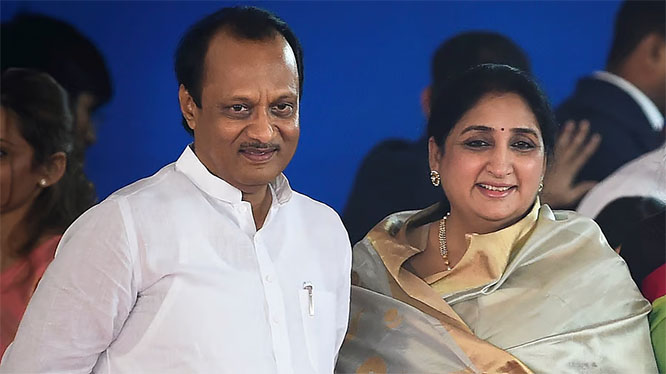
In the NCP, Praful Patel is the Working President and Raigad MP Sunil Tatkare heads the state unit. Ajit Pawar’s wife, Sunetra Pawar, is a Rajya Sabha MP, while their sons Parth and Jay are not actively involved in day-to-day politics. Parth Pawar briefly entered electoral politics in 2019 but lost the Lok Sabha election from Maval. Jay Pawar’s political debut was under consideration.

With Ajit Pawar gone, speculation has intensified that a member of the family may be asked to assume a larger role. For now, Sunetra Pawar is expected to play a key coordinating role in party affairs, alongside Patel and Tatkare.

The NCP continues to have several heavyweight leaders, including Chhagan Bhujbal, Hasan Mushrif, Dattatreya Bharne, Manikrao Kokate and Dhananjay Munde.

Ajit Pawar had already begun steps towards reconciliation between the two factions. While they contested the Pune and Pimpri-Chinchwad municipal elections separately, they later decided to fight the zilla parishad elections together under the ‘clock’ symbol—seen as the first formal step towards reunification.

Nagpur meet and party roadmap

Both NCP factions claim adherence to the ideology of ‘Shiv–Shahu–Phule–Ambedkar’. At the Rashtravadi Chintan Shivir held in Nagpur on September 19, 2025, the NCP reaffirmed its commitment to sarva dharma sambhav and discussed strengthening ties with the BJP “for the welfare and development of Maharashtra”.

In recent days, reports had suggested Ajit Pawar might return to the Maha Vikas Aghadi following the party’s poor performance in Pune municipal elections, but these claims were denied.

Big question for Maha Yuti

Ajit Pawar’s death also presents an immediate challenge for the Devendra Fadnavis-led Maha Yuti government. Pawar held crucial portfolios, including Finance, Planning and Excise. With the Budget Session approaching, appointing a new Finance Minister has become urgent.

Beyond numbers and portfolios, Maha Yuti has lost a swift decision-maker known for his administrative grip and political finesse—leaving a vacuum that will not be easy to fill.

Comments

Add new comment

  • Coastaldigest.com reserves the right to delete or block any comments.
  • Coastaldigset.com is not responsible for its readers’ comments.
  • Comments that are abusive, incendiary or irrelevant are strictly prohibited.
  • Please use a genuine email ID and provide your name to avoid reject.
coastaldigest.com news network
February 5,2026

protestkerala.jpg

Mangaluru: The KSRTC Mangaluru division has rolled back the fare hike on buses operating on the Mangaluru–Kasaragod route following the suspension of toll collection at the Arikkady toll plaza near Kumbala in Kasaragod district.

The fare revision had been implemented after the National Highways Authority of India (NHAI) began toll collection at the Arikkady plaza on NH-66. As a result, fares for ordinary and Rajahamsa services were increased by ₹7 and ₹10, respectively, raising the bus fare from Mangaluru to Kasaragod from ₹81 to ₹88.

Senior Divisional Controller of KSRTC’s Mangaluru division, Rajesh Shetty, said the fares were reduced after toll collection at the Arikkady plaza was stopped. “The tollgate began operations on January 13, and the toll amount was deducted from the FASTag accounts of KSRTC buses operating on the route. Following an order from the central government to suspend toll collection, KSRTC has also withdrawn the additional fare with immediate effect,” he said.

At present, vehicles travelling on the Mangaluru–Kasaragod route pay toll only at the Talapady toll plaza. The toll for light motor vehicles (LMVs) at Talapady is ₹80 for a same-day return, while heavy vehicles, including buses, are charged ₹250. At Arikkady, the toll rates were ₹130 for LMVs (same-day return) and ₹450 for buses.

Protests against Arikkady toll plaza

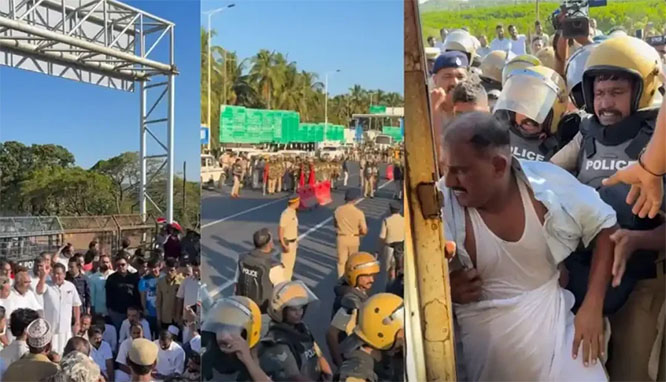
The Arikkady toll plaza witnessed widespread protests from January 12, the day toll collection commenced. On the second day, an action committee led by Manjeshwar MLA A K M Ashraf launched an indefinite protest at the site. Except for the BJP, leaders and workers of most major political parties participated in the agitation.

On the night of January 14, a large number of protesters gathered at the plaza and vandalised property, following which authorities temporarily suspended toll operations. The BJP later also expressed opposition to the toll plaza and criticised NHAI’s decision. 

Comments

Add new comment

  • Coastaldigest.com reserves the right to delete or block any comments.
  • Coastaldigset.com is not responsible for its readers’ comments.
  • Comments that are abusive, incendiary or irrelevant are strictly prohibited.
  • Please use a genuine email ID and provide your name to avoid reject.
News Network
February 5,2026

In an era where digital distractions are the primary rival to academic excellence, the Karnataka Education Department is taking the fight directly to the living room. As the SSLC (Class 10) annual examinations loom, officials have launched a localized "digital strike" to ensure students aren't losing their competitive edge to scrolling or soap operas.

The 7-to-9 Lockdown

The department has issued a formal directive urging—and in some cases, enforcing via home visits—a total blackout of mobile phones and television sets between 7:00 PM and 9:00 PM. This two-hour window is being designated as "sacred study time" across the state until the examinations conclude on April 2.

Key Pillars of the Initiative:

•    Doorstep Advocacy: Teachers are transitioning from classrooms to living rooms, meeting parents to explain the psychological benefits of a distraction-free environment.

•    Parental Accountability: The campaign shifts the burden of discipline from the student to the household, asking parents to lead by example and switch off their own devices.

•    The Timeline: The focus remains sharp on the upcoming exam block, scheduled from March 18 to April 2.

"The objective is simple: uninterrupted focus. We are reclaiming the evening hours for the students, ensuring their environment is as prepared as their minds," stated a senior department official.

Student vs. Reality

While the student community has largely welcomed the "forced focus"—with many admitting they lack the willpower to ignore notifications—the move has sparked a debate on enforceability. Without a "TV Police," the success of this initiative rests entirely on the shoulders of parents and the persuasive power of visiting educators.

Comments

Add new comment

  • Coastaldigest.com reserves the right to delete or block any comments.
  • Coastaldigset.com is not responsible for its readers’ comments.
  • Comments that are abusive, incendiary or irrelevant are strictly prohibited.
  • Please use a genuine email ID and provide your name to avoid reject.