



After Muslims reject saffron, UP Haj House repainted in white

Agencies
January 7, 2018

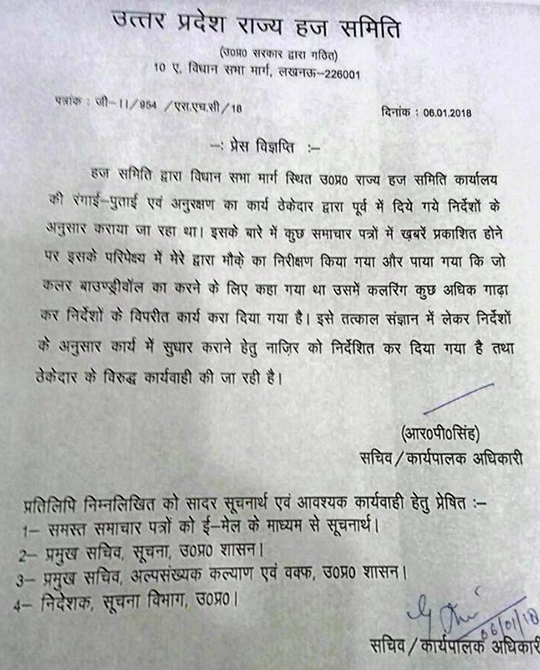
Lucknow, Jan 7: The Haj House in Lucknow, which was painted saffron by the Yogi Adityanath government on Friday, is being repainted. The exterior walls of the building, used by Muslims as a transit place on their way to pilgrimage in Mecca, was initially green-and-white in colour.

The Uttar Pradesh government has issued a clarification stating that extra coating of the paint made the walls appear saffron, which is now being repainted in white. It will now take action the contractor as it was against the issued instructions.

After the BJP government painted the Haj House in Uttar Pradesh's capital city yesterday, many Opposition parties and Muslims objected to the move.

They had accused the government of a deliberate provocation by raising religious sentiments.

The painting of the Haj House into saffron came two days after the Yogi government ordered the madrassas in his state to reduce the number of holidays on Muslim festivals, and remain closed on Hindu festivals too.
After assuming office in March last year, Chief Minister Yogi Adityanath showed his fondness for the colour as the state government gave saffron tinge to covers of official booklets and background of official posters issued by the public relations department and ministries.

In October last year, 50 saffron-coloured buses of the UP State Road Transport Corporation, named Sankalp Seva, were launched to provide service in rural areas.  
Comments

Add new comment

  • Coastaldigest.com reserves the right to delete or block any comments.
  • Coastaldigset.com is not responsible for its readers’ comments.
  • Comments that are abusive, incendiary or irrelevant are strictly prohibited.
  • Please use a genuine email ID and provide your name to avoid reject.
News Network
December 16,2025

bengal.jpg

The deletion of over 58 lakh names from West Bengal’s draft electoral rolls following a Special Intensive Revision (SIR) has sparked widespread concern and is likely to deepen political tensions in the poll-bound state.

According to the Election Commission, the revision exercise has identified 24 lakh voters as deceased, 19 lakh as relocated, 12 lakh as missing, and 1.3 lakh as duplicate entries. The draft list, published after the completion of the first phase of SIR, aims to remove errors and duplication from the electoral rolls.

However, the scale of deletions has raised fears that a large number of eligible voters may have been wrongly excluded. The Election Commission has said that individuals whose names are missing can file objections and seek corrections. The final voter list is scheduled to be published in February next year, after which the Assembly election announcement is expected. Notably, the last Special Intensive Revision in Bengal was conducted in 2002.

The development has intensified the political row over the SIR process. Chief Minister Mamata Banerjee and her Trinamool Congress have strongly opposed the exercise, accusing the Centre and the Election Commission of attempting to disenfranchise lakhs of voters ahead of the elections.

Addressing a rally in Krishnanagar earlier this month, Banerjee urged people to protest if their names were removed from the voter list, alleging intimidation during elections and warning of serious consequences if voting rights were taken away.

The BJP, meanwhile, has defended the revision and accused the Trinamool Congress of politicising the issue to protect what it claims is an illegal voter base. Leader of the Opposition Suvendu Adhikari alleged that the ruling party fears losing power due to the removal of deceased, fake, and illegal voters.

The controversy comes amid earlier allegations by the Trinamool Congress that excessive work pressure during the SIR led to the deaths by suicide of some Booth Level Officers (BLOs), for which the party blamed the Election Commission. With the draft list now out, another round of political confrontation appears imminent.

As objections begin to be filed, the focus will be on whether the correction mechanism is accessible, transparent, and timely—critical factors in ensuring that no eligible voter is denied their democratic right ahead of a crucial election.

Comments

Add new comment

  • Coastaldigest.com reserves the right to delete or block any comments.
  • Coastaldigset.com is not responsible for its readers’ comments.
  • Comments that are abusive, incendiary or irrelevant are strictly prohibited.
  • Please use a genuine email ID and provide your name to avoid reject.

