



Amid tension in South China Sea, Beijing flags global naval role

April 27, 2017

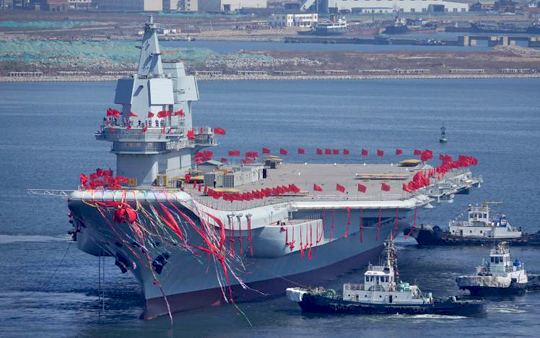
Shanghai, Apr 27: China needs to raise its military capabilities to protect its growing overseas interests, its foreign minister said following the launch of China's first domestically built aircraft carrier, but he vowed not to pursue expansionism. China launched the carrier on Wednesday amid rising tension over North Korea and regional worries about Beijing's assertiveness in the South China Sea and its broader military modernisation programme.
naval

Speaking during a visit to Germany, Chinese Foreign Minister Wang Yi said Chinese business and citizens had spread all around the world, with millions of people living overseas and nearly 30,000 Chinese-funded businesses registered in other countries. "Under this new environment, China has ample reason to raise its own national defence capability to effectively protect its fair rights that are increasingly extending overseas," Wang said in response to a question on the new carrier, according to a statement on the ministry's website on Thursday.Wang said China's increased military muscle would help "safeguard international and regional peace".

China would maintain a "defensive" military policy and had "no intention to engage in any kind of expansion", he said.China's navy has been taking an increasingly prominent role in recent months, with a rising star admiral taking command, its first aircraft carrier sailing around self-ruled Taiwan and new warships appearing in far-flung places.

Little has been known, however, about China's domestic aircraft carrier programme, which is a state secret. China also does not give a spending breakdown for its defence budget.But the government has said the new carrier's design draws on experiences from its first carrier, the Liaoning, bought second-hand from Ukraine in 1998 and refitted in China. State media has quoted experts as saying China needs at least six carriers, and a corresponding number of overseas bases to support them.

But experts say China is far from being able to challenge the United States which operates 10 carriers and plans to build two more, and has decades of experience operating them.Unlike the U.S. navy's longer-range nuclear carriers, both of China's feature Soviet-design ski-jump bows, intended to give fighter jets enough lift to take off from shorter decks.But they lack the powerful catapult technology for launching aircraft that US carriers use. The new carrier is not expected to enter full service until 2020.


Comments

Add new comment

  • Coastaldigest.com reserves the right to delete or block any comments.
  • Coastaldigset.com is not responsible for its readers’ comments.
  • Comments that are abusive, incendiary or irrelevant are strictly prohibited.
  • Please use a genuine email ID and provide your name to avoid reject.
News Network
December 7,2025

envoy.jpg

Since 1946, the United States has attempted 93 coups or “regime change” operations across the world — including two in Iran, US Special Envoy for Syria Tom Barrack has admitted.

Speaking to the UAE-based IMI Media Group, in remarks published by The National, Barrack said Washington tried twice to overthrow the Iranian government but failed both times. 

“For (Trump) then to be imputed with regime change — we had two regime changes in Iran already. Neither one worked. So I think wisely leave it to the region to solve,” said Barrack, who also serves as the US ambassador to Turkey.

His comments come six months after the US joined Israel in airstrikes against Iran during ongoing indirect nuclear negotiations between Tehran and Washington.

On June 13, Israel launched an attack on Iran that killed at least 1,064 people and hit civilian infrastructure. Days later, the United States targeted three nuclear facilities — Fordow, Natanz and Isfahan — in what Iran called a clear violation of international law. Iranian retaliation eventually forced a halt to the assault on June 24.

Barrack further claimed that US President Donald Trump and Foreign Secretary Marco Rubio are “not into regime change” and prefer a regional approach driven by Middle Eastern countries themselves. According to him, regional dialogue and non-interference by outside powers offer a more durable path forward.

He added that Washington is still open to an agreement with Tehran if Iranian authorities show “seriousness” and willingness to engage constructively.

However, Iran maintains the US has not shown readiness for meaningful talks. In an interview with Japan’s Kyodo News, Iranian Foreign Minister Abbas Araghchi said negotiations could advance only if Washington acknowledges Iran’s right to peaceful nuclear energy and lifts unilateral sanctions.

Comments

Add new comment

  • Coastaldigest.com reserves the right to delete or block any comments.
  • Coastaldigset.com is not responsible for its readers’ comments.
  • Comments that are abusive, incendiary or irrelevant are strictly prohibited.
  • Please use a genuine email ID and provide your name to avoid reject.