Anger over US’ Jerusalem move spreads from Jakarta to Rabat

Al Jazeera
December 11, 2017

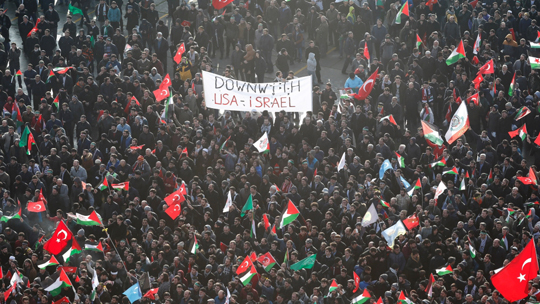
A wave of anger against a US decision to recognise Jerusalem as Israel's capital has spread from Asia, through the Middle East, to North Africa, with tens of thousands of people taking to the streets to denounce the controversial move.

Protesters filled central avenues and squares in a number of major international cities on Sunday, waving the flag of Palestine and shouting slogans to express their solidarity with the Palestinians, who see East Jerusalem as the capital of their future state.

US President Donald Trump's announcement on Wednesday drew near-universal condemnation from world leaders and inflamed the Palestinian-Israeli conflict, with violence flaring up in the occupied Palestinian territories for a fifth day.

According to the Palestinian Red Crescent, 157 people were injured on Sunday in confrontations with Israeli forces in the occupied West Bank, Jerusalem and Gaza.  

At least four Palestinians have been killed in the Gaza Strip since the US declaration.

Clashes also erupted on Sunday at a protest in Beirut, where demonstrators fought with security forces outside the US embassy in the Lebanese capital. 

Demonstrators set fires in the street, torched US and Israeli flags and threw stones at police officers, who responded with tear gas and water cannon.

Adnan Abdullah, a protester in Beirut, said Trump's Jerusalem decision "will not happen as long as there are people like us".

Another demonstrator, whose face was hidden behind a black mask, held up a tear gas canister and condemned Lebanese forces for "defending America".

He went on to add, "There is no one by our side. None of the Arab countries. Oh God, we will raise the Palestinian flag"

Arab foreign ministers, in a resolution on Sunday, urged Trump to rescind the decision and have called for a UN Security Council condemnation of the shift in US policy.

Meanwhile, more than 5,000 Indonesians rallied outside the US embassy in Jakarta to vent their anger for a second day. Protesters carried Palestinian flags and banners saying "Pray for Palestine".

"We are not satisfied with just official statements," said Nurjannah Nurwani, one of the lead organisers of the gathering. "We need follow-up, international lobbying which could pressure them into withdrawing their decision."

Another female protester in Jakarta urged Trump to "use his brain" and "withdraw from Jerusalem".

Indonesian President Joko Widodo has condemned Trump's decision. On Thursday, he ordered the US ambassador in Jakarta to be summoned over the move.

In Turkey's Istanbul, thousands of demonstrators took to the streets again, transforming the city's Yenikapi Square into a sea of Turkish and Palestinian flags.  

"I feel like I should defend Palestine because I don't know any other way to defend them," said Ananda Sereka, who was at the protest. "So this is what I can do. This is the least I can do."

Turkey's President Recep Tayyip Erdogan, one of the most vocal critics of Trump's move, has called the declaration "null and void" and vowed to fight it.

He has also called a summit of Islamic countries to discuss the move on Wednesday.

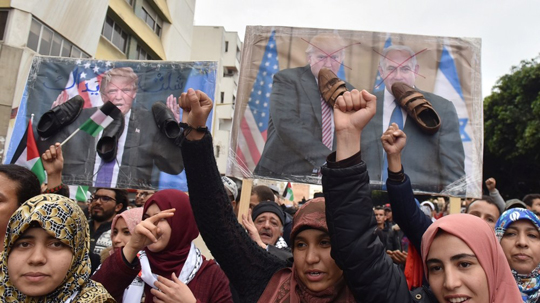
In Rabat, Morocco's capital, protesters yelled slurs against Trump and carried banners saying Jerusalem belonged to Palestine.

Al Jazeera's Hashem Ahelbarra, reporting from Rabat, said the protest was "a show of solidarity with the Palestinian people but also an opportunity to express anger" over Trump's decision.

"The protesters came from all walks of life," he said. "Government officials, members of the opposition, seculars and conservatives - all denouncing what they consider to be a decision that could destabilise the region."

Mohamed Boussaid, Morocco's finance minister, said the demonstration was a way "to express our indignation and un-satisfaction" and to show that "we refuse completely the decision taken by the president of the US".

Protester Mohamed Alghram agreed.

"We totally reject the decision that targets the most sacred place for us and we say no," he said. "Jerusalem is a red line."

Jerusalem is home to Islam's third holiest site and its status is deeply sensitive for Muslims.

In Indian-administered Kashmir, protesters took a different approach.

Residents of the capital Srinagar, home to 1.1 million people, closed their shops and abandoned the streets in protest. Salman Khan, a Srinagar resident, told the ANI news agency that Trump's decision was "completely unjust".

Muslim solidarity with Palestine also spread to the war-torn nations of Yemen and Syria.

Further protests were held in Egypt, where students and professors demonstrated at the Al-Azhar university.

In Pakistan's Karachi, hundreds of protesters marched towards the US Consulate in the city, but were turned back by riot police.
Comments

Add new comment

  • Coastaldigest.com reserves the right to delete or block any comments.
  • Coastaldigset.com is not responsible for its readers’ comments.
  • Comments that are abusive, incendiary or irrelevant are strictly prohibited.
  • Please use a genuine email ID and provide your name to avoid reject.
News Network
February 3,2026

wind.jpg

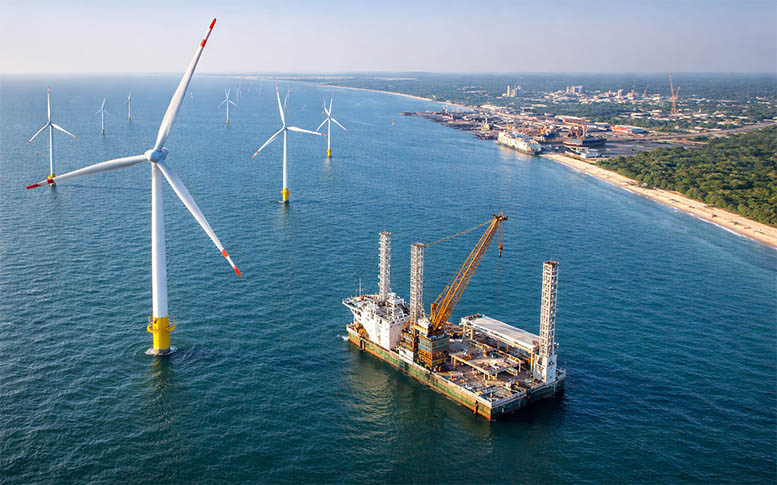
Dakshina Kannada MP Capt Brijesh Chowta has urged the Centre to give high priority to offshore wind energy generation along the Mangaluru coast, citing its strategic importance to India’s green energy and port-led development goals.

Raising the issue in the Lok Sabha under Rule 377, Chowta said studies by the National Institute of Oceanography have identified the Mangaluru coastline as part of India’s promising offshore wind ‘Zone-2’, covering nearly 6,490 sq km. He noted that the region’s relatively low exposure to cyclones and earthquakes makes it suitable for long-term offshore wind projects and called for its development as a dedicated offshore wind energy zone.

Highlighting the role of New Mangalore Port, Chowta said its modern infrastructure, multiple berths and heavy cargo-handling capacity position it well as a logistics hub for transporting and assembling large wind energy equipment.

He also pointed to the presence of major industrial units such as MRPL, OMPL, UPCL and the Mangaluru SEZ, which could serve as direct buyers of green power through power purchase agreements, improving project viability and speeding up execution.

With Karnataka’s peak power demand crossing 18,000 MW in early 2025, Chowta stressed the need to diversify renewable energy sources. He added that offshore wind projects in the Arabian Sea are strategically safer compared to the cyclone-prone Bay of Bengal.

Calling the project vital to India’s target of 500 GW of renewable energy by 2030, Chowta urged the Ministry of New and Renewable Energy to initiate resource assessments, pilot projects and stakeholder consultations at the earliest.

Comments

Add new comment

  • Coastaldigest.com reserves the right to delete or block any comments.
  • Coastaldigset.com is not responsible for its readers’ comments.
  • Comments that are abusive, incendiary or irrelevant are strictly prohibited.
  • Please use a genuine email ID and provide your name to avoid reject.
News Network
February 1,2026

Bengaluru, Feb 1: For travelers landing at Kempegowda International Airport (KIA), the sleek, wood-paneled curves of Terminal 2 promise a world-class welcome. But the famed “Garden City” charm quickly withers at the curb. As India’s aviation sector swells to record numbers—handling over 43 million passengers in Bengaluru alone this past year—the “last mile” has turned into a marathon of frustration.

The Bengaluru Logjam: Rules vs Reality

While the city awaits the 2027 completion of the Namma Metro Blue Line, the interim has been chaotic. Recent “decongestion” rules at Terminal 1 have pushed app-based cab pickups to distant parking zones, forcing weary passengers into a 20-minute walk with luggage.

“I landed after ten months away and felt like a stranger in my own city,” says Ruchitha Jain, a Koramangala resident. “My driver couldn’t find me, staff couldn’t guide me, and the so-called ‘Premium’ lane is just a fancy tax on convenience.”

•    The Cost of Distance: A 40-km cab ride can now easily cross ₹1,500, driven by demand pricing and airport surcharges.

•    The Bus Gap: While Vayu Vajra remains a lifeline, its ₹300–₹400 fare is often cited as the most expensive airport bus service in the country.

A National Pattern of Disconnect

The struggle is not unique to Karnataka. From Chennai’s coast to Hyderabad’s plateau, India’s airports tell a familiar story: brilliant runways, broken exits.

City:    Primary Issue   |    Recent Development

Bengaluru:    Cab pickup restrictions & distance  |    App-based taxis shifted to far parking zones; long walks and fare spikes reported

Chennai:    Multi-Level Parking (MLCP) hike  |    Passengers report 40-minute walks to reach cab pickup points

Hyderabad:    “Taxi mafia” & touting  |    Over 440 touting cases reported; security presence intensified

Mumbai:    Fare scams  |     Tourists charged ₹18,000 for just 400 metres, triggering police action

In Hyderabad, travelers continue to battle entrenched local groups that intimidate Uber and Ola drivers, pushing passengers toward overpriced private taxis. Chennai flyers, meanwhile, complain that reaching the designated pickup zones now takes longer than short-haul flights from cities like Coimbatore.

The ‘Budget Day’ Hope

As Finance Minister Nirmala Sitharaman presents the Union Budget 2026 today, the aviation sector is watching closely. With the government’s renewed emphasis on multimodal integration, there is cautious hope for funding toward seamless airport-metro-bus hubs.

The vision is clear: a future where planes, trains, and metros speak the same language. Until then, passengers at KIA—and airports across India—will continue to discover that the hardest part of flying isn’t the thousands of kilometres in the air, but the last few on the ground.

Comments

Add new comment

  • Coastaldigest.com reserves the right to delete or block any comments.
  • Coastaldigset.com is not responsible for its readers’ comments.
  • Comments that are abusive, incendiary or irrelevant are strictly prohibited.
  • Please use a genuine email ID and provide your name to avoid reject.
News Network
January 23,2026

oscar.jpg

The Voice of Hind Rajab, inspired by the tragic final moments of a young Palestinian girl killed by Israeli fire in Gaza, has been nominated for an Academy Award in the Best International Feature Film category.

Directed by Tunisian filmmaker Kaouther Ben Hania, the film recounts the true story of five-year-old Hind Rajab, who lost her life in January 2024 while fleeing Israeli bombardment with her family.

The film features the real audio of Hind’s desperate call to the Palestinian Red Crescent Society, where she pleaded for help moments before the vehicle she was in was struck by 355 bullets.

The haunting narrative begins with a brief call made from the besieged Tel al-Hawa neighborhood of Gaza, where gunfire and armored vehicles drowned out every sound.

After witnessing the brutal killing of her family, she made a trembling call, her voice reduced to a whisper as she spoke of the massacre and her unbearable loneliness as the sole survivor.

Premiering at the Venice International Film Festival in September 2025, The Voice of Hind Rajab garnered widespread acclaim, receiving a record-setting 23-minute standing ovation and the Silver Lion Grand Jury Prize, the festival’s second-highest honor.

In her acceptance speech, Ben Hania dedicated the film to humanitarian workers and first responders in Gaza, emphasizing that Hind's voice symbolizes countless civilians affected by war.

She aims to give voice to victims often reduced to mere statistics, highlighting the broader suffering of civilians in war zones.

The film’s Oscar nomination underscores its powerful storytelling and ethical approach to depicting real-life tragedy, making it a crucial piece of contemporary cinema.

It serves not only as a narration of individual tragedy but also as an artistic and documentary response to the silence and censorship that often overshadow West Asian struggles and wars.

Using an innovative method she calls docufiction, Ben Hania bridges unvarnished reality and narrative structure, creating a work that is both artistically valuable and socially impactful.

Born in 1977 in Sidi Bouzid—later the epicenter of the Arab revolution—her background profoundly influenced her worldview and artistic approach.

She is a graduate of the Higher School of Audiovisual Arts of Tunis, Pantheon-Sorbonne University, and La Fémis in Paris, where her studies equipped her with the technical and theoretical tools needed to address complex subjects. 

Comments

Add new comment

  • Coastaldigest.com reserves the right to delete or block any comments.
  • Coastaldigset.com is not responsible for its readers’ comments.
  • Comments that are abusive, incendiary or irrelevant are strictly prohibited.
  • Please use a genuine email ID and provide your name to avoid reject.