Brunei introduces stoning to death for gay sex,adultery

Agencies
April 3, 2019

Brunei, Apr 3: Brunei on Wednesday introduced harsh new sharia laws, including death by stoning for adultery and gay sex, despite a storm of global criticism from politicians, celebrities and rights groups.
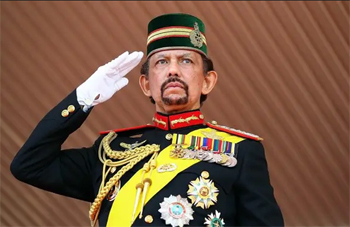
The tough penal code in the tiny country on tropical Borneo island -- ruled by the all-powerful Sultan Hassanal Bolkiah -- fully came into force following years of delays.

The laws, which also include amputation of hands and feet for thieves, make Brunei the first place in East or Southeast Asia to have a sharia penal code at the national level, joining several mostly Middle Eastern countries such as Saudi Arabia.

Rape and robbery are also punishable by death under the code and many of the new laws, such as capital punishment for insulting the Prophet Mohammed, apply to non-Muslims as well as Muslims.

The decision to push ahead with the punishments has sparked alarm around the world, with the United Nations labelling them "cruel and inhumane" and celebrities, led by actor George Clooney and pop star Elton John, calling for Brunei-owned hotels to be boycotted.

In a public address to mark a special date in the Muslim calendar, the sultan called for stronger Islamic teachings but did not mention the new penal code.

"I want to see Islamic teachings in this country grow stronger," he said in the nationally televised speech at a convention centre near the capital Bandar Seri Begawan.

The sultan, who has been on the throne for over five decades, also insisted that Brunei was a "fair" country and the environment for visitors was "safe and harmonious".

Government officials later confirmed the laws had entered into force.

The sharia laws have triggered worldwide condemnation, and Phil Robertson, deputy Asia director at Human Rights Watch, described the code as "barbaric to the core, imposing archaic punishments for acts that shouldn't even be crimes".

The European Union said in a statement that some of the new punishments "amount to torture, acts of cruel, inhuman or degrading treatment".

They are particularly upsetting for the country's small lesbian, gay, bisexual and transgender (LGBT) community. Before the new laws, sex between men was already illegal in Brunei and punishable with up to 10 years in jail.

But the new code stipulates death by stoning as a punishment for sex between men, while women convicted of having sexual relations with other women face up to 40 strokes of the cane or a maximum 10-year jail term.

A 33-year-old gay Bruneian man, who spoke anonymously, said the new laws were "unfair, cruel and should not happen".

"It really takes away my happiness and freedom to express myself, and depresses me so much," he told AFP.

Zulhelmi bin Mohamad, a transgender woman who fled Brunei last year and is seeking asylum in Canada, told AFP that the environment will be more terrifying for the country's LGBT community, who were already leading "very secretive" lives.

"Some worry a lot and would like to escape the country before they are found out not to be... heterosexual," the 19-year-old said.

Confirming the new penal code was now in force, a religious affairs ministry official told AFP: "The statement from the prime minister's office last weekend on (the code's) implementation prevails, hence (April 3) marks the date of its implementation."

A second government official, speaking anonymously, confirmed it had entered into force.

The sultan -- who is one of the world's wealthiest men and lives in a vast, golden-domed palace -- announced plans for the code in 2013.

The first section was introduced in 2014 and included less stringent penalties, such as fines or jail terms for offences including indecent behaviour or skipping Friday prayers.

Clooney's call to boycott nine Brunei-owned hotels in Europe and the United States last week catapulted the issue into the international headlines.

Since then, a series of well-known figures have lined up to add their names to the chorus of condemnation.

The sultan, who is the world's second-longest reigning monarch, first called for the penal code in the late 1990s and it appears to enjoy broad support in the former British protectorate of about 400,000 people.

Analysts say he is seeking to burnish his Islamic credentials and shore up support among the country's conservatives due to the waning fortunes of the oil-dependent economy, which has been ravaged by recession in recent years.

It is also unclear whether death by stoning will actually be implemented, as a high burden of proof is needed to hand down the punishment and Brunei has not executed anyone for decades.

Comments

Add new comment

  • Coastaldigest.com reserves the right to delete or block any comments.
  • Coastaldigset.com is not responsible for its readers’ comments.
  • Comments that are abusive, incendiary or irrelevant are strictly prohibited.
  • Please use a genuine email ID and provide your name to avoid reject.
News Network
February 1,2026

Bengaluru, Feb 1: For travelers landing at Kempegowda International Airport (KIA), the sleek, wood-paneled curves of Terminal 2 promise a world-class welcome. But the famed “Garden City” charm quickly withers at the curb. As India’s aviation sector swells to record numbers—handling over 43 million passengers in Bengaluru alone this past year—the “last mile” has turned into a marathon of frustration.

The Bengaluru Logjam: Rules vs Reality

While the city awaits the 2027 completion of the Namma Metro Blue Line, the interim has been chaotic. Recent “decongestion” rules at Terminal 1 have pushed app-based cab pickups to distant parking zones, forcing weary passengers into a 20-minute walk with luggage.

“I landed after ten months away and felt like a stranger in my own city,” says Ruchitha Jain, a Koramangala resident. “My driver couldn’t find me, staff couldn’t guide me, and the so-called ‘Premium’ lane is just a fancy tax on convenience.”

•    The Cost of Distance: A 40-km cab ride can now easily cross ₹1,500, driven by demand pricing and airport surcharges.

•    The Bus Gap: While Vayu Vajra remains a lifeline, its ₹300–₹400 fare is often cited as the most expensive airport bus service in the country.

A National Pattern of Disconnect

The struggle is not unique to Karnataka. From Chennai’s coast to Hyderabad’s plateau, India’s airports tell a familiar story: brilliant runways, broken exits.

City:    Primary Issue   |    Recent Development

Bengaluru:    Cab pickup restrictions & distance  |    App-based taxis shifted to far parking zones; long walks and fare spikes reported

Chennai:    Multi-Level Parking (MLCP) hike  |    Passengers report 40-minute walks to reach cab pickup points

Hyderabad:    “Taxi mafia” & touting  |    Over 440 touting cases reported; security presence intensified

Mumbai:    Fare scams  |     Tourists charged ₹18,000 for just 400 metres, triggering police action

In Hyderabad, travelers continue to battle entrenched local groups that intimidate Uber and Ola drivers, pushing passengers toward overpriced private taxis. Chennai flyers, meanwhile, complain that reaching the designated pickup zones now takes longer than short-haul flights from cities like Coimbatore.

The ‘Budget Day’ Hope

As Finance Minister Nirmala Sitharaman presents the Union Budget 2026 today, the aviation sector is watching closely. With the government’s renewed emphasis on multimodal integration, there is cautious hope for funding toward seamless airport-metro-bus hubs.

The vision is clear: a future where planes, trains, and metros speak the same language. Until then, passengers at KIA—and airports across India—will continue to discover that the hardest part of flying isn’t the thousands of kilometres in the air, but the last few on the ground.

Comments

Add new comment

  • Coastaldigest.com reserves the right to delete or block any comments.
  • Coastaldigset.com is not responsible for its readers’ comments.
  • Comments that are abusive, incendiary or irrelevant are strictly prohibited.
  • Please use a genuine email ID and provide your name to avoid reject.
News Network
January 31,2026

trumpkill.jpg

The US Department of Justice has released millions of new documents linked to the case of convicted child sex offender Jeffrey Epstein, before removing some pages that contained complaints mentioning President Donald Trump.

Deputy Attorney General Todd Blanche said on Friday that approximately 3.5 million files were published to comply with the Epstein Transparency Act, following criticism that the administration had missed a December 19 deadline set by Congress.

The documents include FBI communications and complaints submitted as tips, some of which list comments mentioning Trump and others who had social or professional ties to Epstein.

Trump has repeatedly denied any wrongdoing in relation to his past association with Epstein.

Pages removed from DOJ website

After their publication, pages containing complaints that mentioned Trump were removed from the DOJ website and now return a “page not found” message. Copies of the documents, however, have circulated widely on social media. CNN anchor Jake Tapper was among those who publicly noted that the pages had been taken down.

One complaint, filed by a friend of a victim, says Trump forced a girl aged 13–14 to perform “oral sex” approximately 35 years ago in New Jersey. The document states that an investigator was sent to Washington to conduct an interview.

Another complaint says Trump regularly paid an individual to perform sexual acts and adds that he was present when her newborn child was murdered by a relative. The paperwork notes that there was “no contact made” with the complainant.

A separate complaint, which provided no contact information, said “calendar girls” parties at Trump’s Mar-a-Lago involved children and sexual abuse. The document also names several public figures as present at such events.

In another account, a complainant said they witnessed a “sex trafficking ring” at Trump National Golf Club in Rancho Palos Verdes, California, in the mid-1990s. The person noted “threats” from Trump’s head of security if she spoke publicly about what she had seen.

Other figures mentioned in the files

The latest release also includes a draft email Epstein wrote to himself in 2013, referring to Microsoft co-founder Bill Gates. In the message, Epstein said Gates asked him to delete emails and referenced “personal matters.”

The DOJ has not provided a detailed explanation for why certain pages were removed after publication. The department said the document release was ongoing.

Comments

Add new comment

  • Coastaldigest.com reserves the right to delete or block any comments.
  • Coastaldigset.com is not responsible for its readers’ comments.
  • Comments that are abusive, incendiary or irrelevant are strictly prohibited.
  • Please use a genuine email ID and provide your name to avoid reject.
News Network
January 20,2026

iran.jpg

Iranian security and intelligence forces have captured more than 470 individuals in three provinces, identified as key figures behind the recent wave of violent unrest and terrorist activities linked to foreign-backed networks.

The Intelligence Ministry's provincial office in Khorasan Razavi announced on Monday the arrest of 192 armed terrorists, identified as the main agents behind recent riots in the region. 

According to an official statement, the detainees were involved in the killing of several security personnel and civilians, setting fire to mosques, public service facilities, and buses, as well as attacks on military and law enforcement centers.

The seized items from the group include several bulletproof vests, Kalashnikov rifles, hunting weapons, Winchester rifles, and various cold weapons such as daggers, swords, brass knuckles, tactical knives, crossbows, and chains.

Evidence indicates that some of the individuals were tied to hostile movements and terrorist organizations, with links overseas. Others were identified as members of violent criminal gangs, actively taking part in the unrest alongside their associates.

Simultaneously, in the western province of Lorestan, the IRGC announced the arrest of 134 individuals as the main leaders and influential field agents of a US-Israeli terrorist network.

The IRGC statement stated that these individuals formed terrorist cells during the recent unrest, committing "Daesh-like" acts.

They wounded security forces with firearms and cold weapons, and burned and destroyed public and private properties, including mosques, shops, banks, and private and public vehicles.

In the northwestern province of Zanjan, the police reported detaining 150 people identified as principal leaders and agents behind recent riots.

Authorities noted that these individuals were responsible for destroying public and private property and intentionally setting fire to vehicles in the province's squares.

Their crimes include shedding the blood of innocent people, destroying public and private property, attempting to enter military sites, disrupting public order, and spreading terror among citizens.

A variety of cold weapons were reportedly seized from the detainees.

What began late last month as peaceful protests over economic hardship across Iran turned violent after public statements by US and Israeli regime figures encouraged vandalism and disorder.

During the unrest, foreign-backed mercenaries rampaged through cities, killing security forces and civilians and damaging public property.

Comments

Add new comment

  • Coastaldigest.com reserves the right to delete or block any comments.
  • Coastaldigset.com is not responsible for its readers’ comments.
  • Comments that are abusive, incendiary or irrelevant are strictly prohibited.
  • Please use a genuine email ID and provide your name to avoid reject.