



Brunei introduces stoning to death for gay sex,adultery

Agencies
April 3, 2019

Brunei, Apr 3: Brunei on Wednesday introduced harsh new sharia laws, including death by stoning for adultery and gay sex, despite a storm of global criticism from politicians, celebrities and rights groups.
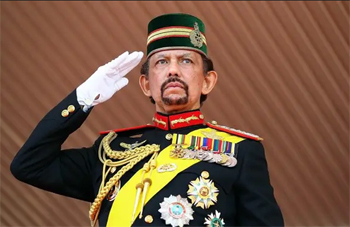
The tough penal code in the tiny country on tropical Borneo island -- ruled by the all-powerful Sultan Hassanal Bolkiah -- fully came into force following years of delays.

The laws, which also include amputation of hands and feet for thieves, make Brunei the first place in East or Southeast Asia to have a sharia penal code at the national level, joining several mostly Middle Eastern countries such as Saudi Arabia.

Rape and robbery are also punishable by death under the code and many of the new laws, such as capital punishment for insulting the Prophet Mohammed, apply to non-Muslims as well as Muslims.

The decision to push ahead with the punishments has sparked alarm around the world, with the United Nations labelling them "cruel and inhumane" and celebrities, led by actor George Clooney and pop star Elton John, calling for Brunei-owned hotels to be boycotted.

In a public address to mark a special date in the Muslim calendar, the sultan called for stronger Islamic teachings but did not mention the new penal code.

"I want to see Islamic teachings in this country grow stronger," he said in the nationally televised speech at a convention centre near the capital Bandar Seri Begawan.

The sultan, who has been on the throne for over five decades, also insisted that Brunei was a "fair" country and the environment for visitors was "safe and harmonious".

Government officials later confirmed the laws had entered into force.

The sharia laws have triggered worldwide condemnation, and Phil Robertson, deputy Asia director at Human Rights Watch, described the code as "barbaric to the core, imposing archaic punishments for acts that shouldn't even be crimes".

The European Union said in a statement that some of the new punishments "amount to torture, acts of cruel, inhuman or degrading treatment".

They are particularly upsetting for the country's small lesbian, gay, bisexual and transgender (LGBT) community. Before the new laws, sex between men was already illegal in Brunei and punishable with up to 10 years in jail.

But the new code stipulates death by stoning as a punishment for sex between men, while women convicted of having sexual relations with other women face up to 40 strokes of the cane or a maximum 10-year jail term.

A 33-year-old gay Bruneian man, who spoke anonymously, said the new laws were "unfair, cruel and should not happen".

"It really takes away my happiness and freedom to express myself, and depresses me so much," he told AFP.

Zulhelmi bin Mohamad, a transgender woman who fled Brunei last year and is seeking asylum in Canada, told AFP that the environment will be more terrifying for the country's LGBT community, who were already leading "very secretive" lives.

"Some worry a lot and would like to escape the country before they are found out not to be... heterosexual," the 19-year-old said.

Confirming the new penal code was now in force, a religious affairs ministry official told AFP: "The statement from the prime minister's office last weekend on (the code's) implementation prevails, hence (April 3) marks the date of its implementation."

A second government official, speaking anonymously, confirmed it had entered into force.

The sultan -- who is one of the world's wealthiest men and lives in a vast, golden-domed palace -- announced plans for the code in 2013.

The first section was introduced in 2014 and included less stringent penalties, such as fines or jail terms for offences including indecent behaviour or skipping Friday prayers.

Clooney's call to boycott nine Brunei-owned hotels in Europe and the United States last week catapulted the issue into the international headlines.

Since then, a series of well-known figures have lined up to add their names to the chorus of condemnation.

The sultan, who is the world's second-longest reigning monarch, first called for the penal code in the late 1990s and it appears to enjoy broad support in the former British protectorate of about 400,000 people.

Analysts say he is seeking to burnish his Islamic credentials and shore up support among the country's conservatives due to the waning fortunes of the oil-dependent economy, which has been ravaged by recession in recent years.

It is also unclear whether death by stoning will actually be implemented, as a high burden of proof is needed to hand down the punishment and Brunei has not executed anyone for decades.

Comments

Add new comment

  • Coastaldigest.com reserves the right to delete or block any comments.
  • Coastaldigset.com is not responsible for its readers’ comments.
  • Comments that are abusive, incendiary or irrelevant are strictly prohibited.
  • Please use a genuine email ID and provide your name to avoid reject.
News Network
January 20,2026

Mangaluru: In a major step towards strengthening rural innovation, the Office of the Principal Scientific Adviser (PSA) to the Government of India is supporting the establishment of RuTAGe Smart Village Centres (RSVCs) across the country through collaborations with academic institutions, civil society organisations and philanthropic partners.

As part of this national initiative, Nitte (Deemed to be University) will set up the first RSVCs in the region at Nitte GP in Udupi district and at the Nitte Health Centre, Sevanjali Trust, Farangipete, in Dakshina Kannada district. The centres will be inaugurated on January 21. In South India, the programme is being implemented by the Section Infin-8 Foundation (SI-8).

Speaking to reporters on Monday, SI-8 founder-director Vishwas US said experts from Nitte University and SI-8 would work closely with farmers, students, youth and local entrepreneurs to adapt and deploy technologies tailored to local needs.

Project head Prof Iddya Karunasagar, representing Nitte DU, said the RSVCs at Nitte and Farangipete would serve as demonstration hubs for a wide range of agriculture, energy, skill-development and assistive technologies. These include solar dryers for fruits, vegetables and crops; soil-testing solutions; power weeders and women-friendly farm tools; wind-powered devices for rural artisans; grain storage systems; grass-cutting and tree-climbing equipment; and liquid fertiliser production using cowshed waste.

SI-8 CEO Aravind C Kumar said the centres would also provide access to digital and knowledge-based platforms such as ISRO applications, government scheme portals, market linkage tools and gamified learning resources, along with assistive technologies for persons with visual impairments.

Highlighting the broader impact of the initiative, Principal Scientific Adviser Prof Ajay Kumar Sood said it demonstrated how applied research could bridge the rural–urban divide and help create self-reliant, technology-enabled villages.

The initiative has been made possible through philanthropic support from Dr NC Murthy of ACM Business Solutions, LLC, USA. Dr Sapna Poti, Director (Strategic Alliances) at the Office of the Principal Scientific Adviser, said the long-term objective is to build self-sufficient, technology-driven communities capable of generating sustainable livelihoods on their own.

Comments

Add new comment

  • Coastaldigest.com reserves the right to delete or block any comments.
  • Coastaldigset.com is not responsible for its readers’ comments.
  • Comments that are abusive, incendiary or irrelevant are strictly prohibited.
  • Please use a genuine email ID and provide your name to avoid reject.
News Network
January 23,2026

Karnataka Governor Thaawarchand Gehlot read only three lines from the 122-paragraph address prepared by the Congress-led state government while addressing the joint session of the Legislature on Thursday, effectively bypassing large sections critical of the BJP-led Union government.

The omitted portions of the customary Governor’s address outlined what the state government described as a “suppressive situation in economic and policy matters” under India’s federal framework. The speech also sharply criticised the Centre’s move to replace the Mahatma Gandhi National Rural Employment Guarantee Act (MGNREGA) with the Viksit Bharat–Guarantee for Rozgar and Ajeevika Mission (Gramin) Act, commonly referred to as the VB-GRAM (G) Act.

Governor Gehlot had earlier conveyed his objection to several paragraphs that were explicitly critical of the Union government. On Thursday, he confined himself to the opening lines — “I extend a warm welcome to all of you to the joint session of the State legislature. I am extremely pleased to address this august House” — before jumping directly to the concluding sentence of the final paragraph.

He ended the address by reading the last line of paragraph 122: “Overall, my government is firmly committed to doubling the pace of the State’s economic, social and physical development. Jai Hind — Jai Karnataka.”

According to the prepared speech, the Karnataka government demanded the scrapping of the VB-GRAM (G) Act, describing it as “contractor-centric” and detrimental to rural livelihoods, and called for the full restoration of MGNREGA. The state government argued that the new law undermines decentralisation, weakens labour protections, and centralises decision-making in violation of constitutional norms.

Key points from the unread sections of the speech:

•    Karnataka facing a “suppressive” economic and policy environment within the federal system

•    Repeal of MGNREGA described as a blow to rural livelihoods

•    VB-GRAM (G) Act accused of protecting corporate and contractor interests

•    New law alleged to weaken decentralised governance

•    Decision-making said to be imposed by the Centre without consulting states

•    Rights of Adivasis, women, backward classes and agrarian communities curtailed

•    Labourers allegedly placed under contractor control

•    States facing mounting fiscal stress due to central policies

•    VB-GRAM (G) Act accused of enabling large-scale corruption

Comments

Add new comment

  • Coastaldigest.com reserves the right to delete or block any comments.
  • Coastaldigset.com is not responsible for its readers’ comments.
  • Comments that are abusive, incendiary or irrelevant are strictly prohibited.
  • Please use a genuine email ID and provide your name to avoid reject.
News Network
January 20,2026

iran.jpg

Iranian security and intelligence forces have captured more than 470 individuals in three provinces, identified as key figures behind the recent wave of violent unrest and terrorist activities linked to foreign-backed networks.

The Intelligence Ministry's provincial office in Khorasan Razavi announced on Monday the arrest of 192 armed terrorists, identified as the main agents behind recent riots in the region. 

According to an official statement, the detainees were involved in the killing of several security personnel and civilians, setting fire to mosques, public service facilities, and buses, as well as attacks on military and law enforcement centers.

The seized items from the group include several bulletproof vests, Kalashnikov rifles, hunting weapons, Winchester rifles, and various cold weapons such as daggers, swords, brass knuckles, tactical knives, crossbows, and chains.

Evidence indicates that some of the individuals were tied to hostile movements and terrorist organizations, with links overseas. Others were identified as members of violent criminal gangs, actively taking part in the unrest alongside their associates.

Simultaneously, in the western province of Lorestan, the IRGC announced the arrest of 134 individuals as the main leaders and influential field agents of a US-Israeli terrorist network.

The IRGC statement stated that these individuals formed terrorist cells during the recent unrest, committing "Daesh-like" acts.

They wounded security forces with firearms and cold weapons, and burned and destroyed public and private properties, including mosques, shops, banks, and private and public vehicles.

In the northwestern province of Zanjan, the police reported detaining 150 people identified as principal leaders and agents behind recent riots.

Authorities noted that these individuals were responsible for destroying public and private property and intentionally setting fire to vehicles in the province's squares.

Their crimes include shedding the blood of innocent people, destroying public and private property, attempting to enter military sites, disrupting public order, and spreading terror among citizens.

A variety of cold weapons were reportedly seized from the detainees.

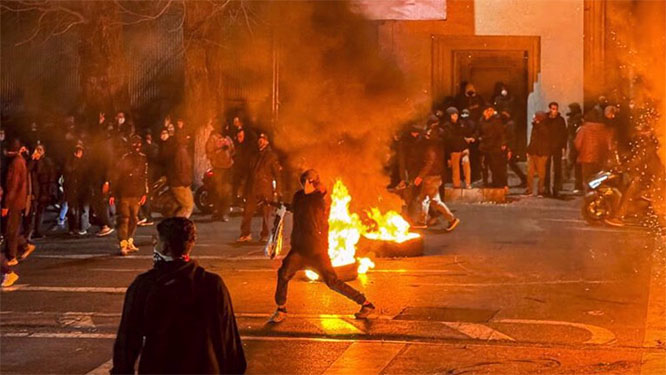
What began late last month as peaceful protests over economic hardship across Iran turned violent after public statements by US and Israeli regime figures encouraged vandalism and disorder.

During the unrest, foreign-backed mercenaries rampaged through cities, killing security forces and civilians and damaging public property.

Comments

Add new comment

  • Coastaldigest.com reserves the right to delete or block any comments.
  • Coastaldigset.com is not responsible for its readers’ comments.
  • Comments that are abusive, incendiary or irrelevant are strictly prohibited.
  • Please use a genuine email ID and provide your name to avoid reject.