To build trust, Modi, Xi agree to issue 'strategic guidance' to their militaries

Agencies
April 28, 2018

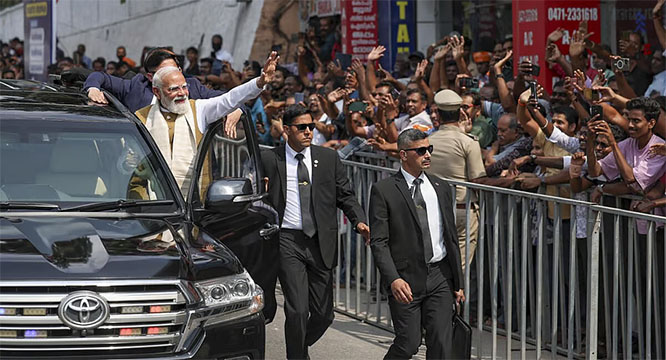
Wuhan, Apr 28: Prime Minister Narendra Modi and Chinese President Xi Jinping have decided to issue "strategic guidance" to their militaries to strengthen communications and to build trust and understanding, a move aimed at avoiding a Dokalam-like situation in the future.

Modi said his talks with President Xi focussed on diverse areas of India-China cooperation. "We discussed ways to give impetus to our economic ties as well as people-to-people relations. Other areas we spoke about include agriculture, technology, energy and tourism," he said.

Briefing reporters at the end of the two-day informal summit between the two leaders in Wuhan on Saturday, Foreign Secretary Vijay Gokhale said the two leaders underscored the importance of maintaining peace and tranquillity in all areas of the India-China border region.

"To this end, they issued strategic guidance to their respective militaries to strengthen communication in order to build trust and mutual understanding and enhance predictability and effectiveness in the management of border affairs," Gokhale said.

The foreign secretary said the two leaders further directed their militaries to earnestly implement various Confidence Building Measures (CBMs) agreed upon between the two sides, including the principle of mutual and equal security, and strengthen existing institutional arrangements and information sharing mechanisms to prevent incidents in border regions.

They also endorsed the work of the special representatives to find a fair, reasonable and mutually acceptable settlement on the boundary issue.

The two countries have so far held 20 rounds of talks to resolve the boundary dispute and worked out different mechanisms to maintain peace along the 3,488-km long Line of Actual Control.

The remarks assume significance as the "heart-to-heart" summit between Modi and Xi is being seen as an effort by India and China to rebuild trust and improve ties that were hit by the 73-day-long Dokalam standoff last year.

"The two leaders were of the view that the two countries have the maturity and wisdom to handle all our differences through peaceful discussions within the context of the overall relationships and bearing in mind, we would respect each other's sensitivities, concerns and aspirations," Gokhale said.

Modi and Xi underlined that as two major countries, India and China have wider and overlapping regional and global interests. They agreed on the need to strengthen strategic communication through greater consultation on all matters of common interest.
 
"They believe that such strategic communication will have a positive influence on enhancing mutual understanding and will contribute to regional and global stability," Gokhale said.

The two leaders recognised the common threat posed by terrorism and committed to cooperate further on counter-terrorism, he said.

When asked whether the issue of Jaish-e-Mohammad chief Masood Azhar was raised, Gokhale said the two leaders "did not go into specifics". China has repeatedly blocked India's bid to designate Azhar as a global terrorist by the United Nations.

The two leaders agreed that India and China are major powers, with strategic and decisional autonomy, and they will pursue peaceful, stable and balanced relations. Such a relationship will be a positive factor for stability amid the current global uncertainties, Gokhale said amid increasing protectionist moves by countries like the US.

"The developments were reviewed from the strategic and long-term perspective. A number of areas where we have conversions were identified, and it was decided that through the established mechanisms, we have about 20 such mechanisms at various levels, through such established mechanisms we would try and build this conversation," Gokhale said.

The two leaders underlined that trade should be balanced, it should be sustainable, and that the two sides should take advantage of the complementarities between the two economies.
Modi also mentioned the importance of balancing trade and the scope of the possibilities of agricultural exports and pharmaceutical exports to China.

The two sides also discussed climate change, sustainable development and food security. Xi shared his experience in terms of the preservation of the Yangtze - China's longest river - and Modi shared his own experience on the question of the cleaning of the Ganga - India's longest river.

They also discussed how to promote sports between the two countries and how to strengthen tourism on the Buddhist circuit.

"They reiterated the importance of building an open, multi-polar, pluralist and participatory global economic order which will enable all countries to pursue their development and contribute to the elimination of poverty and inequality in all regions of the world. They spoke of their respective efforts to contribute to the regional and global economic development," Gokhale said.

"The forward-looking dialogue helped them in forging a common understanding of the future direction of India-China relations built upon mutual respect for each other's developmental aspirations and prudent management of differences with mutual sensitivity," Gokhale added.

Comments

Add new comment

  • Coastaldigest.com reserves the right to delete or block any comments.
  • Coastaldigset.com is not responsible for its readers’ comments.
  • Comments that are abusive, incendiary or irrelevant are strictly prohibited.
  • Please use a genuine email ID and provide your name to avoid reject.
News Network
January 23,2026

modIKERALA.jpg

Prime Minister Narendra Modi, during his visit to Thiruvananthapuram on Friday, January 23, indicated that the Bharatiya Janata Party (BJP) is aiming to expand its political footprint in Kerala ahead of the Assembly elections scheduled in the coming months.

Speaking at a BJP-organised public meeting, Modi drew parallels between the party’s early electoral gains in Gujarat and its recent victory in the Thiruvananthapuram Municipal Corporation. The civic body win, which ended decades of Left control, was cited by the Prime Minister as a possible starting point for the party’s broader ambitions in the state.

Recalling BJP’s political trajectory in Gujarat, Modi said the party was largely insignificant before 1987 and received little media attention. He pointed out that the BJP’s first major breakthrough came with its victory in the Ahmedabad Municipal Corporation that year.

“Just as our journey in Gujarat began with one city, Kerala’s journey has also started with a single city,” Modi said, suggesting that the party’s municipal-level success could translate into wider electoral acceptance.

The Prime Minister alleged that successive governments led by the Left Democratic Front (LDF) and the United Democratic Front (UDF) had failed to adequately develop Thiruvananthapuram. He accused both fronts of corruption and neglect, claiming that basic infrastructure and facilities were denied to the capital city for decades.

According to Modi, the BJP’s control of the civic body represents a shift driven by public dissatisfaction with the existing political alternatives. He asserted that the BJP administration in Thiruvananthapuram had begun working towards development, though no specific details or timelines were outlined.

Addressing the gathering at Putharikandam Maidan, Modi said the BJP intended to project Thiruvananthapuram as a “model city,” reiterating his party’s commitment to governance-led change.

The Prime Minister’s visit to Kerala also included the inauguration of several development projects and the flagging off of new train services, as the BJP intensifies its political outreach in the poll-bound state.

Comments

Add new comment

  • Coastaldigest.com reserves the right to delete or block any comments.
  • Coastaldigset.com is not responsible for its readers’ comments.
  • Comments that are abusive, incendiary or irrelevant are strictly prohibited.
  • Please use a genuine email ID and provide your name to avoid reject.
News Network
February 3,2026

manjeshwar.jpg

Kasaragod: An 18-year-old girl was stabbed to death at Thuminad in Manjeshwar panchayat on Monday, allegedly by her father following a domestic dispute. 

The victim has been identified as K U Mariyamath Jumaila. Her father, Umar Farooq, has been taken into police custody, Manjeshwar Station House Officer Inspector Ajith Kumar P said.

According to the police, Umar Farooq had been working in a West Asian country and returned home about three months ago. 

Family tensions reportedly escalated after his wife, Thahira (41), decided to seek a divorce and asked him to leave her life. Kasaragod district panchayat member Harshad Vorkady alleged that Umer was addicted to marijuana and frequently caused disturbances at home.

On Monday, Thahira asked Umar to come to her sister’s house in Thuminad to discuss the dispute. Jumaila accompanied her mother. 

Manjeshwar panchayat member Illiyas Thuminad said Umar arrived along with his brother, following which Thahira handed over gold ornaments and property documents to him and asked him to sever ties with her.

However, the police said a property dispute had been ongoing between Umar Farooq and his sister-in-law’s husband. During a heated argument, Umar allegedly attempted to attack the man with a sharp weapon. When Jumaila intervened to stop the assault, she was stabbed in the neck.

The teenager collapsed after bleeding profusely and was rushed to a private hospital in Mangaluru, where doctors declared her dead. Her body was later shifted to Mangalpady Taluk Hospital for post-mortem examination.

Jumaila was a former student of Sirajul Huda English Medium Higher Secondary School, Manjeshwar. 

Comments

Add new comment

  • Coastaldigest.com reserves the right to delete or block any comments.
  • Coastaldigset.com is not responsible for its readers’ comments.
  • Comments that are abusive, incendiary or irrelevant are strictly prohibited.
  • Please use a genuine email ID and provide your name to avoid reject.
News Network
February 1,2026

Bengaluru, Feb 1: For travelers landing at Kempegowda International Airport (KIA), the sleek, wood-paneled curves of Terminal 2 promise a world-class welcome. But the famed “Garden City” charm quickly withers at the curb. As India’s aviation sector swells to record numbers—handling over 43 million passengers in Bengaluru alone this past year—the “last mile” has turned into a marathon of frustration.

The Bengaluru Logjam: Rules vs Reality

While the city awaits the 2027 completion of the Namma Metro Blue Line, the interim has been chaotic. Recent “decongestion” rules at Terminal 1 have pushed app-based cab pickups to distant parking zones, forcing weary passengers into a 20-minute walk with luggage.

“I landed after ten months away and felt like a stranger in my own city,” says Ruchitha Jain, a Koramangala resident. “My driver couldn’t find me, staff couldn’t guide me, and the so-called ‘Premium’ lane is just a fancy tax on convenience.”

•    The Cost of Distance: A 40-km cab ride can now easily cross ₹1,500, driven by demand pricing and airport surcharges.

•    The Bus Gap: While Vayu Vajra remains a lifeline, its ₹300–₹400 fare is often cited as the most expensive airport bus service in the country.

A National Pattern of Disconnect

The struggle is not unique to Karnataka. From Chennai’s coast to Hyderabad’s plateau, India’s airports tell a familiar story: brilliant runways, broken exits.

City:    Primary Issue   |    Recent Development

Bengaluru:    Cab pickup restrictions & distance  |    App-based taxis shifted to far parking zones; long walks and fare spikes reported

Chennai:    Multi-Level Parking (MLCP) hike  |    Passengers report 40-minute walks to reach cab pickup points

Hyderabad:    “Taxi mafia” & touting  |    Over 440 touting cases reported; security presence intensified

Mumbai:    Fare scams  |     Tourists charged ₹18,000 for just 400 metres, triggering police action

In Hyderabad, travelers continue to battle entrenched local groups that intimidate Uber and Ola drivers, pushing passengers toward overpriced private taxis. Chennai flyers, meanwhile, complain that reaching the designated pickup zones now takes longer than short-haul flights from cities like Coimbatore.

The ‘Budget Day’ Hope

As Finance Minister Nirmala Sitharaman presents the Union Budget 2026 today, the aviation sector is watching closely. With the government’s renewed emphasis on multimodal integration, there is cautious hope for funding toward seamless airport-metro-bus hubs.

The vision is clear: a future where planes, trains, and metros speak the same language. Until then, passengers at KIA—and airports across India—will continue to discover that the hardest part of flying isn’t the thousands of kilometres in the air, but the last few on the ground.

Comments

Add new comment

  • Coastaldigest.com reserves the right to delete or block any comments.
  • Coastaldigset.com is not responsible for its readers’ comments.
  • Comments that are abusive, incendiary or irrelevant are strictly prohibited.
  • Please use a genuine email ID and provide your name to avoid reject.