China questions exclusion from Indo-Pacific group of India, US, Japan and Australia

Agencies
November 13, 2017

Beijing, Nov 13: Skirting any direct response to the first quadrilateral meeting of India, US, Japan and Australia, China on Monday questioned its exclusion from the group.

At the same time, it expressed hope that the new concept of 'Indo-Pacific' is not directed against it.

"The relevant proposals should be open and inclusive and should be conducive to win-win cooperation and avoid politicising or excluding the relevant parties," Chinese Foreign Ministry spokesman Geng Shuang said at a media briefing.

He was answering a spate of questions on the Indo-Pacific concept and the quadrilateral meeting held yesterday in Manila.

Asked whether he meant "exclusion of the relevant parties" referred to omission of China, Geng said China welcomes the development of friendly cooperation between relevant countries.

"We hope this kind of relations will not be directed at a third party and conducive to the regional peace and stability. This is the general concept and I think this kind of position applies to any proposal," he said, PTI reported.

Responding to a question about persistent references of Indo-Pacific by the US and Japan saying that they want to establish leaders' dialogue mechanism between India, US, Japan and Australia and Tokyo's willingness to conduct cooperation with China under the new concept, Geng said China has noted the Japanese statement in this regard.

"Promoting the stability and the development of the Asia Pacific region is the common responsibility of the regional countries. We hope the policies made and the action taken by the relevant parties can correspond with the trend of times featuring, peace, cooperation, friendship and development and can be conducive to upholding peace, prosperity and stability," he said.

Asked how China viewed the Indo-Pacific concept, Geng said peace and win-win cooperation is the trend of the times.

"It is also the trend of the world. The development of Any country, any region should correspond with the trend of the times and trend of the world," he said.

Officials from India, the US, Japan, and Australia on Sunday held extensive talks to pursue common interests in the strategically important Indo-Pacific region.

In the meeting, seen as the first major move in the formation of the quadrilateral security dialogue or 'quad', the officials deliberated on evolving security scenario in the Indo-Pacific region besides delving into effectively combating the threat of terrorism and other security challenges.

The Ministry of External Affairs (MEA) said in a statement that the consultations were held on issues of common interest in the Indo-Pacific region with a focus on cooperation based on converging vision and values for the promotion of peace, stability and prosperity in the area.

Following is the full statement by the MEA:

"Officials from India’s Ministry of External Affairs, Australia’s Department of Foreign Affairs, Japan’s Ministry of Foreign Affairs and United State’s Department of State met in Manila on November 12, 2017 for consultations on issues of common interest in the Indo-Pacific region. The discussions focused on cooperation based on their converging vision and values for promotion of peace, stability and prosperity in an increasingly inter-connected region that they share with each other and with other partners. They agreed that a free, open, prosperous and inclusive Indo-Pacific region serves the long-term interests of all countries in the region and of the world at large. The officials also exchanged views on addressing common challenges of terrorism and proliferation linkages impacting the region as well as on enhancing connectivity. The Indian side highlighted India’s Act East Policy as the cornerstone of its engagement in the Indo-Pacific region."

The move is seen as counter to China's aggressive behaviour in the area.

Meanwhile, a senior White House official had said earlier that "we have strong and growing ties with India. We talk about 'Indo- Pacific' in part because that phrase captures the importance of India's rise".

And the strategy is "certainly not" to contain China, he had added.

Indo-Pacific broadly refers to the Indian Ocean and Pacific Ocean regions, which also includes the disputed South China Sea where Vietnam, Malaysia, the Philippines, and Brunei question China's claims over almost the entire waterway.

The Indo-Pacific concept has figured prominently during the recent visit by President Donald Trump to the region including to Japan and China.

Comments

Add new comment

  • Coastaldigest.com reserves the right to delete or block any comments.
  • Coastaldigset.com is not responsible for its readers’ comments.
  • Comments that are abusive, incendiary or irrelevant are strictly prohibited.
  • Please use a genuine email ID and provide your name to avoid reject.
News Network
February 1,2026

Bengaluru, Feb 1: For travelers landing at Kempegowda International Airport (KIA), the sleek, wood-paneled curves of Terminal 2 promise a world-class welcome. But the famed “Garden City” charm quickly withers at the curb. As India’s aviation sector swells to record numbers—handling over 43 million passengers in Bengaluru alone this past year—the “last mile” has turned into a marathon of frustration.

The Bengaluru Logjam: Rules vs Reality

While the city awaits the 2027 completion of the Namma Metro Blue Line, the interim has been chaotic. Recent “decongestion” rules at Terminal 1 have pushed app-based cab pickups to distant parking zones, forcing weary passengers into a 20-minute walk with luggage.

“I landed after ten months away and felt like a stranger in my own city,” says Ruchitha Jain, a Koramangala resident. “My driver couldn’t find me, staff couldn’t guide me, and the so-called ‘Premium’ lane is just a fancy tax on convenience.”

•    The Cost of Distance: A 40-km cab ride can now easily cross ₹1,500, driven by demand pricing and airport surcharges.

•    The Bus Gap: While Vayu Vajra remains a lifeline, its ₹300–₹400 fare is often cited as the most expensive airport bus service in the country.

A National Pattern of Disconnect

The struggle is not unique to Karnataka. From Chennai’s coast to Hyderabad’s plateau, India’s airports tell a familiar story: brilliant runways, broken exits.

City:    Primary Issue   |    Recent Development

Bengaluru:    Cab pickup restrictions & distance  |    App-based taxis shifted to far parking zones; long walks and fare spikes reported

Chennai:    Multi-Level Parking (MLCP) hike  |    Passengers report 40-minute walks to reach cab pickup points

Hyderabad:    “Taxi mafia” & touting  |    Over 440 touting cases reported; security presence intensified

Mumbai:    Fare scams  |     Tourists charged ₹18,000 for just 400 metres, triggering police action

In Hyderabad, travelers continue to battle entrenched local groups that intimidate Uber and Ola drivers, pushing passengers toward overpriced private taxis. Chennai flyers, meanwhile, complain that reaching the designated pickup zones now takes longer than short-haul flights from cities like Coimbatore.

The ‘Budget Day’ Hope

As Finance Minister Nirmala Sitharaman presents the Union Budget 2026 today, the aviation sector is watching closely. With the government’s renewed emphasis on multimodal integration, there is cautious hope for funding toward seamless airport-metro-bus hubs.

The vision is clear: a future where planes, trains, and metros speak the same language. Until then, passengers at KIA—and airports across India—will continue to discover that the hardest part of flying isn’t the thousands of kilometres in the air, but the last few on the ground.

Comments

Add new comment

  • Coastaldigest.com reserves the right to delete or block any comments.
  • Coastaldigset.com is not responsible for its readers’ comments.
  • Comments that are abusive, incendiary or irrelevant are strictly prohibited.
  • Please use a genuine email ID and provide your name to avoid reject.
coastaldigest.com news network
February 5,2026

protestkerala.jpg

Mangaluru: The KSRTC Mangaluru division has rolled back the fare hike on buses operating on the Mangaluru–Kasaragod route following the suspension of toll collection at the Arikkady toll plaza near Kumbala in Kasaragod district.

The fare revision had been implemented after the National Highways Authority of India (NHAI) began toll collection at the Arikkady plaza on NH-66. As a result, fares for ordinary and Rajahamsa services were increased by ₹7 and ₹10, respectively, raising the bus fare from Mangaluru to Kasaragod from ₹81 to ₹88.

Senior Divisional Controller of KSRTC’s Mangaluru division, Rajesh Shetty, said the fares were reduced after toll collection at the Arikkady plaza was stopped. “The tollgate began operations on January 13, and the toll amount was deducted from the FASTag accounts of KSRTC buses operating on the route. Following an order from the central government to suspend toll collection, KSRTC has also withdrawn the additional fare with immediate effect,” he said.

At present, vehicles travelling on the Mangaluru–Kasaragod route pay toll only at the Talapady toll plaza. The toll for light motor vehicles (LMVs) at Talapady is ₹80 for a same-day return, while heavy vehicles, including buses, are charged ₹250. At Arikkady, the toll rates were ₹130 for LMVs (same-day return) and ₹450 for buses.

Protests against Arikkady toll plaza

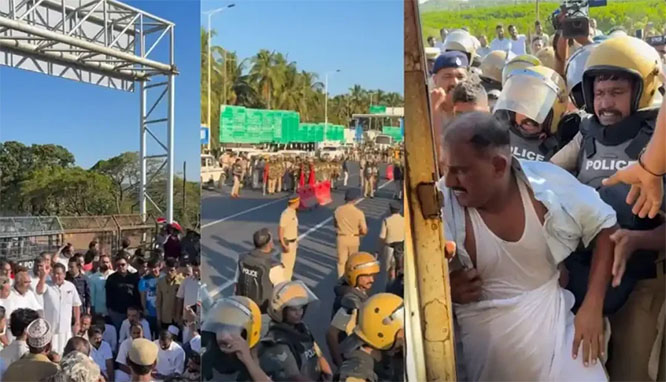
The Arikkady toll plaza witnessed widespread protests from January 12, the day toll collection commenced. On the second day, an action committee led by Manjeshwar MLA A K M Ashraf launched an indefinite protest at the site. Except for the BJP, leaders and workers of most major political parties participated in the agitation.

On the night of January 14, a large number of protesters gathered at the plaza and vandalised property, following which authorities temporarily suspended toll operations. The BJP later also expressed opposition to the toll plaza and criticised NHAI’s decision. 

Comments

Add new comment

  • Coastaldigest.com reserves the right to delete or block any comments.
  • Coastaldigset.com is not responsible for its readers’ comments.
  • Comments that are abusive, incendiary or irrelevant are strictly prohibited.
  • Please use a genuine email ID and provide your name to avoid reject.
News Network
January 28,2026

ajit.jpg

Mumbai: The sudden death of Maharashtra Deputy Chief Minister Ajit Pawar in a plane crash in his hometown of Baramati has plunged the state into political uncertainty, raising a pressing question for both the Nationalist Congress Party (NCP) and its rival faction, the Nationalist Congress Party (Sharadchandra Pawar): what next?

For the two factions that emerged after the dramatic split of June–July 2023, the moment marks their gravest challenge yet. Many believe the answer now rests with party founder Sharad Pawar.

Sharad Pawar, who founded the NCP in 1999 after parting ways with the Congress over Sonia Gandhi’s foreign origin, has already indicated his intention to step away from electoral politics once his Rajya Sabha term ends in April 2026.

Speaking at a public event in Baramati ahead of his 85th birthday on December 12, 2025, Pawar said he would not contest any further elections. “I have contested 14 elections. The younger generation needs to be given an opportunity,” he said, adding that he would decide later whether to seek another Rajya Sabha term.

Often described as the Bhishma Pitamah of Indian politics, Pawar also spoke of his gradual withdrawal from active leadership. “For the first 30 years, I handled everything. For the next 25–30 years, Ajit Dada handled responsibilities. Now, arrangements must be made for new leadership,” he said.

Ajit Pawar’s death has dramatically altered that transition, especially as he was working towards reunifying the two NCP factions.

“After the developments of June–July 2023 and the 2024 Lok Sabha and Vidhan Sabha elections, there were deep changes within the family and the party. In the last six months, serious efforts were made to reunite. Even workers from both sides wanted unity. This is a massive blow,” a Pawar family insider told DH over phone from Baramati.

Electoral outcomes over the past year reflected the split. In the 2024 Lok Sabha elections, NCP (SP) recorded the best strike rate in Maharashtra, winning eight of the 10 seats it contested. The NCP, by contrast, won just one seat out of four.

However, the trend reversed in the subsequent Vidhan Sabha elections, where the NCP emerged stronger, securing 41 of the 288 seats, while NCP (SP) managed only 10.

Within NCP (SP), Sharad Pawar’s daughter Supriya Sule serves as Working President, followed by leaders such as Rohit Pawar, state president Shashikant Shinde and former state chief Jayant Patil.

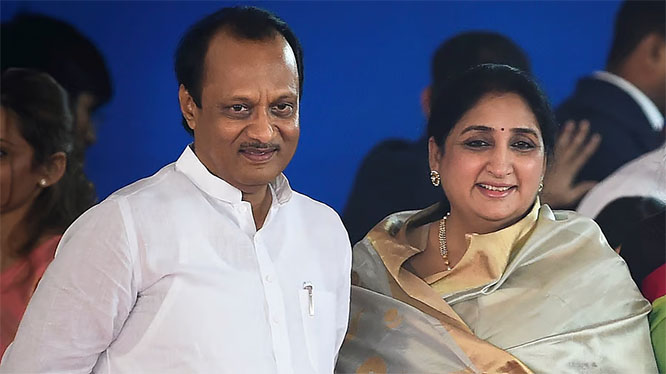
In the NCP, Praful Patel is the Working President and Raigad MP Sunil Tatkare heads the state unit. Ajit Pawar’s wife, Sunetra Pawar, is a Rajya Sabha MP, while their sons Parth and Jay are not actively involved in day-to-day politics. Parth Pawar briefly entered electoral politics in 2019 but lost the Lok Sabha election from Maval. Jay Pawar’s political debut was under consideration.

With Ajit Pawar gone, speculation has intensified that a member of the family may be asked to assume a larger role. For now, Sunetra Pawar is expected to play a key coordinating role in party affairs, alongside Patel and Tatkare.

The NCP continues to have several heavyweight leaders, including Chhagan Bhujbal, Hasan Mushrif, Dattatreya Bharne, Manikrao Kokate and Dhananjay Munde.

Ajit Pawar had already begun steps towards reconciliation between the two factions. While they contested the Pune and Pimpri-Chinchwad municipal elections separately, they later decided to fight the zilla parishad elections together under the ‘clock’ symbol—seen as the first formal step towards reunification.

Nagpur meet and party roadmap

Both NCP factions claim adherence to the ideology of ‘Shiv–Shahu–Phule–Ambedkar’. At the Rashtravadi Chintan Shivir held in Nagpur on September 19, 2025, the NCP reaffirmed its commitment to sarva dharma sambhav and discussed strengthening ties with the BJP “for the welfare and development of Maharashtra”.

In recent days, reports had suggested Ajit Pawar might return to the Maha Vikas Aghadi following the party’s poor performance in Pune municipal elections, but these claims were denied.

Big question for Maha Yuti

Ajit Pawar’s death also presents an immediate challenge for the Devendra Fadnavis-led Maha Yuti government. Pawar held crucial portfolios, including Finance, Planning and Excise. With the Budget Session approaching, appointing a new Finance Minister has become urgent.

Beyond numbers and portfolios, Maha Yuti has lost a swift decision-maker known for his administrative grip and political finesse—leaving a vacuum that will not be easy to fill.

Comments

Add new comment

  • Coastaldigest.com reserves the right to delete or block any comments.
  • Coastaldigset.com is not responsible for its readers’ comments.
  • Comments that are abusive, incendiary or irrelevant are strictly prohibited.
  • Please use a genuine email ID and provide your name to avoid reject.