



Beijing, Aug 1: Chinese President Xi Jinping issued a tough line on national sovereignty on Tuesday amid multiple territorial disputes with his country’s neighbors, saying China will never permit the loss of “any piece” of its land to outsiders.
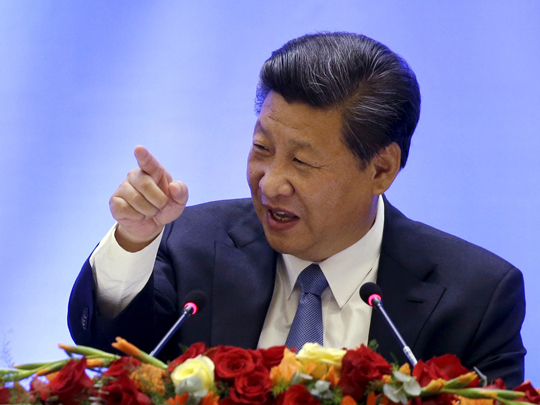
Mr. Xi’s declaration came during a nearly one-hour speech in Beijing marking the 90th anniversary of the founding of the People’s Liberation Army, which has formed a key pillar of support for the ruling Communist Party since 1927 and is the world’s largest standing military, with 2.3 million members.
“The Chinese people treasure peace and we absolutely do not engage in invasion and expansion. However, we have the confidence to conquer all forms of invasion,” Mr. Xi told government leaders and current and retired PLA members gathered at the hulking Great Hall of the People, the seat of the legislature that sits beside Tiananmen Square.
“We absolutely will not permit any person, any organization, any political party at any time, in any form to separate any piece of Chinese territory from China,” Mr. Xi said to applause. “No one should expect us to swallow the bitter fruit of damage to our sovereignty, security and development interests.”
Mr. Xi made no reference to any specific conflicts or disputes during his address, which focused largely on the PLA’s growth from a scrappy guerrilla force fighting Chiang Kai-shek’s Nationalists and Japanese invaders into one of the world’s most powerful, if largely untested, militaries.
China has long been embroiled in a contest with Japan over the East China Sea islands, as well as with five other governments over competing claims to territory in the strategically vital South China Sea. Beijing also threatens to use force to conquer Taiwan if peaceful enticements prove insufficient. China considers the self-governing democratic island its territory.
Mr. Xi also emphasized that the military’s highest loyalty is to the ruling Communist Party, underscoring the PLA’s key role as regime preserver through crises such as the bloody suppression of 1989 pro-democracy protests at Tiananmen Square. Top Chinese leaders have consistently rejected calls to make the PLA loyal to the government and people instead.
“The people’s army will resolutely safeguard the leadership of the Chinese Communist Party and our country’s socialist system, resolutely safeguard national sovereignty, security and development interests, and resolutely safeguard regional and world peace,” Mr. Xi said.
The speech followed a parade on Sunday at a training ground on the edge of the Gobi Desert during which Mr. Xi donned fatigues and declared that the military has the “confidence and capability” to ensure China’s sovereignty, security and national interests.
Mr. Xi, who commands the PLA as chairman of the Central Military Commission, has frequently spoken of his “China Dream” to restore China to a leadership position in international affairs with a modern, far-reaching military force to match.
The parade at the Zhurihe base in Inner Mongolia featured troops and advanced weaponry, and was another forceful indication of Mr. Xi’s iron grip over the PLA and every other political power base within the party ahead of a pivotal congress this autumn that will award him a second five-year term as leader.
That followed similarly high-profile military reviews in Beijing in 2015 and Hong Kong in June. Last week, Mr. Xi bestowed newly created “Aug. 1” honors on servicemen in a further elevation of the armed forces’ stature.
Mr. Xi and his predecessors engineered a radical upgrading of the PLA’s capabilities through years of double-digit percentage increases in the defense budget, making China the world’s second-largest military spender after the United States, although growth has slowed alongside a cooling of the overall economy.
That has also spurred a global role for the PLA, which was formerly overwhelmingly preoccupied with securing China’s territorial integrity.
Alongside its blue water navy, China is building its first overseas military base in the Horn of Africa nation of Djibouti, and Chinese ships held drills last month with Russia’s navy in the Baltic Sea, more than 10,000 km (6,000 miles) from their home ports.


Comments
Add new comment