Online sexual attack against Muslim women: Open letter to CJI

News Network
January 6, 2022

sullibulli.jpg

Request for a Suo motu petition in regard to the unconstitutional, illegal and misogynistic targeting of Muslim women through the SulliDeals and BulliBai Apps.

On the 1st of January, 2022, as the world was sending out celebratory messages to mark the New Year, hundreds of Muslim women woke up to deeply objectionable, obnoxious and misogynistic attack on them via the ‘Bulli Bai App’. Photos of hundreds of Muslim women, including prominent journalists, activists and thinkers, were secured and uploaded without their permission on this app and were subsequently ‘auctioned’.

The Bulli App was hosted at the URL bullibai.github.io. GitHub is platform which hosts websites, with a repository of open-source codes. After much furore, the platform was finally taken down on the morning of 01.01.2022 and the Twitter handle of the Bulli Bai has been suspended. Like ‘Sulli Deals’ the ‘Bulli Bai’ app was also created and used on GitHub. The GitHub platform allows users to create and share apps. While the portal is no longer functional, the offenders continue to walk around scot-free leaving the survivors struggling with their personal identities revealed to millions of social media users who want to buy and sell their bodies. This has rendered them vulnerable in both social media spaces and real world.

This is not the first when such an outrageous public sale of Muslim women’s bodies has taken place openly. In the month of July 2021, a similar App called Sulli Deals app offered photographs of Muslim women as ‘deals.’ for virtual auctions. The perpetrators even had no fear of legal consequences as they publicy declared their intention to launch an application that facilitates the sale of Muslim women. While the very action of downloading and posting pictures and private details of Muslim women, in both instances, was not only non-consensual and in violation of the right to privacy, it was clearly meant to degrade, dehumanize, vilify and demean Muslim women. ‘Auctioning’ women in this manner is a depraved attempt to commodify them and strip them of any personhood or dignity. This is a blatant violation of the very fundamental right to live with dignity and the right to bodily autonomy protected under Article 21 of our Constitution.

However, it is imperative for us to also recognise these repeated attacks on the dignity of Muslim women as a well thought out political strategy by majoritarian forces to systematically isolate Muslims for public harassment and humiliation, and intimidate them into silence. Terms such as ‘Sulli’ and ‘Bulli’ are offensive and derogatory slurs used to specifically insult and denigrate women belonging to the Muslim community and thereby, constitutes hate speech. The public auction of Muslim women is an extreme form of vilification of Muslims reducing them to non-citizens and sub-humans. This only points to the utter moral bankruptcy in our society where communal elements openly target, bully and perpetuate sexual violence against women with alarming impunity. Read along with the public calls for genocide on the streets of Delhi earlier last year, and at the Dharam Sansad in Haridwar more recently, it is evident that instances such as these are carefully strategized hate crimes pushing our country into a dark abyss to which there can be no turning a blind eye to anymore.

Apps such as ‘Sulli deals’ and ‘Bulli Bai’, similarly, perpetuate violence against Muslim women. These apps use pictures and social media accounts of women based on ‘visible indicators’ that establish that they are Muslim, such as their names, usernames, posts, and so on. This is a direct manifestation of the prevalent objectification of Muslim women. These actions, in addition to leading to a severe assault on the dignity of Muslim women, has affected their public participation as well. Many Muslim women were forced to undertake actions such as deleting their pictures and many had to even delete their social media profiles. This has severely limited the participation of Muslim women in online public spaces. State inaction which has allowed this, constitutes a violation of the preambular promise to Equality of Opportunity. Muslims are systematically being denied the opportunity to participate wholly and freely in public life.

Following the attacks against Muslim women on the Sulli Deals App in July, 2021, two FIRs were filed by the Delhi and Uttar Pradesh Police. Both the Delhi Commission for Women (DCW) and the National Commission for Women (NCW) took cognizance of the matter and assured action. Worryingly, nearly six months after the incident was first reported, investigations have made little progress and investigative agencies have not even able to identify the perpetrators of the crime.(1) The callous attitude of the state machinery in addressing the issue has made a complete mockery of the suffering and trauma of the targeted women. As an extension, the deafening silence of the law enforcement agencies in countering repeated communal onslaughts on Muslim women cannot but be seen as an implicit endorsement of such depravity.

The Constitution of India promises every citizen equality and a life of dignity. Nonetheless, routine communal and misogynistic aggressions such as these deprive Muslim women of the most fundamental rights. They compel marginalised women to live in fear and terror in their own country. No civilised society should meekly allow for the targeted harassment, objectification and public auctioning of its women. Given the colossal failure of the state machinery in adequately responding to such instances of hate crimes in the country, the onus now falls upon the Supreme Court to urgently intervene to safeguard the constitutional rights of minority communities and restore public faith in constitutional systems.

Such despicable assaults on the dignity of Muslim women are also calculated attacks on the very idea of India as envisaged by the Indian Constitution. They are carried out with the specific intent of ‘othering’ all marginalised communities and breaking our cherished secular fabric. These actions, solely based on religious hatred, militate against the Constitutional notions of fraternity and violate the right to equality, the right against discrimination, the right to personal liberty, right to religious freedom and the right to life. While our constitution strives for a safe environment for people irrespective of their gender and religion, such acts of violence continue to promote discrimination and public disharmony.

We, therefore, demand that the Supreme Court register a Suo motu petition and ensure that:

(i) The police register FIRs Suo moto and on the basis of complaints, investigate the offence expeditiously and take necessary steps against the perpetrators.

(ii) Monitor the investigation and prosecution in regard to these offences. (edited on 4th Jan)

(iii) Investigation and prosecution in regard to the FIRs registered in July, 2021 also be monitored by the Supreme Court and necessary action be taken if it is found that the police have failed to discharge their duties.

(iv) Direct the concerned authorities to ensure that the GitHub and Twitter platforms are not used for such blatantly illegal activities as Sulli deals and Bulli Bai apps.

(v) Direct payment of suitable compensation to the victims of these communal hate crimes.

(vi) Direct that appropriate steps be taken to ensure the prevention of recurrence of any such communal hate crime.


Comments

Add new comment

  • Coastaldigest.com reserves the right to delete or block any comments.
  • Coastaldigset.com is not responsible for its readers’ comments.
  • Comments that are abusive, incendiary or irrelevant are strictly prohibited.
  • Please use a genuine email ID and provide your name to avoid reject.
News Network
February 3,2026

wind.jpg

Dakshina Kannada MP Capt Brijesh Chowta has urged the Centre to give high priority to offshore wind energy generation along the Mangaluru coast, citing its strategic importance to India’s green energy and port-led development goals.

Raising the issue in the Lok Sabha under Rule 377, Chowta said studies by the National Institute of Oceanography have identified the Mangaluru coastline as part of India’s promising offshore wind ‘Zone-2’, covering nearly 6,490 sq km. He noted that the region’s relatively low exposure to cyclones and earthquakes makes it suitable for long-term offshore wind projects and called for its development as a dedicated offshore wind energy zone.

Highlighting the role of New Mangalore Port, Chowta said its modern infrastructure, multiple berths and heavy cargo-handling capacity position it well as a logistics hub for transporting and assembling large wind energy equipment.

He also pointed to the presence of major industrial units such as MRPL, OMPL, UPCL and the Mangaluru SEZ, which could serve as direct buyers of green power through power purchase agreements, improving project viability and speeding up execution.

With Karnataka’s peak power demand crossing 18,000 MW in early 2025, Chowta stressed the need to diversify renewable energy sources. He added that offshore wind projects in the Arabian Sea are strategically safer compared to the cyclone-prone Bay of Bengal.

Calling the project vital to India’s target of 500 GW of renewable energy by 2030, Chowta urged the Ministry of New and Renewable Energy to initiate resource assessments, pilot projects and stakeholder consultations at the earliest.

Comments

Add new comment

  • Coastaldigest.com reserves the right to delete or block any comments.
  • Coastaldigset.com is not responsible for its readers’ comments.
  • Comments that are abusive, incendiary or irrelevant are strictly prohibited.
  • Please use a genuine email ID and provide your name to avoid reject.
News Network
January 28,2026

ajit.jpg

Mumbai: The sudden death of Maharashtra Deputy Chief Minister Ajit Pawar in a plane crash in his hometown of Baramati has plunged the state into political uncertainty, raising a pressing question for both the Nationalist Congress Party (NCP) and its rival faction, the Nationalist Congress Party (Sharadchandra Pawar): what next?

For the two factions that emerged after the dramatic split of June–July 2023, the moment marks their gravest challenge yet. Many believe the answer now rests with party founder Sharad Pawar.

Sharad Pawar, who founded the NCP in 1999 after parting ways with the Congress over Sonia Gandhi’s foreign origin, has already indicated his intention to step away from electoral politics once his Rajya Sabha term ends in April 2026.

Speaking at a public event in Baramati ahead of his 85th birthday on December 12, 2025, Pawar said he would not contest any further elections. “I have contested 14 elections. The younger generation needs to be given an opportunity,” he said, adding that he would decide later whether to seek another Rajya Sabha term.

Often described as the Bhishma Pitamah of Indian politics, Pawar also spoke of his gradual withdrawal from active leadership. “For the first 30 years, I handled everything. For the next 25–30 years, Ajit Dada handled responsibilities. Now, arrangements must be made for new leadership,” he said.

Ajit Pawar’s death has dramatically altered that transition, especially as he was working towards reunifying the two NCP factions.

“After the developments of June–July 2023 and the 2024 Lok Sabha and Vidhan Sabha elections, there were deep changes within the family and the party. In the last six months, serious efforts were made to reunite. Even workers from both sides wanted unity. This is a massive blow,” a Pawar family insider told DH over phone from Baramati.

Electoral outcomes over the past year reflected the split. In the 2024 Lok Sabha elections, NCP (SP) recorded the best strike rate in Maharashtra, winning eight of the 10 seats it contested. The NCP, by contrast, won just one seat out of four.

However, the trend reversed in the subsequent Vidhan Sabha elections, where the NCP emerged stronger, securing 41 of the 288 seats, while NCP (SP) managed only 10.

Within NCP (SP), Sharad Pawar’s daughter Supriya Sule serves as Working President, followed by leaders such as Rohit Pawar, state president Shashikant Shinde and former state chief Jayant Patil.

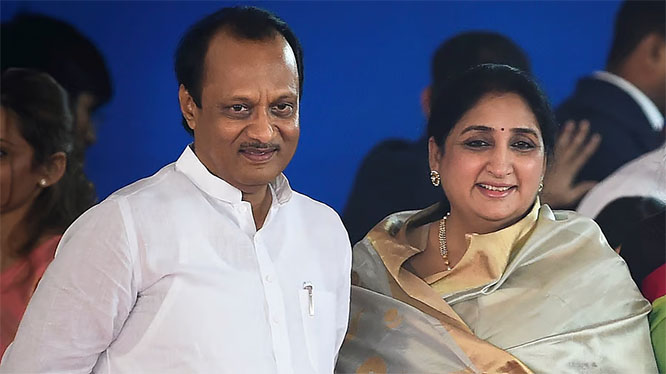
In the NCP, Praful Patel is the Working President and Raigad MP Sunil Tatkare heads the state unit. Ajit Pawar’s wife, Sunetra Pawar, is a Rajya Sabha MP, while their sons Parth and Jay are not actively involved in day-to-day politics. Parth Pawar briefly entered electoral politics in 2019 but lost the Lok Sabha election from Maval. Jay Pawar’s political debut was under consideration.

With Ajit Pawar gone, speculation has intensified that a member of the family may be asked to assume a larger role. For now, Sunetra Pawar is expected to play a key coordinating role in party affairs, alongside Patel and Tatkare.

The NCP continues to have several heavyweight leaders, including Chhagan Bhujbal, Hasan Mushrif, Dattatreya Bharne, Manikrao Kokate and Dhananjay Munde.

Ajit Pawar had already begun steps towards reconciliation between the two factions. While they contested the Pune and Pimpri-Chinchwad municipal elections separately, they later decided to fight the zilla parishad elections together under the ‘clock’ symbol—seen as the first formal step towards reunification.

Nagpur meet and party roadmap

Both NCP factions claim adherence to the ideology of ‘Shiv–Shahu–Phule–Ambedkar’. At the Rashtravadi Chintan Shivir held in Nagpur on September 19, 2025, the NCP reaffirmed its commitment to sarva dharma sambhav and discussed strengthening ties with the BJP “for the welfare and development of Maharashtra”.

In recent days, reports had suggested Ajit Pawar might return to the Maha Vikas Aghadi following the party’s poor performance in Pune municipal elections, but these claims were denied.

Big question for Maha Yuti

Ajit Pawar’s death also presents an immediate challenge for the Devendra Fadnavis-led Maha Yuti government. Pawar held crucial portfolios, including Finance, Planning and Excise. With the Budget Session approaching, appointing a new Finance Minister has become urgent.

Beyond numbers and portfolios, Maha Yuti has lost a swift decision-maker known for his administrative grip and political finesse—leaving a vacuum that will not be easy to fill.

Comments

Add new comment

  • Coastaldigest.com reserves the right to delete or block any comments.
  • Coastaldigset.com is not responsible for its readers’ comments.
  • Comments that are abusive, incendiary or irrelevant are strictly prohibited.
  • Please use a genuine email ID and provide your name to avoid reject.
News Network
February 4,2026

Mangaluru: Urban local bodies and gram panchayats should make the use of Kannada on signboards mandatory while issuing trade licences to commercial establishments, Dakshina Kannada Deputy Commissioner Darshan HV said. He also called for regular inspections to ensure compliance.

Presiding over the District Kannada Awareness Committee meeting at the deputy commissioner’s office, Darshan said the city corporation would be directed to ensure that shops operating in malls prominently display their names in Kannada. “All commercial establishments, including shops, companies, offices and hotels, must mandatorily display their names in Kannada on signboards,” he said.

The deputy commissioner added that the National Highways Authority of India (NHAI) would be instructed to include Kannada on signboards along national highways. Banks, he said, would be directed through committee meetings to provide application forms in Kannada.

“Even if English-medium schools and colleges impart education in English, their signboards must display the institution’s name in Kannada. Steps will also be taken to ensure that private buses display place names in Kannada,” Darshan said.

During the meeting, committee members raised concerns over the closure of Kannada-medium schools in rural areas due to a shortage of teachers and stressed the need for immediate corrective measures. They also pointed out that several industries employ workers from other states while overlooking local candidates.

Members further demanded that nationalised banks provide deposit and withdrawal slips in Kannada. It was brought to the deputy commissioner’s notice that the presence of staff without knowledge of Kannada in rural branches of nationalised banks is causing hardship to local customers.

Meanwhile, MP Srinath, president of the District Kannada Sahitya Parishat, urged the district administration to allot land for the construction of a district Kannada Bhavana in Mangaluru.

Comments

Add new comment

  • Coastaldigest.com reserves the right to delete or block any comments.
  • Coastaldigset.com is not responsible for its readers’ comments.
  • Comments that are abusive, incendiary or irrelevant are strictly prohibited.
  • Please use a genuine email ID and provide your name to avoid reject.