Quadruplet babies born to Kasargod couple, one dies after month long battle

April 3, 2012

1A4C1
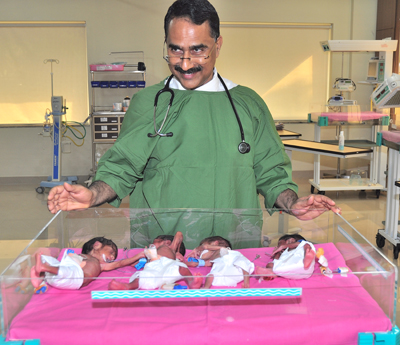
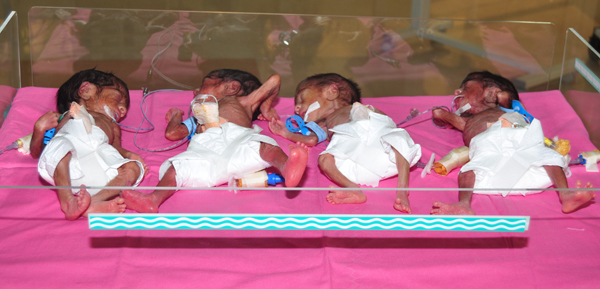
Mangalore, April 3: A very rare case of four babies of same sex in a single birth (quadruplets) succeeded nearly a month of life by the team effort of highly qualified doctors and medical personals led by Dr Ali kumble in tertiary centre, lndiana Hospital, Mangalore.

However, one among the four babies died on Monday, April 2.

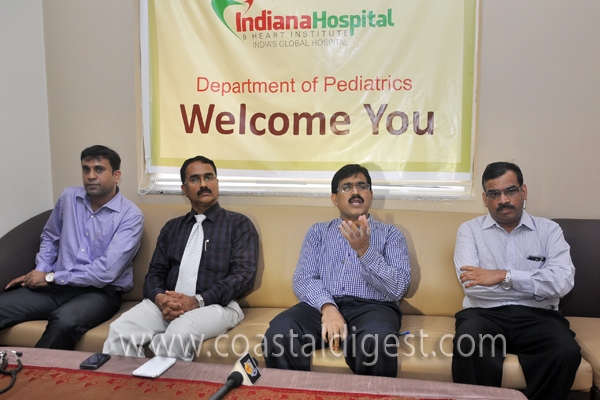
Dr Yusuf kumble Managing Director of the Hospital told media persons that with this Indiana Hospital and Heart Institute's medical team achieved a new milestone in Indian pediatric healthcare.

Aysha Tahira and Latheef hailing from kasargod were not blessed with offspring's for many years. After a prolonged period of waiting they were quite happy to come to know that Aysha has conceived. But the happiness did not last for long time as she delivered prematurely four babies in a single birth. Gynecologist Dr Veena Manjunath was surprised to see new babies one after the other.

The parents were informed that the chance of survival of these babies were extremely rare. Quadruplet incidences occur once in 70 lakh births. These babies survival for more than one week is extremely rare especially if they are very premature. Also it is very expensive and life saving support is required in a high tech care center to make them survive.

Dr Yousuf Kumble said that the four babies got admitted at Indiana hospital's NICU on March 11, this year. Team of doctors led by Dr Ali Kumble took it as a challenge and with their effort babies survived since their admission. Financial support was offered by the hospital management as the father was not in a position to support all the four babies.

“What makes our case still more fascinating is that babies being treated here are identical quadruplet which occurs once in every 13 million births. There are only 60 such cases on record worldwide and it is extremely challenging to ensure they survive into infancy especially if they are born premature at 26 weeks of pregnancy and weigh between 500 to 900 grams”, he said.

He said multiple pregnancies are high risk pregnancies and are associated with increased neonatal morbidity and mortality. The frequency of multiple pregnancies has increased in the past 2 decades, mostly as a result of assisted reproductive techniques for infertile couples.

The average period of gestation in quadruplet pregnancy is 31.2 weeks and the average weight is 1.362 kg as per the literature available. In this case the period of gestation was only 26 weeks and the weights being 900 grams for the first two and 580 grams for the other two offspring, the average weight being only 740 grams, perhaps the first such case of preterm identical quadruplets that goes on record in India, he said.

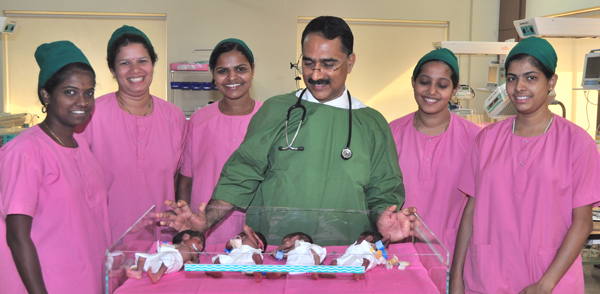
Dr Kumble said the babies pose serious challenges to both the pediatricians and the family, right from ensuring their survival to the many complications they may develop during their course of hospital stay. “We need to ensure they maintain a normal breathing pattern and tolerate the feed given ok them. Strict hygiene and sanitation to avoid sepsis is a benchmark for ensuring survival of such extremely low birth weight babies. That is why handling and care is undertaken by skilled and experienced nurses assigned specifically for this role”, he said.

“We have taken utmost caution in providing only the mother's milk to the newborns. They have now entered the fourth week of life when chances of intolerance to feeds are high. Survival of such babies beyond the first four weeks of life greatly improves the clinical outcome”, he said.
1A4C3

1A4C2

hospital1

Comments

Kusuma Kumari G
 - 
Monday, 14 Mar 2016

A VERY GOOD NEWS FOR PARENTS BECAUSE GOD HAS BLESSED THEM WITH FOUR WONDEFUL KIDS.

Add new comment

  • Coastaldigest.com reserves the right to delete or block any comments.
  • Coastaldigset.com is not responsible for its readers’ comments.
  • Comments that are abusive, incendiary or irrelevant are strictly prohibited.
  • Please use a genuine email ID and provide your name to avoid reject.
coastaldigest.com news network
February 5,2026

protestkerala.jpg

Mangaluru: The KSRTC Mangaluru division has rolled back the fare hike on buses operating on the Mangaluru–Kasaragod route following the suspension of toll collection at the Arikkady toll plaza near Kumbala in Kasaragod district.

The fare revision had been implemented after the National Highways Authority of India (NHAI) began toll collection at the Arikkady plaza on NH-66. As a result, fares for ordinary and Rajahamsa services were increased by ₹7 and ₹10, respectively, raising the bus fare from Mangaluru to Kasaragod from ₹81 to ₹88.

Senior Divisional Controller of KSRTC’s Mangaluru division, Rajesh Shetty, said the fares were reduced after toll collection at the Arikkady plaza was stopped. “The tollgate began operations on January 13, and the toll amount was deducted from the FASTag accounts of KSRTC buses operating on the route. Following an order from the central government to suspend toll collection, KSRTC has also withdrawn the additional fare with immediate effect,” he said.

At present, vehicles travelling on the Mangaluru–Kasaragod route pay toll only at the Talapady toll plaza. The toll for light motor vehicles (LMVs) at Talapady is ₹80 for a same-day return, while heavy vehicles, including buses, are charged ₹250. At Arikkady, the toll rates were ₹130 for LMVs (same-day return) and ₹450 for buses.

Protests against Arikkady toll plaza

The Arikkady toll plaza witnessed widespread protests from January 12, the day toll collection commenced. On the second day, an action committee led by Manjeshwar MLA A K M Ashraf launched an indefinite protest at the site. Except for the BJP, leaders and workers of most major political parties participated in the agitation.

On the night of January 14, a large number of protesters gathered at the plaza and vandalised property, following which authorities temporarily suspended toll operations. The BJP later also expressed opposition to the toll plaza and criticised NHAI’s decision. 

Comments

Add new comment

  • Coastaldigest.com reserves the right to delete or block any comments.
  • Coastaldigset.com is not responsible for its readers’ comments.
  • Comments that are abusive, incendiary or irrelevant are strictly prohibited.
  • Please use a genuine email ID and provide your name to avoid reject.
News Network
February 3,2026

Bengaluru: Following reports of fresh Nipah virus (NiV) cases in West Bengal and heightened vigilance across parts of Southeast Asia, the Karnataka Health Department has placed the state on high alert and activated emergency preparedness protocols.

Health officials said enhanced surveillance measures have been initiated after two healthcare workers in Barasat, West Bengal, tested positive for the virus earlier this month. While no cases have been reported in Karnataka so far, authorities said the state’s past exposure to Nipah outbreaks and high inter-state mobility warranted preventive action.

Officials have directed district health teams to intensify monitoring, particularly at hospitals and points of entry, and to ensure early detection and isolation of suspected cases.

High Mortality Virus with Multiple Transmission Routes

Nipah virus is a zoonotic disease that can spread from animals to humans and has a reported fatality rate ranging between 60 and 75 per cent. Fruit bats, also known as flying foxes, are the natural reservoirs of the virus and can transmit it by contaminating food sources with saliva or urine.

Known modes of transmission include:

•    Contaminated food: Consumption of fruits partially eaten by bats or raw date-palm sap
•    Animal contact: Exposure to infected pigs or other animals
•    Human-to-human transmission: Close contact with body fluids of infected persons, particularly in healthcare settings

Symptoms and Disease Progression

The incubation period typically ranges from 4 to 14 days, though delayed onset has also been reported. Early symptoms often resemble common viral infections, making prompt clinical suspicion critical.

•    Initial symptoms: Fever, headache, body aches, fatigue, sore throat
•    Progressive symptoms: Drowsiness, disorientation, altered mental state
•    Severe stage: Seizures, neck stiffness and acute encephalitis, which can rapidly progress to coma

Public Health Advisory

The Health Department has issued precautionary guidelines urging the public to adopt risk-avoidance practices to prevent any local spillover.

Do’s
•    Wash fruits thoroughly before consumption
•    Drink boiled and cooled water
•    Use protective equipment while handling livestock
•    Maintain strict hand hygiene

Don’ts
•    Avoid fruits found on the ground or showing bite marks
•    Do not consume beverages made from raw tree sap, including toddy
•    Avoid areas with dense bat populations
•    Do not handle sick or dead animals

Preparedness Measures

Officials confirmed that isolation wards are being readied in major government hospitals and that medical staff are being sensitised to identify early warning signs.

“There is no cause for panic, but there is a need for heightened vigilance,” a senior health official said, adding that there is currently no approved vaccine or specific antiviral treatment for Nipah, and care remains largely supportive.

Comments

Add new comment

  • Coastaldigest.com reserves the right to delete or block any comments.
  • Coastaldigset.com is not responsible for its readers’ comments.
  • Comments that are abusive, incendiary or irrelevant are strictly prohibited.
  • Please use a genuine email ID and provide your name to avoid reject.
News Network
February 5,2026

In an era where digital distractions are the primary rival to academic excellence, the Karnataka Education Department is taking the fight directly to the living room. As the SSLC (Class 10) annual examinations loom, officials have launched a localized "digital strike" to ensure students aren't losing their competitive edge to scrolling or soap operas.

The 7-to-9 Lockdown

The department has issued a formal directive urging—and in some cases, enforcing via home visits—a total blackout of mobile phones and television sets between 7:00 PM and 9:00 PM. This two-hour window is being designated as "sacred study time" across the state until the examinations conclude on April 2.

Key Pillars of the Initiative:

•    Doorstep Advocacy: Teachers are transitioning from classrooms to living rooms, meeting parents to explain the psychological benefits of a distraction-free environment.

•    Parental Accountability: The campaign shifts the burden of discipline from the student to the household, asking parents to lead by example and switch off their own devices.

•    The Timeline: The focus remains sharp on the upcoming exam block, scheduled from March 18 to April 2.

"The objective is simple: uninterrupted focus. We are reclaiming the evening hours for the students, ensuring their environment is as prepared as their minds," stated a senior department official.

Student vs. Reality

While the student community has largely welcomed the "forced focus"—with many admitting they lack the willpower to ignore notifications—the move has sparked a debate on enforceability. Without a "TV Police," the success of this initiative rests entirely on the shoulders of parents and the persuasive power of visiting educators.

Comments

Add new comment

  • Coastaldigest.com reserves the right to delete or block any comments.
  • Coastaldigset.com is not responsible for its readers’ comments.
  • Comments that are abusive, incendiary or irrelevant are strictly prohibited.
  • Please use a genuine email ID and provide your name to avoid reject.