



The secrets of Udupi's Madhwa Brahmin kitchen leaked!

[email protected] (News Network | KM Acharya)
August 26, 2015

Udupi, Aug 26: What connects Bisi Bele Hulianna, Saaru, Modaka, Huggi, Majjige Palidya and Drakshi Gojju? These are some of the famed dishes of the Madhwa Brahmin community of Udupi, a coastal town in Karnataka where the Krishna temple acts as a pivot in people's lives.
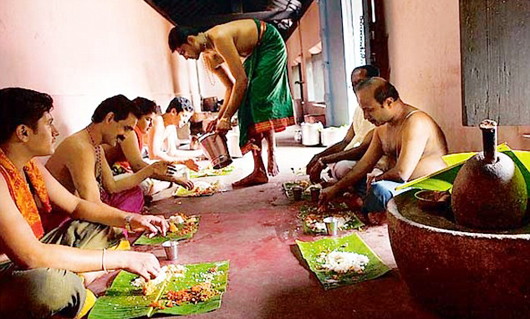
brahmin

Laying out the geographical expanse and scientific logic to the regions Madhwa Brahmins vegetarian food habits, culinary expert Malati Srinivasan and arts and crafts connoisseur Geetha Rao showcase the hitherto unknown vegetarian recipes from Udupi in their book "The Udupi Kitchen."

The authors straddle the traditional and modern and list what was once easily cooked in Udupi households - spice powders, salads and chutneys, savoury snacks, desserts - and elaborate on several recipes which are all-time favourites like Bisi Bele Hulianna, Saaru, Masal Dose and Modaka.

While Bisi Bele Hulianna is a dish of spicy red gram, rice and vegetables, Saaru is spicy red gram soup, Huggi is rice and green gram with black pepper and cumin and Modaka is dumplings with coconut and jiggery filling.

Majjige Palidya is ash gourd with coconut and cumin in sour yoghurt and Drakshi Gojju is raisins in sweet, sour and spicy gravy.

Split into 12 sections, the Udupi Kitchen, published by Westland Ltd, celebrates vegetarian food with aplomb from a town where food is religion as well as a complete mouth-watering experience.

At the core of Udupi cuisine is the use of indigenous vegetables and fruits, cereals and pulses special to the Parashurama Kshetra and traditional Brahmins ate only vegetarian fare without onion and garlic.

According to the authors, Udupi cuisine has a vast variety and is not limited to tiffins or snacks.

"As I began working on this project, I realised how vast and varied our family’s repertoire of Udupi (Madhwa) cuisine was. I wrote down 175 recipes, but have used about a 100 of them in the book," says Srinivasan.

"Writing a cook book for both Indian and non-Indian readers required that a comprehensive multi-lingual glossary be compiled. It also meant using internationally accepted terminology: 'henchu' or 'tava' became griddle, bandle or 'kadhai' became wok, 'tappele' or 'bartan' became saucepan," says Rao.

She says for some kitchen tools like 'eelgemane' and 'ogarane chamcha', which had no "internationally understood" words, substitute words like curved knife blade and tempering-ladle had to be coined.

The story of Udupi cuisine is the story of how a temple-based, Brahmanical culinary tradition got modernised and became a global phenomenon. Food is religion in Udupi.

Fourteen varieties of food are cooked daily and offered to the deity at different times of the day. The food offered to god is 'naivediya', and the food eaten by human beings is 'prasada', food that is blessed.

In Udupi, meals are served on banana leaves in a particular order. Many recipes and foods have also proven health benefits. For example, dishes made from the inner banana stem prevent kidney stones, pepper rasam helps with the lactation of new mothers, jackfruit seeds have high protein content and so on.

The authors also say that the original of the masal dose or the famous masala dosa is attributed to Udupi.

Before it was invented, plain dosa was served with potato playa, without onions, in a separate cup. With changing food tastes, the Udupi chefs began to saute the mashed potatoes with onions and spices.

"As onions were considered taboo food for orthodox Brahmins, it is said that the doses were stuffed with onion-laced playa, instead of served in a separate cup, so that the onion could be 'hidden'," the authors say.


Comments

Usha moorthy
 - 
Wednesday, 8 Jun 2016

I'm extremely pleased that I now have a book to refer to for genuine udupi food!!! Thanks to the authors for painstakingly bringing together these wonderful recipes!!;

Add new comment

  • Coastaldigest.com reserves the right to delete or block any comments.
  • Coastaldigset.com is not responsible for its readers’ comments.
  • Comments that are abusive, incendiary or irrelevant are strictly prohibited.
  • Please use a genuine email ID and provide your name to avoid reject.
News Network
December 7,2025

SHRIMP.jpg

Mangaluru, Dec 7: A rare bamboo shrimp has been rediscovered on mainland India more than 70 years after it was last reported, confirming for the first time the presence of Atyopsis spinipes in the country. The find was made by researchers from the Centre for Climate Change Studies at Sathyabama Institute of Science and Technology, Chennai, during surveys in Karnataka and Odisha.

The team — shrimp expert Dr S Prakash, PhD scholar K Kunjulakshmi, and Mangaluru-based researcher Maclean Antony Santos — combined field surveys, ecological assessments and DNA analysis to identify the elusive species. Their findings, published in Zootaxa, resolve decades of taxonomic confusion stemming from a 1951 report that misidentified the species as Atyopsis moluccensis without strong evidence.

The shrimp has now been confirmed at two locations: the Mulki–Pavanje estuary near Mangaluru and the Kuakhai River in Bhubaneswar. Historical specimens from the Andaman Islands, previously labelled as A. moluccensis, were also found to be misidentified and actually belong to A. spinipes.

The rediscovery began after an aquarium hobbyist in Odisha spotted a shrimp in 2022, prompting systematic surveys across Udupi, Karwar and Mangaluru. Four female specimens were collected in Mulki and one in Odisha, all genetically matching.

Researchers warn the species may exist in very small, vulnerable populations as freshwater habitats face increasing pressure from pollution, sand mining and infrastructure development. All verified specimens have been deposited with the Zoological Survey of India for future reference.

Comments

Add new comment

  • Coastaldigest.com reserves the right to delete or block any comments.
  • Coastaldigset.com is not responsible for its readers’ comments.
  • Comments that are abusive, incendiary or irrelevant are strictly prohibited.
  • Please use a genuine email ID and provide your name to avoid reject.
News Network
December 2,2025

Puttur: The long-cherished dream of a government medical college in Puttur has moved a decisive step closer to reality, with the Karnataka State Finance Department granting its official approval for the construction of a new 300-bed hospital.

Puttur MLA Ashok Kumar Rai announced the crucial development to reporters on Monday, confirming that the official communication from the finance department was issued on November 27. This 300-bed facility is intended to be the cornerstone for the establishment of the government medical college, a project announced in the state budget.

Fast-Track Implementation

The MLA outlined an aggressive timeline for the project:

•    A Detailed Project Report (DPR) for the hospital is expected to be ready within 45 days.

•    The tender process for the construction will be completed within two months.

Following the completion of the tender process, Chief Minister Siddaramaiah is scheduled to lay the foundation stone for the project.

"Setting up a medical college in Puttur is a historical decision by the Congress government in Karnataka," Rai stated. The project has an estimated budget allocation of Rs 1,000 crore for the medical college.

Focus on Medical Education Department

The MLA highlighted a key strategic move: requesting the government to implement the hospital construction through the Medical Education Department instead of the Health and Family Welfare Department. This is intended to streamline the entire process of establishing the full medical college, ensuring the facilities—including labs, operation theatres, and other necessary infrastructure—adhere to the strict guidelines set by the Medical Council of India (MCI). The proposed site for the project is in Bannur.

Rai also took the opportunity to address political criticism, stating that the government has fulfilled its promise despite "apprehensions" and "mocking and criticising" from opposition parties who had failed to take similar initiatives when they were in power. "Chief Minister Siddaramaiah has kept his word," he added.

Comments

Add new comment

  • Coastaldigest.com reserves the right to delete or block any comments.
  • Coastaldigset.com is not responsible for its readers’ comments.
  • Comments that are abusive, incendiary or irrelevant are strictly prohibited.
  • Please use a genuine email ID and provide your name to avoid reject.
News Network
December 4,2025

Mangaluru: Chaos erupted at Mangaluru International Airport (MIA) after IndiGo flight 6E 5150, bound for Mumbai, was repeatedly delayed and ultimately cancelled, leaving around 100 passengers stranded overnight. The incident highlights the ongoing country-wide operational disruptions affecting the airline, largely due to the implementation of new Flight Duty Time Limitations (FDTL) norms for crew.

The flight was initially scheduled for 9:25 PM on Tuesday but was first postponed to 11:40 PM, then midnight, before being cancelled around 3:00 AM. Passengers expressed frustration over last-minute communication and the lack of clarity, with elderly and ailing travellers particularly affected. “Though the airline arranged food, there was no proper communication, leaving us confused,” said one family member.

An IndiGo executive at MIA cited the FDTL rules, designed to prevent pilot fatigue by limiting crew working hours, as the cause of the cancellation. While alternative arrangements, including hotel stays, were offered, about 100 passengers chose to remain at the airport, creating tension. A replacement flight was arranged but also faced delays due to the same constraints, finally departing for Mumbai around 1:45 PM on Wednesday. Passengers either flew, requested refunds, or postponed their travel.

The Mangaluru delay is part of a broader crisis for IndiGo. The airline has been forced to make “calibrated schedule adjustments”—a euphemism for widespread cancellations and delays—after stricter FDTL norms came into effect on November 1.

While an IndiGo spokesperson acknowledged unavoidable flight disruptions due to technology issues, operational requirements, and the updated crew rostering rules, the DGCA has intervened, summoning senior airline officials to explain the chaos and outline corrective measures.

The ripple effect has been felt across the country, with major hubs like Bengaluru and Mumbai reporting numerous cancellations. The Mangaluru incident underscores the systemic operational strain currently confronting India’s largest carrier, leaving passengers nationwide grappling with uncertainty and delays.

Comments

Add new comment

  • Coastaldigest.com reserves the right to delete or block any comments.
  • Coastaldigset.com is not responsible for its readers’ comments.
  • Comments that are abusive, incendiary or irrelevant are strictly prohibited.
  • Please use a genuine email ID and provide your name to avoid reject.