



Legendary humanitarian, Father Teresa' Abdul Sattar Edhi passes away

July 9, 2016

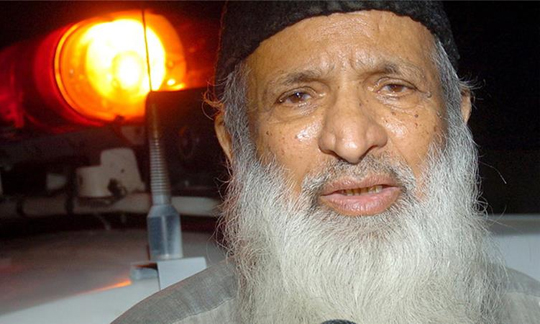
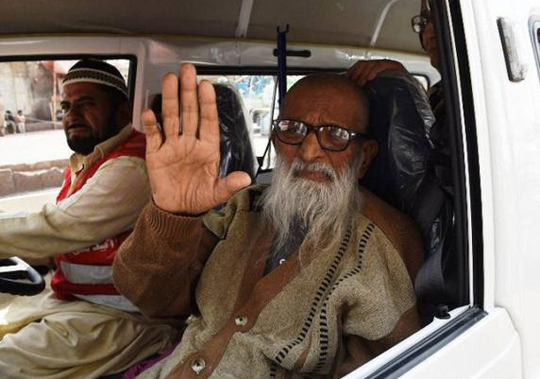
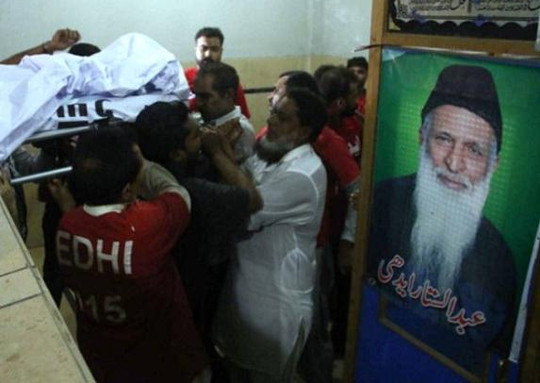
Karachi, Jul 9: Famed philanthropist Abdul Sattar Edhi, who set up one of Pakistan's biggest welfare organisations and was revered as a “living saint” by many in the South Asian country, died in hospital late on Friday.
eedhi

The announcement of his death triggered a wave of accolades on TV and social media. Pakistan's Prime Minister Nawaz Sharif paid tribute to him as “a great servant of humanity,” and said he would receive a posthumous presidential medal and a state funeral.

The 88-year-old's reputation for austerity and generosity resonated deeply in Pakistan, a country of 190 million people.

“There are few men who have done as much good, and made as much a difference to the lives and livelihoods of the Pakistani people as Abdul Sattar Edhi,” Mr. Sharif said hours before Mr. Edhi's death.

Mr. Edhi, a short man with a long white beard who often wore a traditional cap, had been ill for several years after suffering kidney failure, his son Faisal told journalists in Karachi.

Mr. Sharif's government had offered to fly Mr. Edhi abroad for treatment, but he refused, saying he wanted to be treated at a public hospital in his own country.

The Edhi Foundation runs a vast fleet of ambulances, orphanages and medical clinics across the country.

Last year when a devastating heat wave struck Karachi — a city of about 20 million people — the foundation was at the forefront of the response: its ambulances tended to the sick, the Edhi morgue was used to store the dead and many of the poor buried their family members in the Edhi cemetery for free.

Mr. Edhi's funeral on Saturday is expected to be one of the biggest in Pakistan's history.

“He was a noble soul who dedicated his life in service of mankind,” said India's External Affairs Minister Sushma Swaraj.

Pakistan's Mother Teresa'

In a nation often riven by social, ethnic and religious strife, Mr. Edhi won respect from every strata of society for an ascetic lifestyle that was devoted to helping the poor regardless of their background.

Mr. Edhi lived in a bare room in Karachi, alternating between his two suits of black clothes and occasionally listening to recordings of Quranic verses on a battered old tape recorder.

“When my ambulance takes a wounded person who is in pain to the hospital, when people reach the hospital, I find peace in knowing I helped an injured person who was in pain,” Mr. Edhi told Reuters in an interview in 2013.

“My mission is to love human beings... Each day is the best day of my life.”

Mr. Edhi was well-known for berating Islamist groups such as Tehreek-e-Taliban Pakistan (TTP) for their attacks on civilians, criticising the government for incompetence and corruption and denouncing the elites for dodging taxes.

His wife, Bilquis, a nurse, oversees the women's shelters and the adoption of orphans. They have found homes for about 25,000 children.

Mr. Edhi's foundation has provided relief in Bangladesh, Afghanistan, Iran, Sri Lanka, Croatia, Indonesia and in the United States after Hurricane Katrina.

Pakistanis took to Twitter to mourn the death of a national hero many call a “living saint” and “Pakistan's Mother Teresa”.

“In his death he has united all of Pakistan, across all affiliations, in mourning. That in itself is a measure of his greatness,” said a Twitter user named Imran Khan.
eedhi 1

eedhi 2

Comments

Naren kotian
 - 
Saturday, 9 Jul 2016

Mini pakistanis shoka charane nodree ...haha...I understand why many Pakistani news appear in the media now ...ummah effect ...

Muhammed Ali Uchil
 - 
Saturday, 9 Jul 2016

Innaa .......,The man who served the needy and poor till his death. Never shown any kind of partiality on the basis of caste,creed or religion.For his service is only for humanity.

it is unfortunate that he didn't get his share of name or fame for some unforeseen reasons. Even though he never asked or pleaded for recognization,world would have given his due to him!

Ahamad Gulam beary
 - 
Saturday, 9 Jul 2016

Inna lillahi wa inna ilahi rajiwoon

faizal
 - 
Saturday, 9 Jul 2016

inna lillahi wa inna ilahi raajiwoon

Add new comment

  • Coastaldigest.com reserves the right to delete or block any comments.
  • Coastaldigset.com is not responsible for its readers’ comments.
  • Comments that are abusive, incendiary or irrelevant are strictly prohibited.
  • Please use a genuine email ID and provide your name to avoid reject.
News Network
January 23,2026

Karnataka Governor Thaawarchand Gehlot read only three lines from the 122-paragraph address prepared by the Congress-led state government while addressing the joint session of the Legislature on Thursday, effectively bypassing large sections critical of the BJP-led Union government.

The omitted portions of the customary Governor’s address outlined what the state government described as a “suppressive situation in economic and policy matters” under India’s federal framework. The speech also sharply criticised the Centre’s move to replace the Mahatma Gandhi National Rural Employment Guarantee Act (MGNREGA) with the Viksit Bharat–Guarantee for Rozgar and Ajeevika Mission (Gramin) Act, commonly referred to as the VB-GRAM (G) Act.

Governor Gehlot had earlier conveyed his objection to several paragraphs that were explicitly critical of the Union government. On Thursday, he confined himself to the opening lines — “I extend a warm welcome to all of you to the joint session of the State legislature. I am extremely pleased to address this august House” — before jumping directly to the concluding sentence of the final paragraph.

He ended the address by reading the last line of paragraph 122: “Overall, my government is firmly committed to doubling the pace of the State’s economic, social and physical development. Jai Hind — Jai Karnataka.”

According to the prepared speech, the Karnataka government demanded the scrapping of the VB-GRAM (G) Act, describing it as “contractor-centric” and detrimental to rural livelihoods, and called for the full restoration of MGNREGA. The state government argued that the new law undermines decentralisation, weakens labour protections, and centralises decision-making in violation of constitutional norms.

Key points from the unread sections of the speech:

•    Karnataka facing a “suppressive” economic and policy environment within the federal system

•    Repeal of MGNREGA described as a blow to rural livelihoods

•    VB-GRAM (G) Act accused of protecting corporate and contractor interests

•    New law alleged to weaken decentralised governance

•    Decision-making said to be imposed by the Centre without consulting states

•    Rights of Adivasis, women, backward classes and agrarian communities curtailed

•    Labourers allegedly placed under contractor control

•    States facing mounting fiscal stress due to central policies

•    VB-GRAM (G) Act accused of enabling large-scale corruption

Comments

Add new comment

  • Coastaldigest.com reserves the right to delete or block any comments.
  • Coastaldigset.com is not responsible for its readers’ comments.
  • Comments that are abusive, incendiary or irrelevant are strictly prohibited.
  • Please use a genuine email ID and provide your name to avoid reject.
News Network
February 3,2026

Bengaluru: Following reports of fresh Nipah virus (NiV) cases in West Bengal and heightened vigilance across parts of Southeast Asia, the Karnataka Health Department has placed the state on high alert and activated emergency preparedness protocols.

Health officials said enhanced surveillance measures have been initiated after two healthcare workers in Barasat, West Bengal, tested positive for the virus earlier this month. While no cases have been reported in Karnataka so far, authorities said the state’s past exposure to Nipah outbreaks and high inter-state mobility warranted preventive action.

Officials have directed district health teams to intensify monitoring, particularly at hospitals and points of entry, and to ensure early detection and isolation of suspected cases.

High Mortality Virus with Multiple Transmission Routes

Nipah virus is a zoonotic disease that can spread from animals to humans and has a reported fatality rate ranging between 60 and 75 per cent. Fruit bats, also known as flying foxes, are the natural reservoirs of the virus and can transmit it by contaminating food sources with saliva or urine.

Known modes of transmission include:

•    Contaminated food: Consumption of fruits partially eaten by bats or raw date-palm sap
•    Animal contact: Exposure to infected pigs or other animals
•    Human-to-human transmission: Close contact with body fluids of infected persons, particularly in healthcare settings

Symptoms and Disease Progression

The incubation period typically ranges from 4 to 14 days, though delayed onset has also been reported. Early symptoms often resemble common viral infections, making prompt clinical suspicion critical.

•    Initial symptoms: Fever, headache, body aches, fatigue, sore throat
•    Progressive symptoms: Drowsiness, disorientation, altered mental state
•    Severe stage: Seizures, neck stiffness and acute encephalitis, which can rapidly progress to coma

Public Health Advisory

The Health Department has issued precautionary guidelines urging the public to adopt risk-avoidance practices to prevent any local spillover.

Do’s
•    Wash fruits thoroughly before consumption
•    Drink boiled and cooled water
•    Use protective equipment while handling livestock
•    Maintain strict hand hygiene

Don’ts
•    Avoid fruits found on the ground or showing bite marks
•    Do not consume beverages made from raw tree sap, including toddy
•    Avoid areas with dense bat populations
•    Do not handle sick or dead animals

Preparedness Measures

Officials confirmed that isolation wards are being readied in major government hospitals and that medical staff are being sensitised to identify early warning signs.

“There is no cause for panic, but there is a need for heightened vigilance,” a senior health official said, adding that there is currently no approved vaccine or specific antiviral treatment for Nipah, and care remains largely supportive.

Comments

Add new comment

  • Coastaldigest.com reserves the right to delete or block any comments.
  • Coastaldigset.com is not responsible for its readers’ comments.
  • Comments that are abusive, incendiary or irrelevant are strictly prohibited.
  • Please use a genuine email ID and provide your name to avoid reject.
News Network
February 1,2026

Bengaluru: The Karnataka High Court has refused to quash an investigation against a WhatsApp group administrator accused of allowing the circulation of obscene and offensive images depicting Hindutva politicians and idols in 2021.

Justice M Nagaprasanna observed that, prima facie, the ingredients of the offence under Section 295A of the Indian Penal Code were made out. “The offence under Section 295A of the IPC is met to every word of its ingredient, albeit prima facie,” the judge said.

The petitioner, Sirajuddin, a resident of Belthangady taluk in Dakshina Kannada district, had challenged the FIR registered against him at the CEN (Cyber, Economics and Narcotics) police station, Mangaluru, for offences under Section 295A of the IPC and Section 67 of the Information Technology Act. Section 295A relates to punishment for deliberate and malicious acts intended to outrage the religious feelings of any class of citizens.

According to the complaint filed by K Jayaraj Salian, also a resident of Belthangady taluk, he received a WhatsApp group link from an unknown source and was added to the group after accessing it. The group reportedly had six administrators and around 250 participants, where obscene and offensive images depicting Hindu deities and certain political figures were allegedly circulated repeatedly.

Sirajuddin was arrested in connection with the case and later released on bail on February 16, 2021. He argued before the court that he was being selectively targeted, while other administrators—including the creator of the group—were neither arrested nor investigated. He also contended that the Magistrate could not have taken cognisance of the offence under Section 295A without prior sanction under Section 196(1) of the CrPC.

Rejecting the argument, Justice Nagaprasanna held that prior sanction is required only at the stage of taking cognisance, and not at the stage of registration of the crime or during investigation.

The judge noted that the State had produced the entire investigation material before the court. “A perusal of the material reveals depictions of Hindu deities in an extraordinarily obscene, demeaning and profane manner. The content is such that its reproduction in a judicial order would itself be inappropriate,” the court said, adding that the material, on its face, had the tendency to outrage religious feelings and disturb communal harmony.

Observing that the case was still at the investigation stage, the court said it could not interdict the probe at this juncture. However, it expressed concern that the investigating officer appeared to have not proceeded uniformly against all administrators. The court clarified that if the investigation revealed the active involvement of any member in permitting the circulation of such content, they must also be proceeded against.

“At this investigative stage, any further observation by this Court would be unnecessary,” the order concluded.

Comments

Add new comment

  • Coastaldigest.com reserves the right to delete or block any comments.
  • Coastaldigset.com is not responsible for its readers’ comments.
  • Comments that are abusive, incendiary or irrelevant are strictly prohibited.
  • Please use a genuine email ID and provide your name to avoid reject.
