



Imran Khan now marries his spiritual guide Bushra Maneka

Agencies
February 19, 2018

Lahore, Feb 19: Pakistan Tehreek-e-Insaf (PTI) has confirmed party chief Imran Khan's marriage to his spiritual guide Bushra Maneka, thus ending weeks of speculation about the union.

Khan, a cricketer turned politician, married Bushra Bibi (also known as Pinki Pir) in a simple ceremony held in Lahore yesterday, PTI spokesman Fawad Chaudhry said in a tweet.

He said the marriage ceremony was held at Maneka's brother's residence in Lahore. PTI Central Executive Committee member Mufti Muhammad Saeed performed the 'nikah'.

"Marriage is the combination of two hearts and two souls which join each on this special day of wedding. I wish a very happy and blessed married life to Imran Khan," Chaudhry said.

"The valima ceremony will also be held in a simple manner in a few days," he said.

The PTI's media wing released pictures of the marriage ceremony in which Khan is seen wearing shalwar kameez and black jacket while the bride is decked in red suit with woolen shawl.

None of Imran's sisters was present in the ceremony triggering rumours that Khan had not taken them into confidence about his third marriage.

Khan's previous two marriages ended in divorce. His first marriage was with Jemima Goldsmith, daughter of a British billionaire, in 1995, which lasted nine years. Khan has two sons from her.

His second marriage with TV anchor Reham Khan in 2015 ended after a brief 10 months.

Earlier, Khan had rejected the reports that he had contracted his marriage with Maneka on January 1 in Lahore's Defence residence of his 'new' brother-in-law.

A source in the party said Khan was under immense pressure from the PTI to disclose his third marriage after a humiliating defeat in Punjab's Lodhran district last week.

"The PTI leadership was of the view that strong rumours about his third marriage had played a role in the defeat of the partyâs strong man Jahangir Tareen's son at the hands of a candidate of ruling PML-N," he said.

"Khan was advised to disclose his marriage as early as possible because the general elections are not far away and the PTI may suffer more politically if this news was broken just before the polls," he said.

Maneka is in her late 40s and has five children from her first marriage. She is a resident of Pakpatan district, some 250 km from Lahore, which is known for the shrine of Baba Farid Ganj Shakar.

According to a source, Khan had started visiting her over a year ago to seek spiritual advice.

"He got closer to her when some of political predictions she made about his party came true. Later, both developed some 'intimacy' and finally Bushra took divorce from her husband and contracted marriage with Imran early last month," the source said. Last month, Khan had admitted that he had proposed marriage to Maneka.

"I would like to reiterate that every time I met her, with family and alone, she has been in purdah (veil). My interest in her lies in the fact that I have not seen or met anyone with her level of spirituality. I only sent the proposal for marriage after she divorced her husband," said Khan.

Comments

sharief
 - 
Monday, 19 Feb 2018

3rd on Pich.....


Mr. Imran, bowl well

Add new comment

  • Coastaldigest.com reserves the right to delete or block any comments.
  • Coastaldigset.com is not responsible for its readers’ comments.
  • Comments that are abusive, incendiary or irrelevant are strictly prohibited.
  • Please use a genuine email ID and provide your name to avoid reject.
News Network
February 1,2026

Bengaluru, Feb 1: For travelers landing at Kempegowda International Airport (KIA), the sleek, wood-paneled curves of Terminal 2 promise a world-class welcome. But the famed “Garden City” charm quickly withers at the curb. As India’s aviation sector swells to record numbers—handling over 43 million passengers in Bengaluru alone this past year—the “last mile” has turned into a marathon of frustration.

The Bengaluru Logjam: Rules vs Reality

While the city awaits the 2027 completion of the Namma Metro Blue Line, the interim has been chaotic. Recent “decongestion” rules at Terminal 1 have pushed app-based cab pickups to distant parking zones, forcing weary passengers into a 20-minute walk with luggage.

“I landed after ten months away and felt like a stranger in my own city,” says Ruchitha Jain, a Koramangala resident. “My driver couldn’t find me, staff couldn’t guide me, and the so-called ‘Premium’ lane is just a fancy tax on convenience.”

•    The Cost of Distance: A 40-km cab ride can now easily cross ₹1,500, driven by demand pricing and airport surcharges.

•    The Bus Gap: While Vayu Vajra remains a lifeline, its ₹300–₹400 fare is often cited as the most expensive airport bus service in the country.

A National Pattern of Disconnect

The struggle is not unique to Karnataka. From Chennai’s coast to Hyderabad’s plateau, India’s airports tell a familiar story: brilliant runways, broken exits.

City:    Primary Issue   |    Recent Development

Bengaluru:    Cab pickup restrictions & distance  |    App-based taxis shifted to far parking zones; long walks and fare spikes reported

Chennai:    Multi-Level Parking (MLCP) hike  |    Passengers report 40-minute walks to reach cab pickup points

Hyderabad:    “Taxi mafia” & touting  |    Over 440 touting cases reported; security presence intensified

Mumbai:    Fare scams  |     Tourists charged ₹18,000 for just 400 metres, triggering police action

In Hyderabad, travelers continue to battle entrenched local groups that intimidate Uber and Ola drivers, pushing passengers toward overpriced private taxis. Chennai flyers, meanwhile, complain that reaching the designated pickup zones now takes longer than short-haul flights from cities like Coimbatore.

The ‘Budget Day’ Hope

As Finance Minister Nirmala Sitharaman presents the Union Budget 2026 today, the aviation sector is watching closely. With the government’s renewed emphasis on multimodal integration, there is cautious hope for funding toward seamless airport-metro-bus hubs.

The vision is clear: a future where planes, trains, and metros speak the same language. Until then, passengers at KIA—and airports across India—will continue to discover that the hardest part of flying isn’t the thousands of kilometres in the air, but the last few on the ground.

Comments

Add new comment

  • Coastaldigest.com reserves the right to delete or block any comments.
  • Coastaldigset.com is not responsible for its readers’ comments.
  • Comments that are abusive, incendiary or irrelevant are strictly prohibited.
  • Please use a genuine email ID and provide your name to avoid reject.
coastaldigest.com news network
February 5,2026

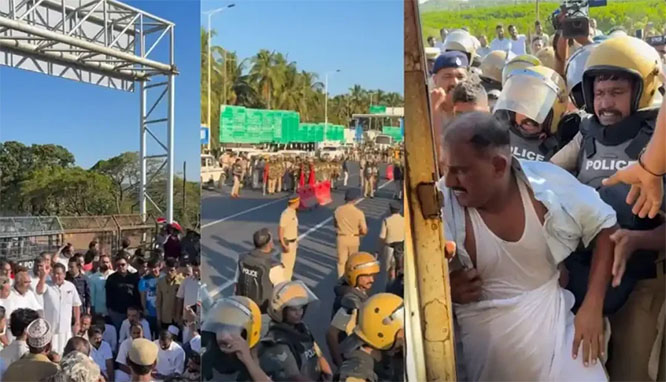
protestkerala.jpg

Mangaluru: The KSRTC Mangaluru division has rolled back the fare hike on buses operating on the Mangaluru–Kasaragod route following the suspension of toll collection at the Arikkady toll plaza near Kumbala in Kasaragod district.

The fare revision had been implemented after the National Highways Authority of India (NHAI) began toll collection at the Arikkady plaza on NH-66. As a result, fares for ordinary and Rajahamsa services were increased by ₹7 and ₹10, respectively, raising the bus fare from Mangaluru to Kasaragod from ₹81 to ₹88.

Senior Divisional Controller of KSRTC’s Mangaluru division, Rajesh Shetty, said the fares were reduced after toll collection at the Arikkady plaza was stopped. “The tollgate began operations on January 13, and the toll amount was deducted from the FASTag accounts of KSRTC buses operating on the route. Following an order from the central government to suspend toll collection, KSRTC has also withdrawn the additional fare with immediate effect,” he said.

At present, vehicles travelling on the Mangaluru–Kasaragod route pay toll only at the Talapady toll plaza. The toll for light motor vehicles (LMVs) at Talapady is ₹80 for a same-day return, while heavy vehicles, including buses, are charged ₹250. At Arikkady, the toll rates were ₹130 for LMVs (same-day return) and ₹450 for buses.

Protests against Arikkady toll plaza

The Arikkady toll plaza witnessed widespread protests from January 12, the day toll collection commenced. On the second day, an action committee led by Manjeshwar MLA A K M Ashraf launched an indefinite protest at the site. Except for the BJP, leaders and workers of most major political parties participated in the agitation.

On the night of January 14, a large number of protesters gathered at the plaza and vandalised property, following which authorities temporarily suspended toll operations. The BJP later also expressed opposition to the toll plaza and criticised NHAI’s decision. 

Comments

Add new comment

  • Coastaldigest.com reserves the right to delete or block any comments.
  • Coastaldigset.com is not responsible for its readers’ comments.
  • Comments that are abusive, incendiary or irrelevant are strictly prohibited.
  • Please use a genuine email ID and provide your name to avoid reject.
News Network
January 23,2026

Mangaluru: The Karnataka Government Polytechnic (KPT), Mangaluru, has achieved autonomous status from the All India Council for Technical Education (AICTE), becoming the first government polytechnic in the country to receive such recognition in its 78-year history. The status was granted by AICTE, New Delhi, and subsequently approved by the Karnataka Board of Technical Education in October last year.

Officials said the autonomy was conferred a few months ago. Until recently, AICTE extended autonomous status only to engineering colleges, excluding diploma institutions. However, with a renewed national focus on skill development, several government polytechnics across India have now been granted autonomy.

KPT, the second-largest polytechnic in Karnataka, was established in 1946 with four branches and has since expanded to offer eight diploma programmes, including computer science and polymer technology. The institution is spread across a 19-acre campus.

Ravindra M Keni, the first dean of the institution, told The Times of India that AICTE had proposed autonomous status for polytechnic institutions that are over 25 years old. “Many colleges applied. In the first round, 100 institutions were shortlisted, which was further narrowed down to 15 in the second round. We have already completed one semester after becoming an autonomous institution,” he said. He added that nearly 500 students are admitted annually across eight three-year diploma courses.

Explaining the factors that helped KPT secure autonomy, Keni said the institution has consistently recorded 100 per cent admissions and placements for its graduates. He also noted its strong performance in sports, with the college emerging champions for 12 consecutive years, along with active student participation in NCC and NSS activities.

Autonomous status allows KPT to design industry-oriented curricula, conduct examinations, prepare question papers, and manage academic documentation independently. The institution can also directly collaborate with industries and receive priority funding from AICTE or the Ministry of Education. While academic autonomy has been granted, financial control will continue to rest with the state government.

“There will be separate committees for examinations, question paper setting, boards of studies, and boards of examiners. The institution will now have the freedom to conduct admissions without government notifications and issue its own marks cards,” Keni said, adding that new academic initiatives would be planned after a year of functioning under the autonomous framework.

Comments

Add new comment

  • Coastaldigest.com reserves the right to delete or block any comments.
  • Coastaldigset.com is not responsible for its readers’ comments.
  • Comments that are abusive, incendiary or irrelevant are strictly prohibited.
  • Please use a genuine email ID and provide your name to avoid reject.