



Days after Doklam standoff, India, China hold first border talks in Beijing

Agencies
November 18, 2017

New Delhi/Beijing, Nov 18: India and China on Friday held their first meeting on the border consultation and coordination mechanism at Beijing after the Doklam standoff and reviewed the situation in all the sectors of their border and exchanged views on enhancing CBMs and military contacts.

The 10th round of the Working Mechanism for Consultation and Coordination on India-China Border Affairs (WMCC) was held in Beijing, a press release from the Indian Embassy in Beijing said.

The WMCC was established in 2012 as an institutional mechanism for consultation and coordination for the maintenance of peace and tranquillity in the India-China border areas.

It was established to deal with the tensions over recurring border incursions as well as to exchange views on strengthening communication and cooperation, including between the border security personnel.

The India-China border dispute covers the 3,488 km long Line of Actual Control (LAC). While China claims Arunachal Pradesh as Southern Tibet, India asserts that the dispute covered Aksai Chin area which was occupied by China during the 1962 war.

Today's (Friday) talks were held in a constructive and forward-looking manner, the release said.

Both sides reviewed the situation in all sectors of India-China border and agreed that maintenance of peace and tranquillity in the border areas is an important prerequisite for sustained growth of bilateral relations, it said.

The two sides also exchanged views on further confidence building measures (CBMs) and strengthening of military-to-military contacts, it said.

The talks between the delegations headed by Pranay Verma, Joint Secretary (East Asia), Ministry of External Affairs and Xiao Qian, Director General, Department of Asian Affairs, were the first such dialogue between the two countries after the 72-day-long standoff at Doklam in the Sikkim section.

The standoff which began in mid-June ended on August 28 after Chinese troops stopped building a key road close to India's Chicken Neck corridor. India objected to the construction highlighting its security concerns. The road was being built by the Chinese troops in the area also claimed by Bhutan.

This is the first round of talks between the two countries after Chinese President Xi Jinping began his second five-year term as the chief of the ruling Communist Party of China in October.

Friday's talks took place ahead of Chinese Foreign Minister Wang Yi's planned to visit to India to take part in the Russia, India and China (RIC) Foreign Ministers meeting expected to be held in New Delhi in December.

Chinese officials earlier said Wang is expected to meet his Indian counterpart Sushma Swaraj as well as top Indian leaders.

The contentious issues bedevilling both the countries, including the USD 50 billion China-Pakistan Economic Corridor (CPEC) as well as Bejing's veto blocking UN listing of JeM leader Masood Azhar as a global terrorist are expected to be discussed during Wang's talks with Indian leaders.

Ahead of the talks, Chinese officials have expressed optimism that differences over the listing of Azhar by China in the 1267 Committee of the UN Security Council may be resolved soon. China has blocked India's application in 2016 and vetoed a similar resolution sponsored by the US, the UK and France twice in 2017.

Also the 20th round of India-China border talks headed by National Security Advisor Ajit Doval and his Chinese counterpart Yang Jiechi, who are the designated Special Representatives, are expected to be held in New Delhi in December.

The dates for both RIC and border talks are yet to be announced.

The Special Representatives were also mandated to discuss all issues related to India-China relations.

The delegations at Friday's talks comprised of diplomatic and military officials from each side.

The two sides agreed to hold the next meeting of the WMCC at a mutually convenient time, the release said.

Comments

Add new comment

  • Coastaldigest.com reserves the right to delete or block any comments.
  • Coastaldigset.com is not responsible for its readers’ comments.
  • Comments that are abusive, incendiary or irrelevant are strictly prohibited.
  • Please use a genuine email ID and provide your name to avoid reject.
News Network
January 23,2026

Karnataka Governor Thaawarchand Gehlot read only three lines from the 122-paragraph address prepared by the Congress-led state government while addressing the joint session of the Legislature on Thursday, effectively bypassing large sections critical of the BJP-led Union government.

The omitted portions of the customary Governor’s address outlined what the state government described as a “suppressive situation in economic and policy matters” under India’s federal framework. The speech also sharply criticised the Centre’s move to replace the Mahatma Gandhi National Rural Employment Guarantee Act (MGNREGA) with the Viksit Bharat–Guarantee for Rozgar and Ajeevika Mission (Gramin) Act, commonly referred to as the VB-GRAM (G) Act.

Governor Gehlot had earlier conveyed his objection to several paragraphs that were explicitly critical of the Union government. On Thursday, he confined himself to the opening lines — “I extend a warm welcome to all of you to the joint session of the State legislature. I am extremely pleased to address this august House” — before jumping directly to the concluding sentence of the final paragraph.

He ended the address by reading the last line of paragraph 122: “Overall, my government is firmly committed to doubling the pace of the State’s economic, social and physical development. Jai Hind — Jai Karnataka.”

According to the prepared speech, the Karnataka government demanded the scrapping of the VB-GRAM (G) Act, describing it as “contractor-centric” and detrimental to rural livelihoods, and called for the full restoration of MGNREGA. The state government argued that the new law undermines decentralisation, weakens labour protections, and centralises decision-making in violation of constitutional norms.

Key points from the unread sections of the speech:

•    Karnataka facing a “suppressive” economic and policy environment within the federal system

•    Repeal of MGNREGA described as a blow to rural livelihoods

•    VB-GRAM (G) Act accused of protecting corporate and contractor interests

•    New law alleged to weaken decentralised governance

•    Decision-making said to be imposed by the Centre without consulting states

•    Rights of Adivasis, women, backward classes and agrarian communities curtailed

•    Labourers allegedly placed under contractor control

•    States facing mounting fiscal stress due to central policies

•    VB-GRAM (G) Act accused of enabling large-scale corruption

Comments

Add new comment

  • Coastaldigest.com reserves the right to delete or block any comments.
  • Coastaldigset.com is not responsible for its readers’ comments.
  • Comments that are abusive, incendiary or irrelevant are strictly prohibited.
  • Please use a genuine email ID and provide your name to avoid reject.
News Network
February 5,2026

In an era where digital distractions are the primary rival to academic excellence, the Karnataka Education Department is taking the fight directly to the living room. As the SSLC (Class 10) annual examinations loom, officials have launched a localized "digital strike" to ensure students aren't losing their competitive edge to scrolling or soap operas.

The 7-to-9 Lockdown

The department has issued a formal directive urging—and in some cases, enforcing via home visits—a total blackout of mobile phones and television sets between 7:00 PM and 9:00 PM. This two-hour window is being designated as "sacred study time" across the state until the examinations conclude on April 2.

Key Pillars of the Initiative:

•    Doorstep Advocacy: Teachers are transitioning from classrooms to living rooms, meeting parents to explain the psychological benefits of a distraction-free environment.

•    Parental Accountability: The campaign shifts the burden of discipline from the student to the household, asking parents to lead by example and switch off their own devices.

•    The Timeline: The focus remains sharp on the upcoming exam block, scheduled from March 18 to April 2.

"The objective is simple: uninterrupted focus. We are reclaiming the evening hours for the students, ensuring their environment is as prepared as their minds," stated a senior department official.

Student vs. Reality

While the student community has largely welcomed the "forced focus"—with many admitting they lack the willpower to ignore notifications—the move has sparked a debate on enforceability. Without a "TV Police," the success of this initiative rests entirely on the shoulders of parents and the persuasive power of visiting educators.

Comments

Add new comment

  • Coastaldigest.com reserves the right to delete or block any comments.
  • Coastaldigset.com is not responsible for its readers’ comments.
  • Comments that are abusive, incendiary or irrelevant are strictly prohibited.
  • Please use a genuine email ID and provide your name to avoid reject.
News Network
January 23,2026

modIKERALA.jpg

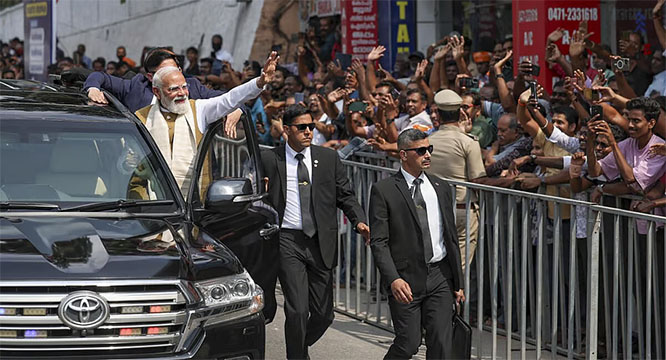
Prime Minister Narendra Modi, during his visit to Thiruvananthapuram on Friday, January 23, indicated that the Bharatiya Janata Party (BJP) is aiming to expand its political footprint in Kerala ahead of the Assembly elections scheduled in the coming months.

Speaking at a BJP-organised public meeting, Modi drew parallels between the party’s early electoral gains in Gujarat and its recent victory in the Thiruvananthapuram Municipal Corporation. The civic body win, which ended decades of Left control, was cited by the Prime Minister as a possible starting point for the party’s broader ambitions in the state.

Recalling BJP’s political trajectory in Gujarat, Modi said the party was largely insignificant before 1987 and received little media attention. He pointed out that the BJP’s first major breakthrough came with its victory in the Ahmedabad Municipal Corporation that year.

“Just as our journey in Gujarat began with one city, Kerala’s journey has also started with a single city,” Modi said, suggesting that the party’s municipal-level success could translate into wider electoral acceptance.

The Prime Minister alleged that successive governments led by the Left Democratic Front (LDF) and the United Democratic Front (UDF) had failed to adequately develop Thiruvananthapuram. He accused both fronts of corruption and neglect, claiming that basic infrastructure and facilities were denied to the capital city for decades.

According to Modi, the BJP’s control of the civic body represents a shift driven by public dissatisfaction with the existing political alternatives. He asserted that the BJP administration in Thiruvananthapuram had begun working towards development, though no specific details or timelines were outlined.

Addressing the gathering at Putharikandam Maidan, Modi said the BJP intended to project Thiruvananthapuram as a “model city,” reiterating his party’s commitment to governance-led change.

The Prime Minister’s visit to Kerala also included the inauguration of several development projects and the flagging off of new train services, as the BJP intensifies its political outreach in the poll-bound state.

Comments

Add new comment

  • Coastaldigest.com reserves the right to delete or block any comments.
  • Coastaldigset.com is not responsible for its readers’ comments.
  • Comments that are abusive, incendiary or irrelevant are strictly prohibited.
  • Please use a genuine email ID and provide your name to avoid reject.