



Washington/Palm beach, Apr 7: US President Donald Trump said on Thursday he ordered missile strikes against a Syrian airfield from which a deadly chemical weapons attack was launched, declaring he acted in America's "vital national security interest" against Syrian President Bashar al-Assad.
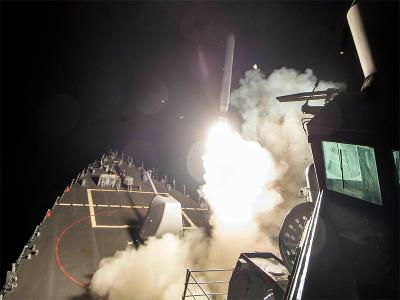
Facing his biggest foreign policy crisis since taking office in January, Trump took the toughest direct US action yet in Syria's six-year-old civil war, raising the risk of confrontation with Russia and Iran, Assad's two main military backers.
US officials insisted they informed Russian forces ahead of the missile attacks and that there were no strikes on sections of the base where Russians were present. But they said the administration did not seek Moscow's approval.
"Years of previous attempts at changing Assad's behavior have all failed and failed very dramatically," Trump said from his Florida resort, Mar-a-Lago, where he was attending a summit with Chinese President Xi Jinping.
Trump ordered the strikes just a day after he pointed the finger at Assad for this week's chemical attack, which killed at least 70 people, many of them children, in the Syrian town of Khan Sheikhoun. The Syrian government has denied it was behind the attack.
Fifty-nine Tomahawk missiles were launched from the USS Porter and USS Ross around 8:40pm EDT (0040 GMT on Friday), striking multiple targets - including the airstrip, aircraft and fuel stations - on the Shayrat Air Base, which the Pentagon says was used to store chemical weapons.
"Initial indications are that this strike has severely damaged or destroyed Syrian aircraft and support infrastructure and equipment at Shayrat Airfield, reducing the Syrian government's ability to deliver chemical weapons," said Pentagon spokesman Captain Jeff Davis.
The attacks spurred a modest flight to safety in global financial markets, sending yields on safe-haven US Treasury securities to their lowest since November. Stocks weakened in Asia and US equity index futures slid, indicating Wall Street would open lower on Friday. Prices for oil and gold both rose, and the dollar slipped against the Japanese yen.
'Proportionate'
Syrian state TV said that "American aggression" had targeted a Syrian military base with "a number of missiles and cited a Syrian military source as saying the strike had "led to losses."
Trump said: "Syrian dictator Bashar al-Assad launched a horrible chemical weapons attack on innocent civilians. ... Tonight I ordered a targeted military strike on the airfield in Syria from where the chemical attack was launched."
"I call on all civilized nations to join us in seeking to end the slaughter and bloodshed in Syria, and also to end terrorism of all kinds and all types," the US President said.
"It is in this vital national security interest of the United States to prevent and deter the spread and use of deadly chemical weapons," Trump said.
"There can be no dispute that Syria used banned chemical weapons, violated its obligations under the chemical weapons convention and ignored the urging of the UN Security Council," he added.
Trump appeared to have opted for measured and targeted air attacks instead of a full-blown assault on Assad's forces and installations.
"We feel the strike itself was proportionate," said US Secretary of State Rex Tillerson.
The relatively quick response to the chemical attack came as Trump faced a growing list of global problems, from North Korea and China to Iran and Islamic State, and may have been intended to send a message to friends and foes alike of his resolve to use military force if deemed necessary.
"One question is whether Russia will respond in any meaningful way," said a senior US official involved in planning the raid. "If they do, they will be further complicit in the actions of the Syrian regime."
'Something should happen'
Trump said earlier on Thursday that "something should happen" with Assad but did not specifically call for his ouster.
Officials from the Pentagon and State Department met all day to discuss plans for the missile strikes.
US military action put the new president at odds with Russia, which has air and ground forces in Syria after intervening there on Assad's side in 2015 and turning the tide against mostly Sunni Muslim rebel groups.
Trump has until now focused his Syria policy almost exclusively on defeating Islamic State militants in northern Syria, where US special forces are supporting Arab and Kurdish armed groups.
The risks have grown worse since 2013, when Barack Obama, Trump's predecessor, considered and then rejected ordering a cruise missile strike in response to the use of chemical weapons by Assad's loyalists.
Only last week, US Ambassador to the United Nations Nikki Haley said the US diplomatic policy on Syria for now was no longer focused on making Assad leave power, one of Obama's aims.
But Trump said on Wednesday the gas attack in Idlib province, which sparked outrage around the world, had caused him to think again about Assad.
Speaking just before the strikes were announced, Russia's deputy U.N. envoy, Vladimir Safronkov, warned of "negative consequences" if the United States went ahead with military action, saying the blame would be "on shoulders of those who initiated such doubtful and tragic enterprise."
The deployment of military force against Assad marked a major reversal for Trump.
Obama set a "red line" in 2012 against Assad's use of chemical weapons. When Obama then threatened military action after a 2013 chemical attack, Trump issued a series of tweets opposing the idea, including "Do NOT attack Syria, fix USA."
Obama backtracked on the air strikes, and after the latest attack, Trump was quick to blame his Democratic predecessor for "weakness and irresolution" that he said emboldened Assad.

Comments
Add new comment