



Facebook confirms data sharing with Chinese companies, including Huawei and Oppo

Agencies
June 6, 2018

Washington, Jun 6: Facebook Inc said Tuesday it has data sharing partnerships with at least four Chinese companies including Huawei, the world`s third largest smartphone maker, which has come under scrutiny from US intelligence agencies on security concerns.

The social media company said Huawei, computer maker Lenovo Group, and smartphone makers OPPO and TCL Corp were among about 60 companies worldwide that received access to some user data after they signed contracts to re-create Facebook-like experiences for their users.

Members of Congress raised concerns after The New York Times reported on the practice on Sunday, saying that data of users` friends could have been accessed without their explicit consent. Facebook denied that and said the data access was to allow its users to access account features on mobile devices.

More than half of the partnerships have already been wound down, Facebook said. It said on Tuesday it would end the Huawei agreement later this week. It is ending the other three partnerships with Chinese firms as well.

Chinese telecommunications companies have come under scrutiny from US intelligence officials who argue they provide an opportunity for foreign espionage and threaten critical US infrastructure, something the Chinese have consistently denied.

Senator Mark Warner, vice chairman of the Intelligence Committee, who asked Facebook if Huawei was among the companies that received user data, said in a statement that the House of Representatives Intelligence Committee had raised concerns about Huawei dating back in 2012.

"The news that Facebook provided privileged access to Facebook’s API to Chinese device makers like Huawei and TCL raises legitimate concerns, and I look forward to learning more about how Facebook ensured that information about their users was not sent to Chinese servers," Warner said.

API, or application program interface, essentially specifies how software components should interact.

A Facebook executive said the company had carefully managed the access it gave to the Chinese companies.

"Facebook along with many other U.S. tech companies have worked with them and other Chinese manufacturers to integrate their services onto these phones," Francisco Varela, vice president of mobile partnerships for Facebook, said in a statement. "Facebook`s integrations with Huawei, Lenovo, OPPO and TCL were controlled from the get-go — and we approved the Facebook experiences these companies built."

Varela added that "given the interest from Congress, we wanted to make clear that all the information from these integrations with Huawei was stored on the device, not on Huawei`s servers."

RESPONSE DEMANDED FROM ZUCKERBERG

Earlier on Tuesday, the Senate Commerce Committee demanded that Facebook`s chief executive officer, Mark Zuckerberg, respond to a report that user data was shared with at least 60 device manufacturers, weeks after the social media company said it would change its practices after a political firm got access to data from millions of users.

Senators John Thune, the committee`s Republican chairman, and Bill Nelson, the ranking Democrat, on Tuesday wrote to Zuckerberg after The New York Times reported that manufacturers were able to access data of users` friends even if the friends denied permission to share the information with third parties.

In April, the Federal Communications Commission proposed new rules that would bar purchases by government programs from companies that it says pose a security threat to U.S. telecoms networks, a move aimed at Huawei and ZTE Corp, China’s No. 2 telecommunications equipment maker.

The Pentagon in May ordered retail outlets on U.S. military bases to stop selling Huawei and ZTE phones, citing potential security risks.

ZTE was not among the firms that received access to Facebook data, but it has been the subject of U.S. national security concerns.

The letter asks if Facebook audited partnerships with the device manufacturers under a 2011 consent order with the Federal Trade Commission (FTC). It also asked if Zuckerberg wanted to revise his testimony before the Senate in April.

Facebook said it looks forward to addressing any questions the Commerce Committee has.

Facebook still has not answered hundreds of written questions submitted from members of Congress after Zuckerberg`s testimony in April, according to congressional staff.

The data sharing mentioned in the Times story was used over the last decade by about 60 companies, including Amazon.com Inc, Apple Inc, Blackberry Ltd, HTC Corp, Microsoft Corp and Samsung Electronics Co Ltd, Ime Archibong, Facebook vice president of product partnerships, wrote in a blog post on June 3.

The FTC confirmed in March that it was investigating Facebook`s privacy practices.

Facebook allowed Apple and other device makers to have "deep" access to users` personal data without their consent, according to the Times.

The Times said Facebook allowed companies access to the data of users` friends without their explicit consent, even after it had declared it would no longer share the information with outsiders.

Archibong said the data was only shared with device makers in order to improve Facebook users` access to the information. "These partners signed agreements that prevented people’s Facebook information from being used for any other purpose than to recreate Facebook-like experiences."

Regulators and authorities in several countries have increased scrutiny of Facebook after it failed to protect the data of some 87 million users that was shared with now-defunct political data firm Cambridge Analytica.

Two Democrats on the Senate Commerce Committee, Edward Markey and Richard Blumenthal, on Monday also wrote to Zuckerberg.

Archibong said the cases were "very different" from the use of data by third-party developers in the Cambridge row.

New York Attorney General Barbara Underwood said on Monday the "data-sharing partnerships with other corporations" is part of the ongoing investigation into the reported misuse of Facebook user data by Cambridge Analytica.

Comments

Add new comment

  • Coastaldigest.com reserves the right to delete or block any comments.
  • Coastaldigset.com is not responsible for its readers’ comments.
  • Comments that are abusive, incendiary or irrelevant are strictly prohibited.
  • Please use a genuine email ID and provide your name to avoid reject.
News Network
January 23,2026

modIKERALA.jpg

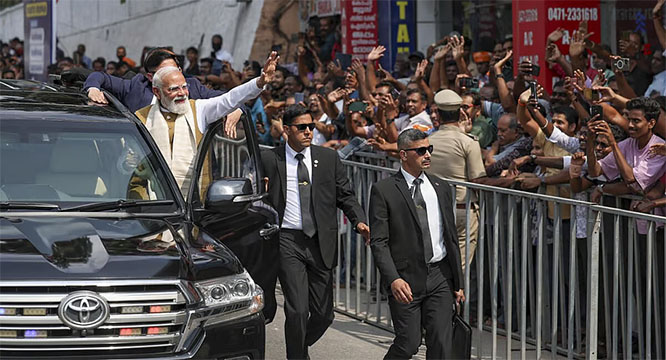
Prime Minister Narendra Modi, during his visit to Thiruvananthapuram on Friday, January 23, indicated that the Bharatiya Janata Party (BJP) is aiming to expand its political footprint in Kerala ahead of the Assembly elections scheduled in the coming months.

Speaking at a BJP-organised public meeting, Modi drew parallels between the party’s early electoral gains in Gujarat and its recent victory in the Thiruvananthapuram Municipal Corporation. The civic body win, which ended decades of Left control, was cited by the Prime Minister as a possible starting point for the party’s broader ambitions in the state.

Recalling BJP’s political trajectory in Gujarat, Modi said the party was largely insignificant before 1987 and received little media attention. He pointed out that the BJP’s first major breakthrough came with its victory in the Ahmedabad Municipal Corporation that year.

“Just as our journey in Gujarat began with one city, Kerala’s journey has also started with a single city,” Modi said, suggesting that the party’s municipal-level success could translate into wider electoral acceptance.

The Prime Minister alleged that successive governments led by the Left Democratic Front (LDF) and the United Democratic Front (UDF) had failed to adequately develop Thiruvananthapuram. He accused both fronts of corruption and neglect, claiming that basic infrastructure and facilities were denied to the capital city for decades.

According to Modi, the BJP’s control of the civic body represents a shift driven by public dissatisfaction with the existing political alternatives. He asserted that the BJP administration in Thiruvananthapuram had begun working towards development, though no specific details or timelines were outlined.

Addressing the gathering at Putharikandam Maidan, Modi said the BJP intended to project Thiruvananthapuram as a “model city,” reiterating his party’s commitment to governance-led change.

The Prime Minister’s visit to Kerala also included the inauguration of several development projects and the flagging off of new train services, as the BJP intensifies its political outreach in the poll-bound state.

Comments

Add new comment

  • Coastaldigest.com reserves the right to delete or block any comments.
  • Coastaldigset.com is not responsible for its readers’ comments.
  • Comments that are abusive, incendiary or irrelevant are strictly prohibited.
  • Please use a genuine email ID and provide your name to avoid reject.
News Network
February 1,2026

Bengaluru: The Karnataka High Court has refused to quash an investigation against a WhatsApp group administrator accused of allowing the circulation of obscene and offensive images depicting Hindutva politicians and idols in 2021.

Justice M Nagaprasanna observed that, prima facie, the ingredients of the offence under Section 295A of the Indian Penal Code were made out. “The offence under Section 295A of the IPC is met to every word of its ingredient, albeit prima facie,” the judge said.

The petitioner, Sirajuddin, a resident of Belthangady taluk in Dakshina Kannada district, had challenged the FIR registered against him at the CEN (Cyber, Economics and Narcotics) police station, Mangaluru, for offences under Section 295A of the IPC and Section 67 of the Information Technology Act. Section 295A relates to punishment for deliberate and malicious acts intended to outrage the religious feelings of any class of citizens.

According to the complaint filed by K Jayaraj Salian, also a resident of Belthangady taluk, he received a WhatsApp group link from an unknown source and was added to the group after accessing it. The group reportedly had six administrators and around 250 participants, where obscene and offensive images depicting Hindu deities and certain political figures were allegedly circulated repeatedly.

Sirajuddin was arrested in connection with the case and later released on bail on February 16, 2021. He argued before the court that he was being selectively targeted, while other administrators—including the creator of the group—were neither arrested nor investigated. He also contended that the Magistrate could not have taken cognisance of the offence under Section 295A without prior sanction under Section 196(1) of the CrPC.

Rejecting the argument, Justice Nagaprasanna held that prior sanction is required only at the stage of taking cognisance, and not at the stage of registration of the crime or during investigation.

The judge noted that the State had produced the entire investigation material before the court. “A perusal of the material reveals depictions of Hindu deities in an extraordinarily obscene, demeaning and profane manner. The content is such that its reproduction in a judicial order would itself be inappropriate,” the court said, adding that the material, on its face, had the tendency to outrage religious feelings and disturb communal harmony.

Observing that the case was still at the investigation stage, the court said it could not interdict the probe at this juncture. However, it expressed concern that the investigating officer appeared to have not proceeded uniformly against all administrators. The court clarified that if the investigation revealed the active involvement of any member in permitting the circulation of such content, they must also be proceeded against.

“At this investigative stage, any further observation by this Court would be unnecessary,” the order concluded.

Comments

Add new comment

  • Coastaldigest.com reserves the right to delete or block any comments.
  • Coastaldigset.com is not responsible for its readers’ comments.
  • Comments that are abusive, incendiary or irrelevant are strictly prohibited.
  • Please use a genuine email ID and provide your name to avoid reject.
News Network
January 23,2026

Karnataka Governor Thaawarchand Gehlot read only three lines from the 122-paragraph address prepared by the Congress-led state government while addressing the joint session of the Legislature on Thursday, effectively bypassing large sections critical of the BJP-led Union government.

The omitted portions of the customary Governor’s address outlined what the state government described as a “suppressive situation in economic and policy matters” under India’s federal framework. The speech also sharply criticised the Centre’s move to replace the Mahatma Gandhi National Rural Employment Guarantee Act (MGNREGA) with the Viksit Bharat–Guarantee for Rozgar and Ajeevika Mission (Gramin) Act, commonly referred to as the VB-GRAM (G) Act.

Governor Gehlot had earlier conveyed his objection to several paragraphs that were explicitly critical of the Union government. On Thursday, he confined himself to the opening lines — “I extend a warm welcome to all of you to the joint session of the State legislature. I am extremely pleased to address this august House” — before jumping directly to the concluding sentence of the final paragraph.

He ended the address by reading the last line of paragraph 122: “Overall, my government is firmly committed to doubling the pace of the State’s economic, social and physical development. Jai Hind — Jai Karnataka.”

According to the prepared speech, the Karnataka government demanded the scrapping of the VB-GRAM (G) Act, describing it as “contractor-centric” and detrimental to rural livelihoods, and called for the full restoration of MGNREGA. The state government argued that the new law undermines decentralisation, weakens labour protections, and centralises decision-making in violation of constitutional norms.

Key points from the unread sections of the speech:

•    Karnataka facing a “suppressive” economic and policy environment within the federal system

•    Repeal of MGNREGA described as a blow to rural livelihoods

•    VB-GRAM (G) Act accused of protecting corporate and contractor interests

•    New law alleged to weaken decentralised governance

•    Decision-making said to be imposed by the Centre without consulting states

•    Rights of Adivasis, women, backward classes and agrarian communities curtailed

•    Labourers allegedly placed under contractor control

•    States facing mounting fiscal stress due to central policies

•    VB-GRAM (G) Act accused of enabling large-scale corruption

Comments

Add new comment

  • Coastaldigest.com reserves the right to delete or block any comments.
  • Coastaldigset.com is not responsible for its readers’ comments.
  • Comments that are abusive, incendiary or irrelevant are strictly prohibited.
  • Please use a genuine email ID and provide your name to avoid reject.