




Gulf Dirt Track National Championship on March 17, 18

[email protected] (CD Network)
March 9, 2012

GulfT_1

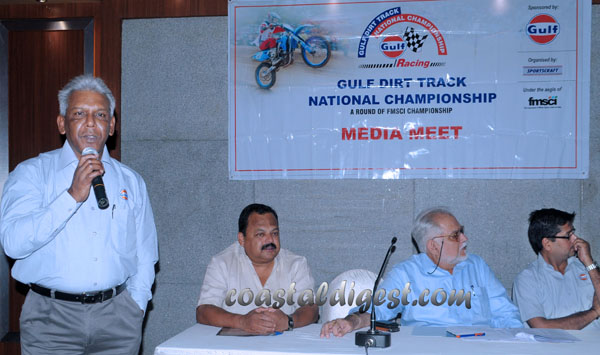
Mangalore, March 9: The country's best two wheeler riders will be in action in the opening round of the Gulf Dirt Track National Championship 2012, a round of FMSCI National Championship.

The popular Dirt Track National Championship sponsored by Gulf Oil Corporation for the year 2012 will be held in Mangalore on March 17 and 18.

The event will be organized by Mumbai's Sportscraft in association with Mangalore Motor Sports Association and this will be the first five rounds of this FMSCI championship and will be held at the Fisheries College ground, Mangalore.

The total points garnered by the riders over the five rounds of the Gulf Dirt Track National Championship from the last couple of years, the Mangalore leg should be very competitive.

For those unfamiliar with the event, Dirt track racing is like an F1 race on motorcycles, where riders after a mass start speed around a serpentine track, on natural surface often slushy at places looking to cross the finish first.

The race is an exercise in judicious maneuvering and good balance of the bike aroud the many sharp bends. There will be a total of 6 classes in championship round. The riders will fight for the honour as well as the total prize money of Rs 1,75,000 along with the trophies which will be awarded. Whereas for the champions who garner maximum points in all five rounds a total prize money of Rs 4,50,000 and trophies will be awarded.

For racing enthusiasts of Mangalore a treat awaits. Besides some class riding they will also have the opportunity to see latest dirt racing bikes from the TVS Motors, Yamaha and Honda stables. Riders from all over India will be seen in action. Bangalore based- TVS riders Pramod Joshua ,R Natraj who all excelled last season in the glamour class of the event ,Indian expert group A (foreign modified bikes), will be challenged by Harit Noah,Siddhanth Nayak, Adnan Ahmed ,Alen Sequeira, Javed Shaikh , Joaquim D'Silva from Goa, Vineeth Kurup, Shamim Khan and Ganesh Lokhande from Nashik will join the fray.

There will be stiff competition private group B class riders like Jagjith Singh, Kannan Naidu, Kshitij Shukla from Mumbai ,Kush Rao from Goa, Maansingh Thakur from Nashik, Firoz Khan, Ismail Shaikh and Akash Satpute from Aurangabad ,Suhail Ahmed and Wishvas S D from Bangalore.

Yuva Kumar and Abhijeeth Shetty riders from TVS team will be in action in Novice class to challenge them will be Aditya Thakkar,Anish Nair from Nashik,Kieth Das, Wasim Shaikh and Irfan Killedar from Goa.

Sportscraft has already received 95 entries. A maximum of 25 entries per classification will be accepted.

Additionally, there will be separate events for Karnataka and Mangalore riders. The standard entries closed on Wednesday March 7, 2012 and late entries will closes on March 13.

Entry forms and Supplementary regulation are available at the Sportscraft office, Chitrakut ,3 rd floor,Siri Road, Chowpatty Bandstand, Mumbai 400 006, or, on site www.sportscraftindia.com. However all the entries will have to reach Sportcraft before Tuesday March 13.

GulfT_2

Comments

Add new comment

  • Coastaldigest.com reserves the right to delete or block any comments.
  • Coastaldigset.com is not responsible for its readers’ comments.
  • Comments that are abusive, incendiary or irrelevant are strictly prohibited.
  • Please use a genuine email ID and provide your name to avoid reject.
News Network
February 5,2026

In an era where digital distractions are the primary rival to academic excellence, the Karnataka Education Department is taking the fight directly to the living room. As the SSLC (Class 10) annual examinations loom, officials have launched a localized "digital strike" to ensure students aren't losing their competitive edge to scrolling or soap operas.

The 7-to-9 Lockdown

The department has issued a formal directive urging—and in some cases, enforcing via home visits—a total blackout of mobile phones and television sets between 7:00 PM and 9:00 PM. This two-hour window is being designated as "sacred study time" across the state until the examinations conclude on April 2.

Key Pillars of the Initiative:

•    Doorstep Advocacy: Teachers are transitioning from classrooms to living rooms, meeting parents to explain the psychological benefits of a distraction-free environment.

•    Parental Accountability: The campaign shifts the burden of discipline from the student to the household, asking parents to lead by example and switch off their own devices.

•    The Timeline: The focus remains sharp on the upcoming exam block, scheduled from March 18 to April 2.

"The objective is simple: uninterrupted focus. We are reclaiming the evening hours for the students, ensuring their environment is as prepared as their minds," stated a senior department official.

Student vs. Reality

While the student community has largely welcomed the "forced focus"—with many admitting they lack the willpower to ignore notifications—the move has sparked a debate on enforceability. Without a "TV Police," the success of this initiative rests entirely on the shoulders of parents and the persuasive power of visiting educators.

Comments

Add new comment

  • Coastaldigest.com reserves the right to delete or block any comments.
  • Coastaldigset.com is not responsible for its readers’ comments.
  • Comments that are abusive, incendiary or irrelevant are strictly prohibited.
  • Please use a genuine email ID and provide your name to avoid reject.
News Network
February 5,2026

Bengaluru: As air quality continues to worsen across several parts of the city, hospitals in Bengaluru are reporting a steady rise in patients suffering from respiratory illnesses such as asthma, bronchitis and Chronic Obstructive Pulmonary Disease (COPD), health officials and doctors said.

Data from the Suvarna Arogya Suraksha Trust (SAST) shows that 3,891 patients received treatment for respiratory ailments between April and November 2024. The figure rose to 4,187 during the same period in 2025.

Private hospitals, too, are witnessing a 10–15 per cent year-on-year increase in such cases.

While doctors caution that the rise cannot be attributed solely to air pollution, a significant number of patients are non-smokers with no prior history of respiratory disease.

“Nearly 70 per cent of the patients we see are non-smokers with no previous respiratory issues. When other causes are ruled out, air pollution emerges as the most likely factor,” said Dr Manjunath PH, consultant interventional pulmonologist at a hospital in Kengeri.

Doctors noted that patient footfall spikes during the winter months and around Deepavali, when air quality typically worsens.

“There is a clear correlation between poor air quality and the rise in cases. People commonly present with persistent cough, breathlessness and irritation of the respiratory tract, indicating the impact of polluted air on their health,” said Dr Sheetal Chaurasia, consultant in pulmonary medicine at a private hospital in Whitefield.

Dr Chaurasia added that respiratory tract infections are also on the rise.

“Poor air quality leads to chronic airway inflammation, making the airways more vulnerable to infections. We are seeing an increase in both upper and lower respiratory tract infections,” she said.

Patients with pre-existing respiratory conditions remain the worst affected.

“For those already diagnosed with respiratory illnesses, deteriorating air quality significantly worsens the condition. Both the frequency and severity of attacks increase sharply,” said Dr Vandana P, a pulmonologist at a hospital on Bannerghatta Road.

Doctors also flagged a worrying trend of rising respiratory problems among younger adults and children.

To reduce exposure, they advised people to wear masks while travelling on two-wheelers or autos and ensure adequate ventilation at home to minimise indoor air pollution.

Comments

Add new comment

  • Coastaldigest.com reserves the right to delete or block any comments.
  • Coastaldigset.com is not responsible for its readers’ comments.
  • Comments that are abusive, incendiary or irrelevant are strictly prohibited.
  • Please use a genuine email ID and provide your name to avoid reject.
News Network
January 23,2026

Mangaluru: The Karnataka Government Polytechnic (KPT), Mangaluru, has achieved autonomous status from the All India Council for Technical Education (AICTE), becoming the first government polytechnic in the country to receive such recognition in its 78-year history. The status was granted by AICTE, New Delhi, and subsequently approved by the Karnataka Board of Technical Education in October last year.

Officials said the autonomy was conferred a few months ago. Until recently, AICTE extended autonomous status only to engineering colleges, excluding diploma institutions. However, with a renewed national focus on skill development, several government polytechnics across India have now been granted autonomy.

KPT, the second-largest polytechnic in Karnataka, was established in 1946 with four branches and has since expanded to offer eight diploma programmes, including computer science and polymer technology. The institution is spread across a 19-acre campus.

Ravindra M Keni, the first dean of the institution, told The Times of India that AICTE had proposed autonomous status for polytechnic institutions that are over 25 years old. “Many colleges applied. In the first round, 100 institutions were shortlisted, which was further narrowed down to 15 in the second round. We have already completed one semester after becoming an autonomous institution,” he said. He added that nearly 500 students are admitted annually across eight three-year diploma courses.

Explaining the factors that helped KPT secure autonomy, Keni said the institution has consistently recorded 100 per cent admissions and placements for its graduates. He also noted its strong performance in sports, with the college emerging champions for 12 consecutive years, along with active student participation in NCC and NSS activities.

Autonomous status allows KPT to design industry-oriented curricula, conduct examinations, prepare question papers, and manage academic documentation independently. The institution can also directly collaborate with industries and receive priority funding from AICTE or the Ministry of Education. While academic autonomy has been granted, financial control will continue to rest with the state government.

“There will be separate committees for examinations, question paper setting, boards of studies, and boards of examiners. The institution will now have the freedom to conduct admissions without government notifications and issue its own marks cards,” Keni said, adding that new academic initiatives would be planned after a year of functioning under the autonomous framework.

Comments

Add new comment

  • Coastaldigest.com reserves the right to delete or block any comments.
  • Coastaldigset.com is not responsible for its readers’ comments.
  • Comments that are abusive, incendiary or irrelevant are strictly prohibited.
  • Please use a genuine email ID and provide your name to avoid reject.