



Haj 1435: Yet another success story

October 6, 2014

Haj 1435

Mina, Oct 6: Haj has never been so organized — from the trains that run on elevated tracks to the extremely helpful security forces on the ground and in the many helicopters that hover overhead informing the central operations command about possible bottlenecks.

Saudi Arabia has poured billions of riyals into infrastructure here at the holy sites. Most of these gigantic projects have been carried out in the last five years. They have helped ease the pilgrimage for the millions who come from the four corners of the world every year to perform the annual pilgrimage.

“Only Saudi Arabia can do this,” said Mohammed Shahnawaz, an Indian pilgrim from Delhi. His wife, Samreen, nodded in affirmation. “We were told by people who performed Haj in the past, that it would be very hard, very tough.”

Of course, Shahnawaz’s informants were referring to a time when Mina did not have a massive Jamrat complex with multiple layers featuring multiple entry and exit points. Stampedes were a regular occurrence because the pedestrian bridge was too small to serve millions of pilgrims performing the same task of stoning the devil within a limited time.

“People have no idea about the trains that have made the movement of pilgrims from Mina to Arafat and back a breeze. The thrill that you experience when you board a train is indescribable,” said Samreen. “It gives us energy and provides us with a new lease of life. Earlier pilgrims had no such luxury. They walked from one end of Arafat to the other end of Mina in order to reach Jamarat, a distance of nearly 10 km.”

Shahnawaz’s fellow pilgrims paid fulsome tribute to Saudi Arabia, its leadership and its warm and helpful people. “Allah has bestowed upon them rare honor and they have lived up to the expectations of the Ummah. They have provided services that seem impossible,” he said. “May Allah grant Custodian of the Two Holy Mosques King Abdullah and Crown Prince Salman a long life. We will always pray for them. They have taken excellent care of the guests of God.”

Ibrahim Khaleel from Karachi, Pakistan, said he was at the Haj in 2006. “Performing the stoning ritual was fraught with dangers. My mother was with me then and she is also here now,” he said. “At that time, I performed the stoning ritual on her behalf. This time, however, she accompanied me to the Jamarat Bridge and she herself stoned the walls representing the devil on Sunday,” he said.

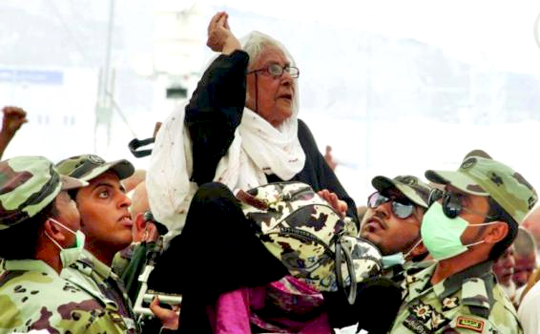
Khaleel wept when he recalled the help provided by the security forces manning the complex. “They took my mother on their shoulders and carried her to the very wall itself so that she could easily throw the stones,” he said. “My mother’s reaction was to bless them. She put her hand on their heads and told them, ‘Your king is a good man, and because he is good and kind, Allah has given the honor to him of being the Custodian of the Holiest Mosques in Islam.’“

At the time of writing, Interior Minister Prince Mohammed bin Naif was visiting tents to check whether proper arrangements had been made. That personal care for the guests of God has endeared the Saudi leadership to all Muslims who perform the Haj. As one pilgrim said, “Allah will bless them with His bounties more than ever because they have done everything they can to ease the pilgrimage.”

Comments

Add new comment

  • Coastaldigest.com reserves the right to delete or block any comments.
  • Coastaldigset.com is not responsible for its readers’ comments.
  • Comments that are abusive, incendiary or irrelevant are strictly prohibited.
  • Please use a genuine email ID and provide your name to avoid reject.
News Network
November 28,2025

fire.jpg

Several Syrians were killed and more than two dozen others injured in Israeli strikes on the outskirts of Damascus, amid intensified incursions by the occupying regime since the fall of former president Bashar al-Assad and the rise of Hayat Tahrir al-Sham (HTS) rule.

Syrian state TV reported that the casualties occurred during an overnight Israeli assault involving helicopters and drones on the town of Beit Jinn in the Damascus countryside. The attack followed an Israeli military unit’s entry into the town, where they were surrounded by local residents, leading to gunfire and direct confrontations.

According to the report, “The occupation army’s helicopters and artillery shelled Beit Jinn, located at the foothills of Mount Hermon, resulting in 13 martyrs and 25 injured civilians.” The broadcaster did not specify the full extent of damage.

Al-Ikhbariyah Syria confirmed that the shelling coincided with Israeli soldiers entering Beit Jinn, while artillery pounded surrounding areas. The broadcaster stated that the escalation began after local residents clashed with an Israeli patrol that had infiltrated the southern town and “kidnapped” three young men.

Following a two-hour exchange of heavy fire, Israeli forces withdrew and repositioned on the hill of Butt al-Warda at the town’s outskirts.

Israeli media acknowledged that six soldiers were wounded in the clashes—three of them seriously—describing the confrontation as a “sudden ambush” that forced the deployment of reserve units and air support to secure an exit route. No further details were provided.

The aggression has fueled renewed displacement from Beit Jinn, with residents fleeing to nearby villages amid increasingly frequent Israeli attacks.

The raid came just a day after Israeli troops carried out another ground incursion into Umm al-Luqas village in Quneitra province. According to SANA, an Israeli unit in four vehicles entered the village, raided several homes, and later withdrew.

Syria condemned the repeated incursions as violations of the 1974 Disengagement Agreement and UN resolutions, urging the international community to enforce compliance and pressure Israel to halt its operations and withdraw fully.

Israel has expanded its attacks across Syrian territory following the collapse of the Assad government last year. Prime Minister Benjamin Netanyahu has reportedly instructed his forces to push deeper into Syrian territory and seize strategic positions.

Meanwhile, critics say the HTS-led interim government’s inaction and growing normalization gestures toward Israel have emboldened Tel Aviv to intensify its military operations. HTS, formerly linked to al-Qaeda, seized control of Damascus last December, formally ending Assad’s rule.

Comments

Add new comment

  • Coastaldigest.com reserves the right to delete or block any comments.
  • Coastaldigset.com is not responsible for its readers’ comments.
  • Comments that are abusive, incendiary or irrelevant are strictly prohibited.
  • Please use a genuine email ID and provide your name to avoid reject.