



High stakes for Macron as France weighs Syria strike

Agencies
April 12, 2018

Paris, Apr 12: In laying his integrity on the line over Syria's suspected use of chemical weapons, French President Emmanuel Macron might be playing for even higher stakes -- maintaining the landmark Iran nuclear accord, analysts say.

The 40-year-old leader, weighing the first foreign military operation on his own initiative, has made clear he considers Damascus behind a suspected chemical attack in the rebel-held Syrian town of Douma last weekend that killed at least 40 people.

Macron's response is expected to be high on the agenda during a TV interview this afternoon, only his third since the centrist swept to power last year.

For many experts, he has no choice but to enforce his "red line" on the use of chemical weapons by the Syrian regime, which would prompt French military strikes.

"Unlike previous incidents, alleged or real, in recent months, what happened Saturday in Douma is a huge and evident violation of Western red lines," said Bruno Tertrais, a political scientist at the Foundation for Strategic Research (FRS). "If France doesn't react now that the conditions are met, we would lose all credibility," he said.

The country, victim of the first extensive use of chemical weapons in military history during World War I, has long made combatting chemical weapons a priority.

It worries that allowing such attacks by Syria's President Bashar al-Assad could set a dangerous precedent for other repressive regimes.

Many French officials still bristle over former US president Barack Obama's last-minute pullback on Syria strikes after a chemical attack in 2013.The decision shocked the French, whose planes were poised for launch to participate in the operation.

"Emmanuel Macron has tied his hands," said Francois Heisbourg of the International Institute for Strategic Studies in London. "He's in the same position as Obama in 2013, and if he decides not to follow through, there will be a political price to pay."

Macron has spoken at length with US President Donald Trump about how to react to the Douma attack. Both men have played up their sound relations since Macron invited the American leader to attend France's Bastille Day festivities last July.

Macron has also taken advantage of weakened leadership in Britain and Germany to carve out a role as Trump's privileged partner in Europe. But he has been unable to sway the US leader on two crucial issues -- the US decision to exit the 2015 Paris agreement on curbing global warming, and Trump's threat to scupper the deal with Iran to curb its nuclear weapons programme.

Several analysts say ending the deal with Tehran and re-imposing American sanctions could inflame tensions across the Middle East, after years of tensions amid the fight against the Islamic State group.

As Macron prepares for a state visit to Washington later this month, "French military action could earn him some much-needed favour," Benjamin Haddad, a researcher at the Hudson Institute, wrote in Foreign Policy magazine this week. Decisive joint action could give him leverage in arguing to uphold the deal, which comes up next for Trump's review on May 12.

"At the betting table of international relations, the chances are still 20 to one" against saving the deal, Heisbourg said.

Against such odds, "a show of France-US unity on Syria surely can't do any harm" during Macron's Washington visit, he said.

Comments

Add new comment

  • Coastaldigest.com reserves the right to delete or block any comments.
  • Coastaldigset.com is not responsible for its readers’ comments.
  • Comments that are abusive, incendiary or irrelevant are strictly prohibited.
  • Please use a genuine email ID and provide your name to avoid reject.
News Network
February 1,2026

Bengaluru, Feb 1: For travelers landing at Kempegowda International Airport (KIA), the sleek, wood-paneled curves of Terminal 2 promise a world-class welcome. But the famed “Garden City” charm quickly withers at the curb. As India’s aviation sector swells to record numbers—handling over 43 million passengers in Bengaluru alone this past year—the “last mile” has turned into a marathon of frustration.

The Bengaluru Logjam: Rules vs Reality

While the city awaits the 2027 completion of the Namma Metro Blue Line, the interim has been chaotic. Recent “decongestion” rules at Terminal 1 have pushed app-based cab pickups to distant parking zones, forcing weary passengers into a 20-minute walk with luggage.

“I landed after ten months away and felt like a stranger in my own city,” says Ruchitha Jain, a Koramangala resident. “My driver couldn’t find me, staff couldn’t guide me, and the so-called ‘Premium’ lane is just a fancy tax on convenience.”

•    The Cost of Distance: A 40-km cab ride can now easily cross ₹1,500, driven by demand pricing and airport surcharges.

•    The Bus Gap: While Vayu Vajra remains a lifeline, its ₹300–₹400 fare is often cited as the most expensive airport bus service in the country.

A National Pattern of Disconnect

The struggle is not unique to Karnataka. From Chennai’s coast to Hyderabad’s plateau, India’s airports tell a familiar story: brilliant runways, broken exits.

City:    Primary Issue   |    Recent Development

Bengaluru:    Cab pickup restrictions & distance  |    App-based taxis shifted to far parking zones; long walks and fare spikes reported

Chennai:    Multi-Level Parking (MLCP) hike  |    Passengers report 40-minute walks to reach cab pickup points

Hyderabad:    “Taxi mafia” & touting  |    Over 440 touting cases reported; security presence intensified

Mumbai:    Fare scams  |     Tourists charged ₹18,000 for just 400 metres, triggering police action

In Hyderabad, travelers continue to battle entrenched local groups that intimidate Uber and Ola drivers, pushing passengers toward overpriced private taxis. Chennai flyers, meanwhile, complain that reaching the designated pickup zones now takes longer than short-haul flights from cities like Coimbatore.

The ‘Budget Day’ Hope

As Finance Minister Nirmala Sitharaman presents the Union Budget 2026 today, the aviation sector is watching closely. With the government’s renewed emphasis on multimodal integration, there is cautious hope for funding toward seamless airport-metro-bus hubs.

The vision is clear: a future where planes, trains, and metros speak the same language. Until then, passengers at KIA—and airports across India—will continue to discover that the hardest part of flying isn’t the thousands of kilometres in the air, but the last few on the ground.

Comments

Add new comment

  • Coastaldigest.com reserves the right to delete or block any comments.
  • Coastaldigset.com is not responsible for its readers’ comments.
  • Comments that are abusive, incendiary or irrelevant are strictly prohibited.
  • Please use a genuine email ID and provide your name to avoid reject.
News Network
January 23,2026

Mangaluru: The Karnataka Government Polytechnic (KPT), Mangaluru, has achieved autonomous status from the All India Council for Technical Education (AICTE), becoming the first government polytechnic in the country to receive such recognition in its 78-year history. The status was granted by AICTE, New Delhi, and subsequently approved by the Karnataka Board of Technical Education in October last year.

Officials said the autonomy was conferred a few months ago. Until recently, AICTE extended autonomous status only to engineering colleges, excluding diploma institutions. However, with a renewed national focus on skill development, several government polytechnics across India have now been granted autonomy.

KPT, the second-largest polytechnic in Karnataka, was established in 1946 with four branches and has since expanded to offer eight diploma programmes, including computer science and polymer technology. The institution is spread across a 19-acre campus.

Ravindra M Keni, the first dean of the institution, told The Times of India that AICTE had proposed autonomous status for polytechnic institutions that are over 25 years old. “Many colleges applied. In the first round, 100 institutions were shortlisted, which was further narrowed down to 15 in the second round. We have already completed one semester after becoming an autonomous institution,” he said. He added that nearly 500 students are admitted annually across eight three-year diploma courses.

Explaining the factors that helped KPT secure autonomy, Keni said the institution has consistently recorded 100 per cent admissions and placements for its graduates. He also noted its strong performance in sports, with the college emerging champions for 12 consecutive years, along with active student participation in NCC and NSS activities.

Autonomous status allows KPT to design industry-oriented curricula, conduct examinations, prepare question papers, and manage academic documentation independently. The institution can also directly collaborate with industries and receive priority funding from AICTE or the Ministry of Education. While academic autonomy has been granted, financial control will continue to rest with the state government.

“There will be separate committees for examinations, question paper setting, boards of studies, and boards of examiners. The institution will now have the freedom to conduct admissions without government notifications and issue its own marks cards,” Keni said, adding that new academic initiatives would be planned after a year of functioning under the autonomous framework.

Comments

Add new comment

  • Coastaldigest.com reserves the right to delete or block any comments.
  • Coastaldigset.com is not responsible for its readers’ comments.
  • Comments that are abusive, incendiary or irrelevant are strictly prohibited.
  • Please use a genuine email ID and provide your name to avoid reject.
coastaldigest.com news network
February 5,2026

protestkerala.jpg

Mangaluru: The KSRTC Mangaluru division has rolled back the fare hike on buses operating on the Mangaluru–Kasaragod route following the suspension of toll collection at the Arikkady toll plaza near Kumbala in Kasaragod district.

The fare revision had been implemented after the National Highways Authority of India (NHAI) began toll collection at the Arikkady plaza on NH-66. As a result, fares for ordinary and Rajahamsa services were increased by ₹7 and ₹10, respectively, raising the bus fare from Mangaluru to Kasaragod from ₹81 to ₹88.

Senior Divisional Controller of KSRTC’s Mangaluru division, Rajesh Shetty, said the fares were reduced after toll collection at the Arikkady plaza was stopped. “The tollgate began operations on January 13, and the toll amount was deducted from the FASTag accounts of KSRTC buses operating on the route. Following an order from the central government to suspend toll collection, KSRTC has also withdrawn the additional fare with immediate effect,” he said.

At present, vehicles travelling on the Mangaluru–Kasaragod route pay toll only at the Talapady toll plaza. The toll for light motor vehicles (LMVs) at Talapady is ₹80 for a same-day return, while heavy vehicles, including buses, are charged ₹250. At Arikkady, the toll rates were ₹130 for LMVs (same-day return) and ₹450 for buses.

Protests against Arikkady toll plaza

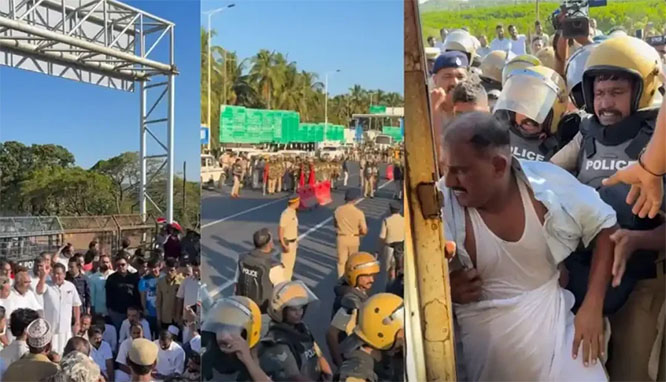
The Arikkady toll plaza witnessed widespread protests from January 12, the day toll collection commenced. On the second day, an action committee led by Manjeshwar MLA A K M Ashraf launched an indefinite protest at the site. Except for the BJP, leaders and workers of most major political parties participated in the agitation.

On the night of January 14, a large number of protesters gathered at the plaza and vandalised property, following which authorities temporarily suspended toll operations. The BJP later also expressed opposition to the toll plaza and criticised NHAI’s decision. 

Comments

Add new comment

  • Coastaldigest.com reserves the right to delete or block any comments.
  • Coastaldigset.com is not responsible for its readers’ comments.
  • Comments that are abusive, incendiary or irrelevant are strictly prohibited.
  • Please use a genuine email ID and provide your name to avoid reject.