'I don't want to hide' says Salman Rushdie, 30 yrs after Khomeini's fatwa

Agencies
February 11, 2019

Paris, Feb 11: After decades spent in the shadow of a death sentence pronounced by Ayatollah Ruhollah Khomeini, Salman Rushdie is quietly defiant.

"I don't want to live hidden away," he told AFP during a visit to Paris.

The novelist's life changed forever on February 14, 1989, when Iran's spiritual leader ordered Rushdie's execution after branding his novel "The Satanic Verses" blasphemous.

Like a kind of reverse Valentine, Tehran renewed the fatwa year after year.

Rushdie, who some say is the greatest writer India has produced since Tagore, spent 13 years living under a false name and constant police protection.

"I was 41 back then, now I am 71. Things are fine now," he said in September.

"We live in a world where the subject changes very fast. And this is a very old subject. There are now many other things to be frightened about -- and other people to kill," he added ruefully.

Rushdie stopped using an assumed name in the months after September 11 2001, three years after Tehran had said the threat against him was "over".

But armed plainclothes police nonetheless sat outside the door of his French publisher's office in Paris during an interview with AFP. Several others had taken up positions in the courtyard.

Earlier, Rushdie had assured a sceptical audience at a book festival in eastern France that he led a "completely normal life" in New York, where he has lived for nearly two decades.

"I take the subway," he said.

"The Satanic Verses" was Rushdie's fifth book, he has now written his 18th. Titled "The Golden House" it is about a man from Mumbai, who much like the author, reinvents himself in the Big Apple in a bid to shake off his past.

The dark years of riots, bomb plots and the murder of one of the book's translators and the shooting and stabbing of two others now "feels like a very long time ago," he said.

"Islam was not a thing. No one was thinking in that way," he explained of the period when "The Satanic Verses" was written.

"One of the things that has happened is that people in the West are more informed than they used to be," he added.

Even so, the book was greatly misunderstood, he insisted: "Really it's a novel about South Asian immigrants in London."

Rushdie's friend, the British Pakistani writer Hanif Kureishi, reckons no one "would have the balls today to write 'The Satanic Verses', let alone publish it."

But even Kureishi, who wrote an acclaimed novel "The Black Album" in its aftermath about young British Muslims radicalising themselves, admitted that he never saw the controversy coming when he read a proof copy.

He mused: "I didn't notice anything about it that might rouse the fundamentalists. I saw it as a book about psychosis, about newness and change."

Yet the fury it generated was a milestone in the rise of political Islam.

Indian author and journalist Salil Tripathi of PEN International, which campaigns for writers' rights, said he hoped major publishers would still be brave enough to publish "The Satanic Verses".

"I have not totally lost hope, but undoubtedly the Rushdie case has created a mental brake. A lot of subjects are now seen as taboo," he conceded.

"In India with Hindu nationalism, people are very wary about saying things about Hindu gods and goddesses because you don't know what might happen to you. The threat of the mob has grown phenomenally," Tripathi added.

Today, intimidation is carried out by foot soldiers rather than declared by governments, he said, suggesting that now all religious clerics have to do to rouse the angry masses is to voice their dislike for a publication.

He warned: "This is a frightening reality check for writers. There is competitive intolerance going on -- 'If Muslims can get the cartoons banned in Denmark, why can't we in Pakistan or India ban this Christian or Hindu writer from saying this or that?'"

Sean Gallagher, of the London-based Index on Censorship, said the world has not moved on much since the Rushdie affair.

"The issues we deal with now are the same. The debate over blasphemy laws is part of a cyclical conversation that is pretty necessary. It's important we continue to be vigilant about freedom of expression and have these cultural dialogues," he explained.

Rushdie himself is equally philosophical. Asked if he should have written the book, he replied, "I take the Edith Piaf position: Je ne regrette rien (I regret nothing)," quoting the French singer's famous anthem of battered defiance.

Comments

Add new comment

  • Coastaldigest.com reserves the right to delete or block any comments.
  • Coastaldigset.com is not responsible for its readers’ comments.
  • Comments that are abusive, incendiary or irrelevant are strictly prohibited.
  • Please use a genuine email ID and provide your name to avoid reject.
News Network
January 20,2026

DGP.jpg

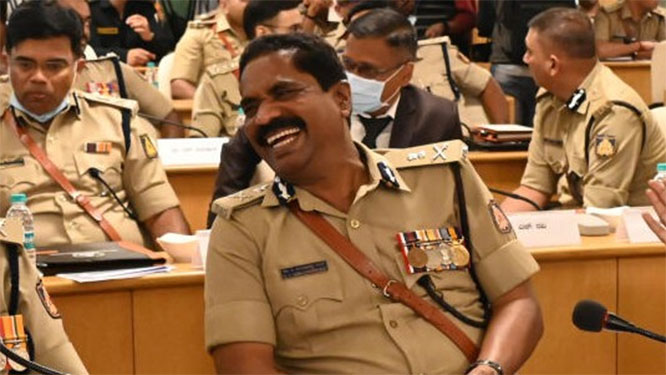
Karnataka DGP (Civil Rights Enforcement) K Ramachandra Rao was suspended with immediate effect, as per a state government order issued on Monday, 19 January. The order cited conduct unbecoming of a government servant and causing embarrassment to the state administration.

The Karnataka government suspended Rao after a purported video showed him in a compromising position with a woman inside his official chamber. The video went viral on social media. Rao rejected the videos outright, terming them "fabricated and false".

Who is K Ramachandra Rao?

Rao is a DGP-rank officer who was heading the Directorate of Civil Rights Enforcement until his suspension. He was promoted to DGP in September 2023 and assumed office in October 2023, the Sunday Guardian reported.

He also served as the Chairman and Managing Director of the Karnataka State Police Housing and Infrastructure Development Corporation Limited.

His stint as the Inspector General of Police (IGP) for the Southern Range was also marred by controversy. In 2014, during a cash seizure near Mysuru’s Yelwal, officials claimed the seized amount was ₹20 lakh, while the accused (Kerala-based merchants) claimed it was around ₹2.27 crore.

Rao, who was present during the seizure, denied all allegations. However, he was transferred soon after.

Allegations of collusion with a businessman surfaced, and a senior police officer was quoted by The Sunday Guardian as saying, “In Rao’s case, the CID has clearly mentioned that there was a great degree of lapse on the part of Rao and a deputy superintendent of police after it was brought to their notice that a few policemen, including a gunman attached to the IGP, were involved in the robbery.”

Rao had denied all wrongdoing in that incident. Despite past controversies, he rose to the state’s top police position, the Sunday Guardian reported.

Ranya Rao’s stepfather

Rao is the stepfather of Kannada actress Harshavardhini Ranya alias Ranya Rao, accused of orchestrating the illegal import of gold worth over ₹12.56 crore from Dubai to India along with two others — businessman Tarun Raju, and jewellery dealer Sahil Jain.

‘Obscene video’ controversy

A viral video showed Rao behaving inappropriately with a woman inside his office while in uniform.

The Karnataka government said in its Monday order that “vide videos and news reports widely broadcast on public news channels and media platforms, it is observed that Dr K Ramachandra Rao has acted in an obscene manner which is unbecoming of a Government Servant and also causing embarrassment to the Government.”

The order said the matter was examined by the state government, which found that the officer's conduct amounted to a violation of Rule 3 of the All India Services (Conduct) Rules, 1968.

The government said it is prima facie satisfied that "it is necessary to place Rao under suspension with immediate effect, pending inquiry".

During the suspension period, Rao will be entitled to subsistence allowance as per Rule 4 of the All India Services (Discipline and Appeal) Rules, 1969.

The order also places restrictions on his movement, stating that during the period of suspension, the officer must not leave headquarters under any circumstances without the written permission of the state government.

Comments

Add new comment

  • Coastaldigest.com reserves the right to delete or block any comments.
  • Coastaldigset.com is not responsible for its readers’ comments.
  • Comments that are abusive, incendiary or irrelevant are strictly prohibited.
  • Please use a genuine email ID and provide your name to avoid reject.
News Network
January 23,2026

modIKERALA.jpg

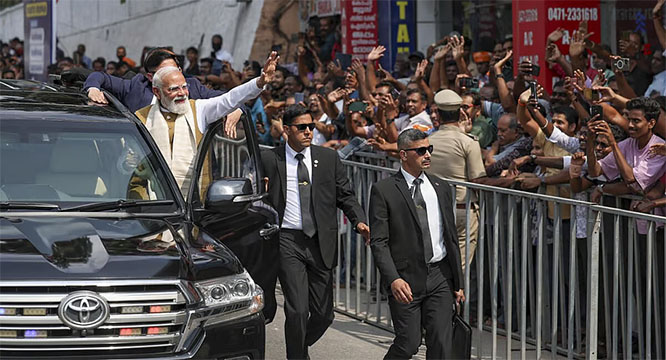
Prime Minister Narendra Modi, during his visit to Thiruvananthapuram on Friday, January 23, indicated that the Bharatiya Janata Party (BJP) is aiming to expand its political footprint in Kerala ahead of the Assembly elections scheduled in the coming months.

Speaking at a BJP-organised public meeting, Modi drew parallels between the party’s early electoral gains in Gujarat and its recent victory in the Thiruvananthapuram Municipal Corporation. The civic body win, which ended decades of Left control, was cited by the Prime Minister as a possible starting point for the party’s broader ambitions in the state.

Recalling BJP’s political trajectory in Gujarat, Modi said the party was largely insignificant before 1987 and received little media attention. He pointed out that the BJP’s first major breakthrough came with its victory in the Ahmedabad Municipal Corporation that year.

“Just as our journey in Gujarat began with one city, Kerala’s journey has also started with a single city,” Modi said, suggesting that the party’s municipal-level success could translate into wider electoral acceptance.

The Prime Minister alleged that successive governments led by the Left Democratic Front (LDF) and the United Democratic Front (UDF) had failed to adequately develop Thiruvananthapuram. He accused both fronts of corruption and neglect, claiming that basic infrastructure and facilities were denied to the capital city for decades.

According to Modi, the BJP’s control of the civic body represents a shift driven by public dissatisfaction with the existing political alternatives. He asserted that the BJP administration in Thiruvananthapuram had begun working towards development, though no specific details or timelines were outlined.

Addressing the gathering at Putharikandam Maidan, Modi said the BJP intended to project Thiruvananthapuram as a “model city,” reiterating his party’s commitment to governance-led change.

The Prime Minister’s visit to Kerala also included the inauguration of several development projects and the flagging off of new train services, as the BJP intensifies its political outreach in the poll-bound state.

Comments

Add new comment

  • Coastaldigest.com reserves the right to delete or block any comments.
  • Coastaldigset.com is not responsible for its readers’ comments.
  • Comments that are abusive, incendiary or irrelevant are strictly prohibited.
  • Please use a genuine email ID and provide your name to avoid reject.
News Network
January 20,2026

Mangaluru: In a major step towards strengthening rural innovation, the Office of the Principal Scientific Adviser (PSA) to the Government of India is supporting the establishment of RuTAGe Smart Village Centres (RSVCs) across the country through collaborations with academic institutions, civil society organisations and philanthropic partners.

As part of this national initiative, Nitte (Deemed to be University) will set up the first RSVCs in the region at Nitte GP in Udupi district and at the Nitte Health Centre, Sevanjali Trust, Farangipete, in Dakshina Kannada district. The centres will be inaugurated on January 21. In South India, the programme is being implemented by the Section Infin-8 Foundation (SI-8).

Speaking to reporters on Monday, SI-8 founder-director Vishwas US said experts from Nitte University and SI-8 would work closely with farmers, students, youth and local entrepreneurs to adapt and deploy technologies tailored to local needs.

Project head Prof Iddya Karunasagar, representing Nitte DU, said the RSVCs at Nitte and Farangipete would serve as demonstration hubs for a wide range of agriculture, energy, skill-development and assistive technologies. These include solar dryers for fruits, vegetables and crops; soil-testing solutions; power weeders and women-friendly farm tools; wind-powered devices for rural artisans; grain storage systems; grass-cutting and tree-climbing equipment; and liquid fertiliser production using cowshed waste.

SI-8 CEO Aravind C Kumar said the centres would also provide access to digital and knowledge-based platforms such as ISRO applications, government scheme portals, market linkage tools and gamified learning resources, along with assistive technologies for persons with visual impairments.

Highlighting the broader impact of the initiative, Principal Scientific Adviser Prof Ajay Kumar Sood said it demonstrated how applied research could bridge the rural–urban divide and help create self-reliant, technology-enabled villages.

The initiative has been made possible through philanthropic support from Dr NC Murthy of ACM Business Solutions, LLC, USA. Dr Sapna Poti, Director (Strategic Alliances) at the Office of the Principal Scientific Adviser, said the long-term objective is to build self-sufficient, technology-driven communities capable of generating sustainable livelihoods on their own.

Comments

Add new comment

  • Coastaldigest.com reserves the right to delete or block any comments.
  • Coastaldigset.com is not responsible for its readers’ comments.
  • Comments that are abusive, incendiary or irrelevant are strictly prohibited.
  • Please use a genuine email ID and provide your name to avoid reject.