



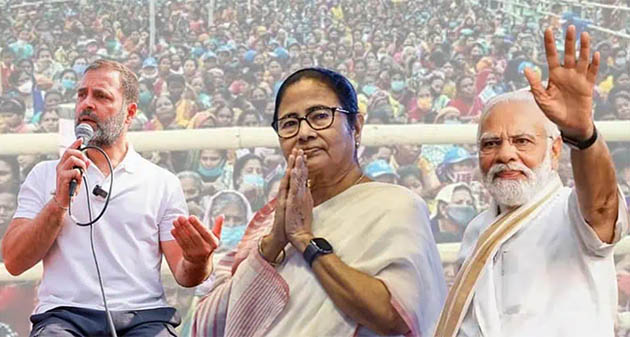
After Congress-TMC break up, BJP bets on Ram Mandir, CAA for 35 Lok Sabha seats in Bengal

News Network
February 11, 2024

bengalpolitics.jpg

Kolkata, Feb 11: Struggling to gain political traction on issues of corruption, the West Bengal BJP is shifting its focus to emotive topics such as the Ram Temple in Ayodhya and the Citizenship Amendment Act (CAA) in a bid to achieve its target of securing 35 out of the 42 Lok Sabha seats from the state.

The BJP's strategy is buoyed by the decision of the Trinamool Congress to contest alone in the upcoming Lok Sabha elections in West Bengal, breaking away from the I.N.D.I.A. bloc in the state.

This move has raised hopes within the saffron camp of consolidating anti-TMC votes, a trend evident in the party's surge from a 17 per cent vote share in 2014 to 40 per cent in 2019, resulting in 18 Lok Sabha seats.

Despite facing internal strife and electoral setbacks since its defeat in the 2021 assembly polls, the BJP's attempts to capitalise on corruption allegations against the Mamata Banerjee government have fallen short. With a target of winning 35 out of the 42 Lok Sabha seats, the BJP is now banking on emotive issues like the Ram Temple and CAA.

"Both inauguration of Ram Temple and implementation of CAA are core issues of the party," Agnimitra Paul, BJP state general secretary told PTI.

She emphasised the party's resonance with voters in Bengal by saying, "Both the issues are emotive, and people can connect with it."

An idol of the new Ram Lalla was consecrated at the Ayodhya temple on January 22, the event coming just months ahead of the Lok Sabha elections and 34 years after BJP veteran L K Advani's iconic 'Mandir Wahin Banayenge' speech during his Rath yatra that shaped Ram Mandir politics.

Echoing this sentiment, BJP MP and former state president Dilip Ghosh underscored the emotive appeal of these issues, asserting their historical significance in uniting Hindu voters and addressing refugee concerns, particularly among the Matua community.

"The promise of implementing the CAA has played a significant role in BJP's electoral successes," said Ghosh.

"The Ram temple issue has benefitted the BJP in the past, and this time too, it will help us to unite the Hindus across the country, including Bengal," the BJP leader said during whose tenure as state president from 2015 to 2021 the party had witnessed a meteoric rise in the state.

The Matuas, a significant portion of the state's Scheduled Caste population, have been migrating to West Bengal since the 1950s, fleeing religious persecution in East Pakistan, now Bangladesh.

Their cohesive voting behaviour makes them a valuable voting bloc, particularly in alignment with the BJP's stance on the CAA.

Riding on the promises of the Citizenship Amendment Act (CAA) and the National Register of Citizens (NRC), the Matua community in 2019 voted en masse for the saffron camp in the state.

The CAA, enacted by the BJP-led central government in 2019, seeks to grant Indian citizenship to persecuted non-Muslim migrants, including Hindus, Sikhs, Jains, Buddhists, Parsis, and Christians, from Bangladesh, Pakistan, and Afghanistan who entered India before December 31, 2014.

Union Minister and Matua leader Shantanu Thakur had recently said the CAA will be implemented soon, amidst reports that rules of the legislation would be framed before the Lok Sabha polls.

While the BJP aims for over 35 seats, insiders indicate a more pragmatic goal of 24.

Speaking on the issue of BJP resorting back to Ram Mandir and CAA to win the election in the state, party leaders said it reflects an 'acknowledgement of organisational challenges and a desire to counter the Trinamool's narrative of Bengali sub-nationalism'.

"Organisationally, we are not in a very good situation where we can claim that we will win 35 seats in the state. Second, as this is the Lok Sabha election, the TMC's pitch of Bengali sub-nationalism won't blunt our narrative, unlike the assembly polls," a senior state BJP leader said.

The TMC has fanned the 'Bengali pride' and had created a poll narrative of sub-nationalism to counter BJP's identity politics in the 2021 assembly polls.

The party also pointed out that the break-up of the INDIA bloc in Bengal with TMC deciding to fight alone will further help in consolidation of the anti-TMC votes in BJP's account.

"After the Left and Congress alliance fell apart in West Bengal in 2019, it had led to a four-cornered contest with BJP bagging the entire chunk of the anti-TMC votes in the state. This time too, we are hopeful that despite the Left-Congress alliance, we will gain the most," a BJP leader said.

Responding to the BJP's strategy, the Trinamool Congress remains confident in its appeal to voters, dismissing BJP's communal politics as ineffective.

TMC spokesperson Kunal Ghosh said "voters will support Mamata Banerjee to thwart BJP's divisive tactics in Bengal."

Political analyst Maidul Islam suggested that the BJP's reliance on emotive issues stems from its organisational weaknesses.

"Issues like the Ram Temple, Uniform Civil Code (UCC), and CAA will dominate the narrative in upcoming Lok Sabha polls in Bengal, with polarisation and counter-polarisation at play," he said.

Comments

Add new comment

  • Coastaldigest.com reserves the right to delete or block any comments.
  • Coastaldigset.com is not responsible for its readers’ comments.
  • Comments that are abusive, incendiary or irrelevant are strictly prohibited.
  • Please use a genuine email ID and provide your name to avoid reject.
News Network
December 13,2025

New Delhi: School-going children are picking up drug and smoking habits and engaging in consumption of alcohol, with the average age of introduction to such harmful substances found to be around 13 years, suggesting a need for earlier interventions as early as primary school, a multi-city survey by AIIMS-Delhi said.

The findings also showed substance use increased in higher grades, with grade XI/XII students two times more likely to report use of substances when compared with grade VIII students. This emphasised the importance of continued prevention and intervention through middle and high school.

The study led by Dr Anju Dhawan of AIIMS's National Drug Dependence Treatment Centre, published in the National Medical Journal of India this month, looks at adolescent substance use across diverse regions.

The survey included 5,920 students from classes 8, 9, 11 and 12 in urban government, private and rural schools across 10 cities -- Bengaluru, Chandigarh, Delhi, Dibrugarh, Hyderabad, Imphal, Jammu, Lucknow, Mumbai, and Ranchi. The data were collected between May 2018 and June 2019.

The average age of initiation for any substance was 12.9 (2.8) years. It was lowest for inhalants (11.3 years) followed by heroin (12.3 years) and opioid pharmaceuticals (without prescription; 12.5 years).

Overall, 15.1 per cent of participants reported lifetime use, 10.3 per cent reported past year use, and 7.2 per cent reported use in the past month of any substance, the study found.

The most common substances used in the past year, after tobacco (4 per cent) and alcohol (3.8 per cent), were opioids (2.8 per cent), followed by cannabis (2 per cent) and inhalants (1.9 per cent). Use of non-prescribed pharmaceutical opioids was most common among opioid users (90.2 per cent).

On being asked, 'Do you think this substance is easily available for a person of your age' separately for each substance category, nearly half the students (46.3 per cent) endorsed that tobacco products and more than one-third of the students (36.5 per cent) agreed that a person of their age can easily procure alcohol products.

Similarly, for Bhang (21.9 per cent), ganja/charas (16.1 per cent), inhalants (15.2 per cent), sedatives (13.7 per cent), opium and heroin (10 per cent each), the students endorsed that these can be easily procured.

About 95 per cent of the children, irrespective of their grade, agreed with the statement that 'drug use is harmful'.

The rates of substance use (any) among boys were significantly higher than those of girls for substance use (ever), use in the past year and use in the past 30 days. Compared to grade VIII students, grade IX students were more likely, and grade XI/XII students were twice as likely to have used any substance (ever).

The likelihood of past-year use of any substance was also higher for grade IX students and for grade XI/XII students as compared to grade VIII students.

About 40 per cent of students mentioned that they had a family member who used tobacco or alcohol each. The use of cannabis (any product) and opioid (any product) by a family member was reported by 8.2 per cent and 3.9 per cent of students, respectively, while the use of other substances, such as inhalants/sedatives by family was 2-3 per cent, the study found.

A relatively smaller percentage of students reported use of tobacco or alcohol among peers as compared to among family members, while a higher percentage reported inhalants, sedatives, cannabis or opioid use among peers.

Children using substances (past year) compared to non-users reported significantly higher any substance use by their family members and peers.

There were 25.7 per cent students who replied 'yes' to the question 'conflicts/fights often occur in your family'. Most students also replied affirmatively to 'family members are aware of how their time is being spent' and 'damily members are aware of with whom they spend their time'.

Comments

Add new comment

  • Coastaldigest.com reserves the right to delete or block any comments.
  • Coastaldigset.com is not responsible for its readers’ comments.
  • Comments that are abusive, incendiary or irrelevant are strictly prohibited.
  • Please use a genuine email ID and provide your name to avoid reject.
News Network
December 4,2025

indigoflight.jpg

Domestic carrier IndiGo has cancelled over 180 flights from three major airports — Mumbai, Delhi and Bengaluru — on Thursday, December 4, as the airline struggles to secure the required crew to operate its flights in the wake of new flight-duty and rest-period norms for pilots.

While the number of cancellations at Mumbai airport stands at 86 (41 arrivals and 45 departures) for the day, at Bengaluru, 73 flights have been cancelled, including 41 arrivals, according to a PTI report that quoted sources.

"IndiGo cancelled over 180 flights on Thursday at three airports-Mumbai, Delhi and Bengaluru," the source told the news agency.

Besides, it had cancelled as many as 33 flights at Delhi airport for Thursday, the source said, adding, "The number of cancellations is expected to be higher by the end of the day."

The Gurugram-based airline's On-Time Performance (OTP) nosedived to 19.7 per cent at six key airports — Delhi, Mumbai, Chennai, Kolkata, Bengaluru and Hyderabad — on December 3, as it struggled to get the required crew to operate its services, down from almost half of December 2, when it was 35 per cent.

"IndiGo has been facing acute crew shortage since the implementation of the second phase of the FDTL (Flight Duty Time Limitations) norms, leading to cancellations and huge delays in its operations across the airports," a source had told PTI on Wednesday.

Chaos continued at several major airports for the third day on Thursday because of the cancellations.

A spokesperson for the Kempegowda International Airport (KIA) in Bengaluru said that 73 IndiGo flights had been cancelled on Thursday.

At least 150 flights were cancelled and dozens of others delayed on Wednesday, airport sources said, leaving thousands of travellers stranded, according to news agency Reuters.

The Directorate General of Civil Aviation (DGCA) has said it is investigating IndiGo flight disruptions and has asked the airline to submit the reasons for the current situation, as well as its plans to reduce flight cancellations and delays.

It may be mentioned here that the pilots' body, Federation of Indian Pilots (FIP), has alleged that IndiGo, despite getting a two-year preparatory window before the full implementation of new flight duty and rest period norms for cockpit crew, "inexplicably" adopted a "hiring freeze".

The FIP said it has urged the safety regulator, the DGCA, not to approve airlines' seasonal flight schedules unless they have adequate staff to operate their services "safely and reliably" in accordance with the New Flight Duty Time Limitations (FDTL) norms.

In a letter to the DGCA late on Wednesday, the FIP urged the DGCA to consider re-evaluating and reallocating slots to other airlines, which have the capacity to operate them without disruption during the peak holiday and fog season if IndiGo continues to "fail in delivering on its commitments to passengers due to its own avoidable staffing shortages."

Comments

Add new comment

  • Coastaldigest.com reserves the right to delete or block any comments.
  • Coastaldigset.com is not responsible for its readers’ comments.
  • Comments that are abusive, incendiary or irrelevant are strictly prohibited.
  • Please use a genuine email ID and provide your name to avoid reject.
News Network
December 7,2025

envoy.jpg

Since 1946, the United States has attempted 93 coups or “regime change” operations across the world — including two in Iran, US Special Envoy for Syria Tom Barrack has admitted.

Speaking to the UAE-based IMI Media Group, in remarks published by The National, Barrack said Washington tried twice to overthrow the Iranian government but failed both times. 

“For (Trump) then to be imputed with regime change — we had two regime changes in Iran already. Neither one worked. So I think wisely leave it to the region to solve,” said Barrack, who also serves as the US ambassador to Turkey.

His comments come six months after the US joined Israel in airstrikes against Iran during ongoing indirect nuclear negotiations between Tehran and Washington.

On June 13, Israel launched an attack on Iran that killed at least 1,064 people and hit civilian infrastructure. Days later, the United States targeted three nuclear facilities — Fordow, Natanz and Isfahan — in what Iran called a clear violation of international law. Iranian retaliation eventually forced a halt to the assault on June 24.

Barrack further claimed that US President Donald Trump and Foreign Secretary Marco Rubio are “not into regime change” and prefer a regional approach driven by Middle Eastern countries themselves. According to him, regional dialogue and non-interference by outside powers offer a more durable path forward.

He added that Washington is still open to an agreement with Tehran if Iranian authorities show “seriousness” and willingness to engage constructively.

However, Iran maintains the US has not shown readiness for meaningful talks. In an interview with Japan’s Kyodo News, Iranian Foreign Minister Abbas Araghchi said negotiations could advance only if Washington acknowledges Iran’s right to peaceful nuclear energy and lifts unilateral sanctions.

Comments

Add new comment

  • Coastaldigest.com reserves the right to delete or block any comments.
  • Coastaldigset.com is not responsible for its readers’ comments.
  • Comments that are abusive, incendiary or irrelevant are strictly prohibited.
  • Please use a genuine email ID and provide your name to avoid reject.