



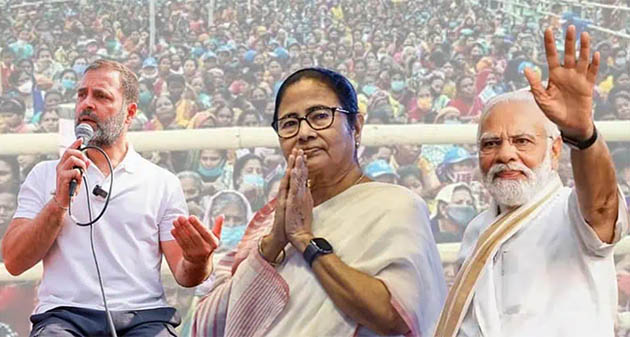
After Congress-TMC break up, BJP bets on Ram Mandir, CAA for 35 Lok Sabha seats in Bengal

News Network
February 11, 2024

bengalpolitics.jpg

Kolkata, Feb 11: Struggling to gain political traction on issues of corruption, the West Bengal BJP is shifting its focus to emotive topics such as the Ram Temple in Ayodhya and the Citizenship Amendment Act (CAA) in a bid to achieve its target of securing 35 out of the 42 Lok Sabha seats from the state.

The BJP's strategy is buoyed by the decision of the Trinamool Congress to contest alone in the upcoming Lok Sabha elections in West Bengal, breaking away from the I.N.D.I.A. bloc in the state.

This move has raised hopes within the saffron camp of consolidating anti-TMC votes, a trend evident in the party's surge from a 17 per cent vote share in 2014 to 40 per cent in 2019, resulting in 18 Lok Sabha seats.

Despite facing internal strife and electoral setbacks since its defeat in the 2021 assembly polls, the BJP's attempts to capitalise on corruption allegations against the Mamata Banerjee government have fallen short. With a target of winning 35 out of the 42 Lok Sabha seats, the BJP is now banking on emotive issues like the Ram Temple and CAA.

"Both inauguration of Ram Temple and implementation of CAA are core issues of the party," Agnimitra Paul, BJP state general secretary told PTI.

She emphasised the party's resonance with voters in Bengal by saying, "Both the issues are emotive, and people can connect with it."

An idol of the new Ram Lalla was consecrated at the Ayodhya temple on January 22, the event coming just months ahead of the Lok Sabha elections and 34 years after BJP veteran L K Advani's iconic 'Mandir Wahin Banayenge' speech during his Rath yatra that shaped Ram Mandir politics.

Echoing this sentiment, BJP MP and former state president Dilip Ghosh underscored the emotive appeal of these issues, asserting their historical significance in uniting Hindu voters and addressing refugee concerns, particularly among the Matua community.

"The promise of implementing the CAA has played a significant role in BJP's electoral successes," said Ghosh.

"The Ram temple issue has benefitted the BJP in the past, and this time too, it will help us to unite the Hindus across the country, including Bengal," the BJP leader said during whose tenure as state president from 2015 to 2021 the party had witnessed a meteoric rise in the state.

The Matuas, a significant portion of the state's Scheduled Caste population, have been migrating to West Bengal since the 1950s, fleeing religious persecution in East Pakistan, now Bangladesh.

Their cohesive voting behaviour makes them a valuable voting bloc, particularly in alignment with the BJP's stance on the CAA.

Riding on the promises of the Citizenship Amendment Act (CAA) and the National Register of Citizens (NRC), the Matua community in 2019 voted en masse for the saffron camp in the state.

The CAA, enacted by the BJP-led central government in 2019, seeks to grant Indian citizenship to persecuted non-Muslim migrants, including Hindus, Sikhs, Jains, Buddhists, Parsis, and Christians, from Bangladesh, Pakistan, and Afghanistan who entered India before December 31, 2014.

Union Minister and Matua leader Shantanu Thakur had recently said the CAA will be implemented soon, amidst reports that rules of the legislation would be framed before the Lok Sabha polls.

While the BJP aims for over 35 seats, insiders indicate a more pragmatic goal of 24.

Speaking on the issue of BJP resorting back to Ram Mandir and CAA to win the election in the state, party leaders said it reflects an 'acknowledgement of organisational challenges and a desire to counter the Trinamool's narrative of Bengali sub-nationalism'.

"Organisationally, we are not in a very good situation where we can claim that we will win 35 seats in the state. Second, as this is the Lok Sabha election, the TMC's pitch of Bengali sub-nationalism won't blunt our narrative, unlike the assembly polls," a senior state BJP leader said.

The TMC has fanned the 'Bengali pride' and had created a poll narrative of sub-nationalism to counter BJP's identity politics in the 2021 assembly polls.

The party also pointed out that the break-up of the INDIA bloc in Bengal with TMC deciding to fight alone will further help in consolidation of the anti-TMC votes in BJP's account.

"After the Left and Congress alliance fell apart in West Bengal in 2019, it had led to a four-cornered contest with BJP bagging the entire chunk of the anti-TMC votes in the state. This time too, we are hopeful that despite the Left-Congress alliance, we will gain the most," a BJP leader said.

Responding to the BJP's strategy, the Trinamool Congress remains confident in its appeal to voters, dismissing BJP's communal politics as ineffective.

TMC spokesperson Kunal Ghosh said "voters will support Mamata Banerjee to thwart BJP's divisive tactics in Bengal."

Political analyst Maidul Islam suggested that the BJP's reliance on emotive issues stems from its organisational weaknesses.

"Issues like the Ram Temple, Uniform Civil Code (UCC), and CAA will dominate the narrative in upcoming Lok Sabha polls in Bengal, with polarisation and counter-polarisation at play," he said.

Comments

Add new comment

  • Coastaldigest.com reserves the right to delete or block any comments.
  • Coastaldigset.com is not responsible for its readers’ comments.
  • Comments that are abusive, incendiary or irrelevant are strictly prohibited.
  • Please use a genuine email ID and provide your name to avoid reject.
News Network
February 1,2026

US President Donald Trump on Saturday claimed that the government of India led by Prime Minister Narendra Modi has made a deal to buy Venezuelan oil, as opposed to purchasing it from Iran.

"We've already made that deal, the concept of the deal," he told reporters on Air Force One.

Trump had imposed 25% tariffs on countries buying Venezuelan oil, including India, in March 2025. He had also hit India with tariffs for buying Russian oil, saying it was "funding" President Vladimir Putin's war against Ukraine.

Trump has said that the US has taken control of the oil-rich Venezuela after capturing former President Nicolas Maduro in January.

A fleet of 18 ships loaded with crude oil bound for refineries in Texas, Louisiana, and Mississippi in January, the most since December 2024, according to a report by the news agency Bloomberg.

Combined crude deliveries to the US will reach about 2,75,000 barrels a day, more than doubling volumes seen in December last year. Shipments to China, which averaged 4,00,000 barrels a day last year, fell to zero in January.

PM Modi, Venezuelan President Agree To Expand Ties

Prime Minister Narendra Modi and Venezuela's acting President Delcy Rodriguez spoke on Friday and agreed to take the bilateral relations to "new heights" in the years ahead.

It was the first phone call between the two leaders since the capture of Maduro and his wife by the US on January 3.

"Spoke with Acting President of Venezuela, Ms. Delcy Rodriguez. We agreed to further deepen and expand our bilateral partnership in all areas, with a shared vision of taking India-Venezuela relations to new heights in the years ahead," PM Modi said in a post on X.

A statement from Prime Minister Modi's office said the two leaders agreed to further expand and deepen the India-Venezuela partnership in all areas, including trade and investment, energy, digital technology, health, agriculture, and people-to-people ties.

They exchanged views on various regional and global issues of mutual interest and underscored the importance of their close cooperation for the Global South, the statement said.

Rodriguez also said that they discussed partnerships in the fields of agriculture, science and technology, mining, and tourism, as well as the pharmaceutical and automotive industries.

Comments

Add new comment

  • Coastaldigest.com reserves the right to delete or block any comments.
  • Coastaldigset.com is not responsible for its readers’ comments.
  • Comments that are abusive, incendiary or irrelevant are strictly prohibited.
  • Please use a genuine email ID and provide your name to avoid reject.
News Network
February 1,2026

Bengaluru: The Karnataka High Court has refused to quash an investigation against a WhatsApp group administrator accused of allowing the circulation of obscene and offensive images depicting Hindutva politicians and idols in 2021.

Justice M Nagaprasanna observed that, prima facie, the ingredients of the offence under Section 295A of the Indian Penal Code were made out. “The offence under Section 295A of the IPC is met to every word of its ingredient, albeit prima facie,” the judge said.

The petitioner, Sirajuddin, a resident of Belthangady taluk in Dakshina Kannada district, had challenged the FIR registered against him at the CEN (Cyber, Economics and Narcotics) police station, Mangaluru, for offences under Section 295A of the IPC and Section 67 of the Information Technology Act. Section 295A relates to punishment for deliberate and malicious acts intended to outrage the religious feelings of any class of citizens.

According to the complaint filed by K Jayaraj Salian, also a resident of Belthangady taluk, he received a WhatsApp group link from an unknown source and was added to the group after accessing it. The group reportedly had six administrators and around 250 participants, where obscene and offensive images depicting Hindu deities and certain political figures were allegedly circulated repeatedly.

Sirajuddin was arrested in connection with the case and later released on bail on February 16, 2021. He argued before the court that he was being selectively targeted, while other administrators—including the creator of the group—were neither arrested nor investigated. He also contended that the Magistrate could not have taken cognisance of the offence under Section 295A without prior sanction under Section 196(1) of the CrPC.

Rejecting the argument, Justice Nagaprasanna held that prior sanction is required only at the stage of taking cognisance, and not at the stage of registration of the crime or during investigation.

The judge noted that the State had produced the entire investigation material before the court. “A perusal of the material reveals depictions of Hindu deities in an extraordinarily obscene, demeaning and profane manner. The content is such that its reproduction in a judicial order would itself be inappropriate,” the court said, adding that the material, on its face, had the tendency to outrage religious feelings and disturb communal harmony.

Observing that the case was still at the investigation stage, the court said it could not interdict the probe at this juncture. However, it expressed concern that the investigating officer appeared to have not proceeded uniformly against all administrators. The court clarified that if the investigation revealed the active involvement of any member in permitting the circulation of such content, they must also be proceeded against.

“At this investigative stage, any further observation by this Court would be unnecessary,” the order concluded.

Comments

Add new comment

  • Coastaldigest.com reserves the right to delete or block any comments.
  • Coastaldigset.com is not responsible for its readers’ comments.
  • Comments that are abusive, incendiary or irrelevant are strictly prohibited.
  • Please use a genuine email ID and provide your name to avoid reject.
News Network
January 20,2026

DGP.jpg

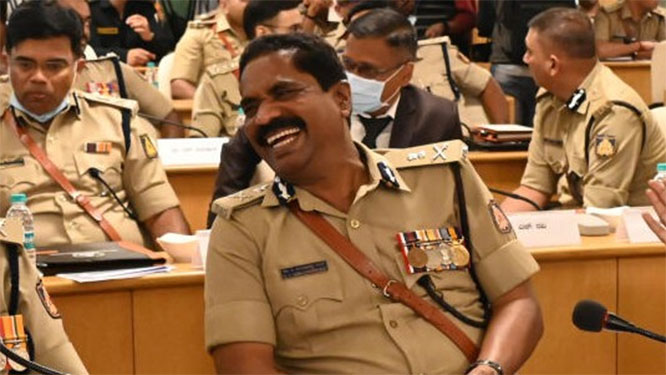
Karnataka DGP (Civil Rights Enforcement) K Ramachandra Rao was suspended with immediate effect, as per a state government order issued on Monday, 19 January. The order cited conduct unbecoming of a government servant and causing embarrassment to the state administration.

The Karnataka government suspended Rao after a purported video showed him in a compromising position with a woman inside his official chamber. The video went viral on social media. Rao rejected the videos outright, terming them "fabricated and false".

Who is K Ramachandra Rao?

Rao is a DGP-rank officer who was heading the Directorate of Civil Rights Enforcement until his suspension. He was promoted to DGP in September 2023 and assumed office in October 2023, the Sunday Guardian reported.

He also served as the Chairman and Managing Director of the Karnataka State Police Housing and Infrastructure Development Corporation Limited.

His stint as the Inspector General of Police (IGP) for the Southern Range was also marred by controversy. In 2014, during a cash seizure near Mysuru’s Yelwal, officials claimed the seized amount was ₹20 lakh, while the accused (Kerala-based merchants) claimed it was around ₹2.27 crore.

Rao, who was present during the seizure, denied all allegations. However, he was transferred soon after.

Allegations of collusion with a businessman surfaced, and a senior police officer was quoted by The Sunday Guardian as saying, “In Rao’s case, the CID has clearly mentioned that there was a great degree of lapse on the part of Rao and a deputy superintendent of police after it was brought to their notice that a few policemen, including a gunman attached to the IGP, were involved in the robbery.”

Rao had denied all wrongdoing in that incident. Despite past controversies, he rose to the state’s top police position, the Sunday Guardian reported.

Ranya Rao’s stepfather

Rao is the stepfather of Kannada actress Harshavardhini Ranya alias Ranya Rao, accused of orchestrating the illegal import of gold worth over ₹12.56 crore from Dubai to India along with two others — businessman Tarun Raju, and jewellery dealer Sahil Jain.

‘Obscene video’ controversy

A viral video showed Rao behaving inappropriately with a woman inside his office while in uniform.

The Karnataka government said in its Monday order that “vide videos and news reports widely broadcast on public news channels and media platforms, it is observed that Dr K Ramachandra Rao has acted in an obscene manner which is unbecoming of a Government Servant and also causing embarrassment to the Government.”

The order said the matter was examined by the state government, which found that the officer's conduct amounted to a violation of Rule 3 of the All India Services (Conduct) Rules, 1968.

The government said it is prima facie satisfied that "it is necessary to place Rao under suspension with immediate effect, pending inquiry".

During the suspension period, Rao will be entitled to subsistence allowance as per Rule 4 of the All India Services (Discipline and Appeal) Rules, 1969.

The order also places restrictions on his movement, stating that during the period of suspension, the officer must not leave headquarters under any circumstances without the written permission of the state government.

Comments

Add new comment

  • Coastaldigest.com reserves the right to delete or block any comments.
  • Coastaldigset.com is not responsible for its readers’ comments.
  • Comments that are abusive, incendiary or irrelevant are strictly prohibited.
  • Please use a genuine email ID and provide your name to avoid reject.