



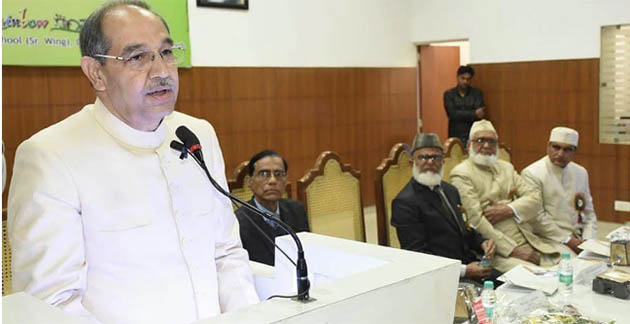
Aligarh Muslim University’s ex Vice-chancellor Tariq Mansoor is BJP’s new Vice President

News Network
July 29, 2023

mansoor.jpg

New Delhi, July 29: In an attempt to strengthen its ongoing outreach among Muslim Pasmanda communities, the BJP on Sunday appointed former Aligarh Muslim University vice-chancellor Tariq Mansoor as one of its vice presidents.

Mr Mansoor was instrumental in steering the AMU, one of the hotbeds of anti-NRC and CAA protests, on a "middle path", and later closely working with the RSS on its project to promote the teachings of Mughal prince Dara Shikoh on peaceful Hindu-Muslim coexistence that was in contradiction to his brother Mughal emperor Aurangzeb's way of working.

The appointment came on a day when Home Minister Amit Shah was in Rameshwaram in Tamil Nadu to launch a book on former president APJ Abdul Kalam, also one of the icons of the party's Pasmanda outreach.

BJP has been continuously reaching out to a section of the Muslim population through Minority Morcha meetings, mostly focused on Pasmanda Muslims, who are from Dalit and other backward class communities. Mr Mansoor was elected to the Uttar Pradesh Legislative Council, the fourth Muslim picked by the BJP for the post in the last few years.

Tariq Mansoor is from Aligarh in Uttar Pradesh, where Muslims constitute roughly 19% of the state's electorate, and have a sizeable presence in at least 30 Lok Sabha seats, out of which they play a major role in deciding the outcome in 15 to 20 constituencies. 

According to an RSS functionary, Mr Mansoor had impressed the sangh's leadership by his work on the Dara Shikoh project, by effectively using the AMU's Persian department to translate much of Shikoh's work on inter-faith dialogue and project him as an ideal for the Muslim community. He organised seminars and conferences on the same.

Mr Mansoor, a surgeon, has been associated with AMU since the 1970s when he completed his MBBS degree in surgery from the university's JN Medical College. He then went on to do his Master of Surgery (MS) degree in 1982 from the same college. Apart from the BJP's focus on the Pasmanda Muslims, which is important in terms of influence, the RSS has been specifically reaching out to Muslim academics, and people of the community from professions such as medicine, law, and bureaucracy, to make a difference in the minority discourse.

Jamal Siddiqui, head of the BJP's Minority Morcha said Mr Mansoor was a "nationalist Muslim" who has always promoted the ideal of "nation first." "His understanding of the fault lines in the Muslim community is as deep as his knowledge about the country and its history. He has led the students of AMU on the right path and prevented them from being misled. His appointment will help the party to expand better."

He was the fourth person from the Muslim community to be promoted to the Legislative Council by the party in UP since 2017, after Bukkal Nawab, Mohsin Raza, and Danish Azad Ansari.

Mr Mansoor was the AMU Vice Chancellor when it witnessed protests against the Citizenship Amendment Act (CAA) and the proposed National Register of Citizens (NRC) in 2020. He was then criticised for "not standing up for students" when policemen allegedly barged into the university, as opposed to the VC of Jamia Millia Islamia in Delhi, who stood by the students. Mr Mansoor has, however, always said he did his best, and talked about the importance of welfare and socio-economic justice over identity issues.

"Mansoor belongs to Aligarh, the hub of Muslim politics, and comes from an educated, middle class family. His family has doctors and lawyers. This is the kind of Muslims we want to work with to take the nation forward," a BJP functionary from UP said.

Khalid Anis Ansari, associate professor from Azim Premji University, who has been actively raising issues pertaining to the community for many years, has often pointed out that Indian Muslims too are victims of caste-based stratification, and are divided into three main classes, and hundreds of biradaris.

The 'Ashraf' Muslims, or native upper caste converts, for instance Syed, Sheikh, Mughal, Pathan, etc are at the top, and the Syed biradari is highly revered. The movements against the Ashraf dominance have been led by the 'lower' ones - Ajlaf (backward Muslims) and Arzal (Dalit Muslims), and these are known as Pasmandas, the community the BJP has been trying to woo. Only 15 percent of the community come from these upper caste communities, while the rest are largely Pasmanda Muslims. The BJP has planned a massive Sneh Yatra to reach out to these Pasmanda Muslims in the coming days.

Muslim intellectuals and opposition parties have, however, said this was an attempt by the BJP to create a divide among the Muslim community, and that often the Muslim victims of hate crimes or economic boycott were Pasmanda themselves.

Comments

Add new comment

  • Coastaldigest.com reserves the right to delete or block any comments.
  • Coastaldigset.com is not responsible for its readers’ comments.
  • Comments that are abusive, incendiary or irrelevant are strictly prohibited.
  • Please use a genuine email ID and provide your name to avoid reject.
News Network
February 1,2026

Bengaluru: The Karnataka High Court has refused to quash an investigation against a WhatsApp group administrator accused of allowing the circulation of obscene and offensive images depicting Hindutva politicians and idols in 2021.

Justice M Nagaprasanna observed that, prima facie, the ingredients of the offence under Section 295A of the Indian Penal Code were made out. “The offence under Section 295A of the IPC is met to every word of its ingredient, albeit prima facie,” the judge said.

The petitioner, Sirajuddin, a resident of Belthangady taluk in Dakshina Kannada district, had challenged the FIR registered against him at the CEN (Cyber, Economics and Narcotics) police station, Mangaluru, for offences under Section 295A of the IPC and Section 67 of the Information Technology Act. Section 295A relates to punishment for deliberate and malicious acts intended to outrage the religious feelings of any class of citizens.

According to the complaint filed by K Jayaraj Salian, also a resident of Belthangady taluk, he received a WhatsApp group link from an unknown source and was added to the group after accessing it. The group reportedly had six administrators and around 250 participants, where obscene and offensive images depicting Hindu deities and certain political figures were allegedly circulated repeatedly.

Sirajuddin was arrested in connection with the case and later released on bail on February 16, 2021. He argued before the court that he was being selectively targeted, while other administrators—including the creator of the group—were neither arrested nor investigated. He also contended that the Magistrate could not have taken cognisance of the offence under Section 295A without prior sanction under Section 196(1) of the CrPC.

Rejecting the argument, Justice Nagaprasanna held that prior sanction is required only at the stage of taking cognisance, and not at the stage of registration of the crime or during investigation.

The judge noted that the State had produced the entire investigation material before the court. “A perusal of the material reveals depictions of Hindu deities in an extraordinarily obscene, demeaning and profane manner. The content is such that its reproduction in a judicial order would itself be inappropriate,” the court said, adding that the material, on its face, had the tendency to outrage religious feelings and disturb communal harmony.

Observing that the case was still at the investigation stage, the court said it could not interdict the probe at this juncture. However, it expressed concern that the investigating officer appeared to have not proceeded uniformly against all administrators. The court clarified that if the investigation revealed the active involvement of any member in permitting the circulation of such content, they must also be proceeded against.

“At this investigative stage, any further observation by this Court would be unnecessary,” the order concluded.

Comments

Add new comment

  • Coastaldigest.com reserves the right to delete or block any comments.
  • Coastaldigset.com is not responsible for its readers’ comments.
  • Comments that are abusive, incendiary or irrelevant are strictly prohibited.
  • Please use a genuine email ID and provide your name to avoid reject.
News Network
February 4,2026

Mangaluru: Urban local bodies and gram panchayats should make the use of Kannada on signboards mandatory while issuing trade licences to commercial establishments, Dakshina Kannada Deputy Commissioner Darshan HV said. He also called for regular inspections to ensure compliance.

Presiding over the District Kannada Awareness Committee meeting at the deputy commissioner’s office, Darshan said the city corporation would be directed to ensure that shops operating in malls prominently display their names in Kannada. “All commercial establishments, including shops, companies, offices and hotels, must mandatorily display their names in Kannada on signboards,” he said.

The deputy commissioner added that the National Highways Authority of India (NHAI) would be instructed to include Kannada on signboards along national highways. Banks, he said, would be directed through committee meetings to provide application forms in Kannada.

“Even if English-medium schools and colleges impart education in English, their signboards must display the institution’s name in Kannada. Steps will also be taken to ensure that private buses display place names in Kannada,” Darshan said.

During the meeting, committee members raised concerns over the closure of Kannada-medium schools in rural areas due to a shortage of teachers and stressed the need for immediate corrective measures. They also pointed out that several industries employ workers from other states while overlooking local candidates.

Members further demanded that nationalised banks provide deposit and withdrawal slips in Kannada. It was brought to the deputy commissioner’s notice that the presence of staff without knowledge of Kannada in rural branches of nationalised banks is causing hardship to local customers.

Meanwhile, MP Srinath, president of the District Kannada Sahitya Parishat, urged the district administration to allot land for the construction of a district Kannada Bhavana in Mangaluru.

Comments

Add new comment

  • Coastaldigest.com reserves the right to delete or block any comments.
  • Coastaldigset.com is not responsible for its readers’ comments.
  • Comments that are abusive, incendiary or irrelevant are strictly prohibited.
  • Please use a genuine email ID and provide your name to avoid reject.