



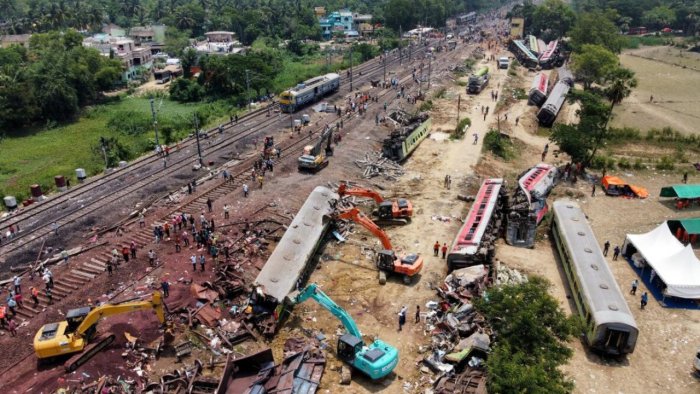
Cause of Odisha train crash identified; tracks to be ready soon: Railway Minister

News Network
June 4, 2023

traintragedy.jpg

New Delhi, June 4: The root cause of the three-train crash in Odisha's Balasore district and the people responsible for it have been identified, Railway Minister Ashwini Vaishnaw said on Sunday as rescue work at the site of the accident ended with the Railways aiming to restore normal services on the affected tracks in the next few days.

As the tragedy triggered a debate over the Kavach anti-collision system, the Congress demanded the resignation of the railway minister and asked when will the Modi government implement the much-hyped system nationwide, after testing.

Vaishnaw maintained that the train crash had nothing to do with the Kavach system.

The change that was done to electronic interlocking which led to the accident has been identified, Vaishnaw, who has been camping at the site of the train accident along with Union Minister Dharmendar Pradhan, said.

He said the issue is of electric point machine, a vital device for railway signalling, and electronic interlocking.

"The setting of the point machine was changed. How and why it was done will be revealed in the probe report," he told PTI.

"The root cause of the horrifying incident has been identified... I do not want to go into details. Let the report come out. I will just say that the root cause and the people responsible have been identified," the railway minister said

An electric point machine is a vital device for railway signalling for quick operation and locking of point switches and plays an important role in the safe running of trains. Failure of these machines severely affects train movement and deficiencies at the time of installation can result in unsafe conditions.

The crash involving Bengaluru-Howrah Superfast Express and Shalimar-Chennai Central Coromandel Express, which were carrying around 2,500 passengers, and a goods train occurred around 7 pm on Friday near the Bahanaga Bazar station in Balasore. At least 288 people were dead and over 1,100 injured in the accident, the worst rail accident in India in nearly three decades.

Railway sources said the number of deaths in the triple train crash has increased from 288 to 295 but this could not be confirmed as yet.

With hospitals around the accident site trying to deal with the enormity of the tragedy, a team of doctors and experts from the AIIMS Delhi and other central hospitals of the national capital were rushed to Bhubaneswar through a special IAF flight.

The team is carrying medicines and heavy critical care equipment, official sources said.

Odisha Chief Minister Naveen Patnaik on Sunday spoke to Prime Minister Narendra Modi over the phone and briefed him about the latest situation.

Noting that doctors, medical students and other health care service providers are doing their best, Patnaik told the prime minister that all possible steps have been taken to save the lives of injured passengers in different hospitals of Odisha.

The prime minister thanked the chief minister, the Odisha government for the prompt and efficient action during the crisis. The Centre is ready to provide any kind of assistance if required, a release issued by CMO said quoting the prime minister.

The prime minister also praised the people of Odisha for the kind of support and timely help in this hour of crisis.

Both the PM and Patnaik visited the train accident site at Bahanga Bazar in Balasore district on Saturday.

Patnaik also announced an ex-gratia of Rs 5 lakh to the family members of the people from the state killed in the triple train accident.

Giving details of the rescue operation, Pradhan said the rescue work is over and we are working with the local administration to send people affected back home.

He also said that the big challenge is to restore tracks so that the railway link between two important wings of the country can start functioning.

"By Tuesday we should be able to do it," the minister said.

A senior railway official at the site said, "We have teams working round-the-clock. Restoring at least two lines -up and down - is absolutely essential as quickly as possible,"

"Restoration work on tracks is on. We are also working on overhead cables and masts which were uprooted … soon the down line will be restored and then the up line,” the official said.

Railway officials said that all 21 coaches which capsized due to the derailment of trains at Bahanaga Bazar station have been grounded. Now the site is being cleared.

"Further three wagons and the locomotive upper part will be grounded," the official said, adding that a special train will start from Bhadrak at 1 pm on Sunday and will run up to Chennai in the path of 12841 Coromandel Express.

It will have stoppages at Cuttack, Bhubaneswar and all other stoppages of 12841 Coromandel Express. Stranded passengers of the train accident and their relatives can avail of the train service, he said.

Vaishnaw also said the kin of around 300 accident victims have been provided compensation.

"We met the patients and doctors at Soro Hospital. Special trains are being run from Hyderabad, Chennai, Bengaluru, Ranchi, Kolkata and other places so that patients can reach homes after treatment."

Restoration work, he said, was being carried out on a war footing and tracks have already been laid on one of the main lines.

"We have mobilised all resources. I also want to say that Kavach has nothing to do with the accident. This accident occurred due to changes to the electronic interlocking system. The remarks of (West Bengal chief minister) Mamata Banerjee are not true," Vaishnaw said.

The West Bengal chief minister on Saturday said the triple train accident was the “biggest of the century” and a proper investigation was needed to unravel the truth.

Banerjee, who has been the Railway minister twice, said the crash could have been averted had the anti-collision system was operational on this route.

At a press conference in Delhi, the Congress demanded the resignation of Vaishnaw, alleging that his "PR gimmicks" overshadowed the "serious deficiencies, criminal negligence and complete disregard for safety and security" of Indian Railways.

The Opposition party also said that Prime Minister Modi should accept part of the responsibility of the "mess" which his government has inflicted on the Indian Railways and the people.

Congress MP Shaktisinh Gohil and AICC's publicity and media department head Pawan Khera alleged that the Odisha rail tragedy was a "man-made devastation caused by "utter negligence, serious lapses in the system, incompetence, and a narcissistic sense of know-it-all attitude of the Modi government".

Prime Minister Modi, who has announced that the guilty would be punished, must first start with his Railway Minister, Khera said. 

"Unequivocally and unambiguously we demand the resignation of the Union Railway Minister Ashwini Vaishnaw. Nothing short of it," he said.

They alleged that Vaishnaw's "over the top publicity, theatrics and PR gimmicks overshadowed the serious deficiencies, criminal negligence and complete disregard for safety and security of Indian Railways".

"PM Modi, himself is responsible for a green-flagging spree of Vande Bharat Express trains. He himself is responsible for creating this 'all is well' facade in the Indian Railways, even as crucial, sensitive, and critical infrastructure of the Indian Railway languishes in neglect," Gohil and Khera said in their statement.

"We demand that despite multiple warnings by the CAG, Parliamentary Standing Committees, and experts – why did the Modi government not spend on sprucing up Railway Safety?" they said.

The Congress leaders also asked when will the Modi government implement the much-hyped Kavach Anti-Collision system nationwide after testing.

Gohil and Khera asked when will the government pump more funds in the Rashtriya Rail Sanraksha Kosh (RRSK) and fill up the three lakh plus vacant positions in the Indian Railways.

Rajya Sabha MP Kapil Sibal also attacked the government over the railway tragedy, and said one minister cannot deal with large ministries such as Railways as well as Communications, Electronics and Information Technology, as was being done by Vaishnaw.

The triple train pile-up near Balasore on Friday disrupted passenger and goods traffic between important industrial centres. Many of the patients initially admitted to Balasore and other local hospitals have been released or shifted to bigger cities with multi-speciality hospitals including Cuttack, Bhubaneswar and Kolkata.

Most of the bodies have been shifted to a facility in Bhubaneswar, said hospital administrators.

Comments

Add new comment

  • Coastaldigest.com reserves the right to delete or block any comments.
  • Coastaldigset.com is not responsible for its readers’ comments.
  • Comments that are abusive, incendiary or irrelevant are strictly prohibited.
  • Please use a genuine email ID and provide your name to avoid reject.
News Network
February 1,2026

Bengaluru, Feb 1: For travelers landing at Kempegowda International Airport (KIA), the sleek, wood-paneled curves of Terminal 2 promise a world-class welcome. But the famed “Garden City” charm quickly withers at the curb. As India’s aviation sector swells to record numbers—handling over 43 million passengers in Bengaluru alone this past year—the “last mile” has turned into a marathon of frustration.

The Bengaluru Logjam: Rules vs Reality

While the city awaits the 2027 completion of the Namma Metro Blue Line, the interim has been chaotic. Recent “decongestion” rules at Terminal 1 have pushed app-based cab pickups to distant parking zones, forcing weary passengers into a 20-minute walk with luggage.

“I landed after ten months away and felt like a stranger in my own city,” says Ruchitha Jain, a Koramangala resident. “My driver couldn’t find me, staff couldn’t guide me, and the so-called ‘Premium’ lane is just a fancy tax on convenience.”

•    The Cost of Distance: A 40-km cab ride can now easily cross ₹1,500, driven by demand pricing and airport surcharges.

•    The Bus Gap: While Vayu Vajra remains a lifeline, its ₹300–₹400 fare is often cited as the most expensive airport bus service in the country.

A National Pattern of Disconnect

The struggle is not unique to Karnataka. From Chennai’s coast to Hyderabad’s plateau, India’s airports tell a familiar story: brilliant runways, broken exits.

City:    Primary Issue   |    Recent Development

Bengaluru:    Cab pickup restrictions & distance  |    App-based taxis shifted to far parking zones; long walks and fare spikes reported

Chennai:    Multi-Level Parking (MLCP) hike  |    Passengers report 40-minute walks to reach cab pickup points

Hyderabad:    “Taxi mafia” & touting  |    Over 440 touting cases reported; security presence intensified

Mumbai:    Fare scams  |     Tourists charged ₹18,000 for just 400 metres, triggering police action

In Hyderabad, travelers continue to battle entrenched local groups that intimidate Uber and Ola drivers, pushing passengers toward overpriced private taxis. Chennai flyers, meanwhile, complain that reaching the designated pickup zones now takes longer than short-haul flights from cities like Coimbatore.

The ‘Budget Day’ Hope

As Finance Minister Nirmala Sitharaman presents the Union Budget 2026 today, the aviation sector is watching closely. With the government’s renewed emphasis on multimodal integration, there is cautious hope for funding toward seamless airport-metro-bus hubs.

The vision is clear: a future where planes, trains, and metros speak the same language. Until then, passengers at KIA—and airports across India—will continue to discover that the hardest part of flying isn’t the thousands of kilometres in the air, but the last few on the ground.

Comments

Add new comment

  • Coastaldigest.com reserves the right to delete or block any comments.
  • Coastaldigset.com is not responsible for its readers’ comments.
  • Comments that are abusive, incendiary or irrelevant are strictly prohibited.
  • Please use a genuine email ID and provide your name to avoid reject.
News Network
February 4,2026

Mangaluru: Urban local bodies and gram panchayats should make the use of Kannada on signboards mandatory while issuing trade licences to commercial establishments, Dakshina Kannada Deputy Commissioner Darshan HV said. He also called for regular inspections to ensure compliance.

Presiding over the District Kannada Awareness Committee meeting at the deputy commissioner’s office, Darshan said the city corporation would be directed to ensure that shops operating in malls prominently display their names in Kannada. “All commercial establishments, including shops, companies, offices and hotels, must mandatorily display their names in Kannada on signboards,” he said.

The deputy commissioner added that the National Highways Authority of India (NHAI) would be instructed to include Kannada on signboards along national highways. Banks, he said, would be directed through committee meetings to provide application forms in Kannada.

“Even if English-medium schools and colleges impart education in English, their signboards must display the institution’s name in Kannada. Steps will also be taken to ensure that private buses display place names in Kannada,” Darshan said.

During the meeting, committee members raised concerns over the closure of Kannada-medium schools in rural areas due to a shortage of teachers and stressed the need for immediate corrective measures. They also pointed out that several industries employ workers from other states while overlooking local candidates.

Members further demanded that nationalised banks provide deposit and withdrawal slips in Kannada. It was brought to the deputy commissioner’s notice that the presence of staff without knowledge of Kannada in rural branches of nationalised banks is causing hardship to local customers.

Meanwhile, MP Srinath, president of the District Kannada Sahitya Parishat, urged the district administration to allot land for the construction of a district Kannada Bhavana in Mangaluru.

Comments

Add new comment

  • Coastaldigest.com reserves the right to delete or block any comments.
  • Coastaldigset.com is not responsible for its readers’ comments.
  • Comments that are abusive, incendiary or irrelevant are strictly prohibited.
  • Please use a genuine email ID and provide your name to avoid reject.
News Network
January 23,2026

Karnataka Governor Thaawarchand Gehlot read only three lines from the 122-paragraph address prepared by the Congress-led state government while addressing the joint session of the Legislature on Thursday, effectively bypassing large sections critical of the BJP-led Union government.

The omitted portions of the customary Governor’s address outlined what the state government described as a “suppressive situation in economic and policy matters” under India’s federal framework. The speech also sharply criticised the Centre’s move to replace the Mahatma Gandhi National Rural Employment Guarantee Act (MGNREGA) with the Viksit Bharat–Guarantee for Rozgar and Ajeevika Mission (Gramin) Act, commonly referred to as the VB-GRAM (G) Act.

Governor Gehlot had earlier conveyed his objection to several paragraphs that were explicitly critical of the Union government. On Thursday, he confined himself to the opening lines — “I extend a warm welcome to all of you to the joint session of the State legislature. I am extremely pleased to address this august House” — before jumping directly to the concluding sentence of the final paragraph.

He ended the address by reading the last line of paragraph 122: “Overall, my government is firmly committed to doubling the pace of the State’s economic, social and physical development. Jai Hind — Jai Karnataka.”

According to the prepared speech, the Karnataka government demanded the scrapping of the VB-GRAM (G) Act, describing it as “contractor-centric” and detrimental to rural livelihoods, and called for the full restoration of MGNREGA. The state government argued that the new law undermines decentralisation, weakens labour protections, and centralises decision-making in violation of constitutional norms.

Key points from the unread sections of the speech:

•    Karnataka facing a “suppressive” economic and policy environment within the federal system

•    Repeal of MGNREGA described as a blow to rural livelihoods

•    VB-GRAM (G) Act accused of protecting corporate and contractor interests

•    New law alleged to weaken decentralised governance

•    Decision-making said to be imposed by the Centre without consulting states

•    Rights of Adivasis, women, backward classes and agrarian communities curtailed

•    Labourers allegedly placed under contractor control

•    States facing mounting fiscal stress due to central policies

•    VB-GRAM (G) Act accused of enabling large-scale corruption

Comments

Add new comment

  • Coastaldigest.com reserves the right to delete or block any comments.
  • Coastaldigset.com is not responsible for its readers’ comments.
  • Comments that are abusive, incendiary or irrelevant are strictly prohibited.
  • Please use a genuine email ID and provide your name to avoid reject.