Child marriage crackdown creating 'havoc' in private life: High Court

News Network
February 15, 2023

child.jpg

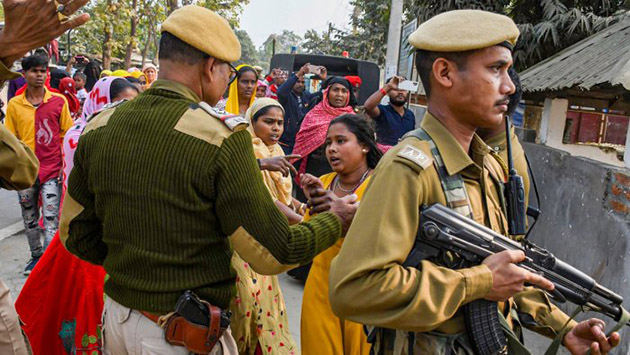
Guwahati, Feb 15: Observing that arresting a large number of people in the crackdown against child marriage created "havoc in the private life of people", the Gauhati High Court has said there is no need for custodial interrogation of the accused in such cases.

The court also rapped the Assam government for slapping stringent laws like the Protection of Children from Sexual Offences Act, 2012 (POCSO) and rape charges on child marriage accused, and stated that these are "absolutely weird" allegations.

Hearing a batch of petitions by a group of accused for anticipatory bail and interim bail, Justice Suman Shyam allowed all the petitioners to be released on bail with immediate effect.

"These are not matters of custodial interrogation. You (state) proceed as per law, we have nothing to say. If you find somebody guilty, file a chargesheet. Let him or her face trial and if they are convicted, they are convicted,” the judge said.

These are not cases related to Narcotic Drugs and Psychotropic Substances (NDPS), smuggling or stolen property, he said.

"This (arrest) is causing havoc in the private life of people. There are children, there are family members, there are old people. This may not be a good idea to go for (arrests), obviously it is a bad idea," he observed on Tuesday.

Till February 14, altogether 3,031 people have been apprehended against registration of 4,225 child marriage cases. The crackdown had started on February 3 with 4,004 FIRs.

Justice Shyam told Additional Public Prosecutor D Das that the state government does not even have space in the jails and suggested that the administration come up with bigger prisons.

When the government advocate pointed out that cases were registered under non-bailable charges under POCSO Act and rape (IPC Section 376), Justice Shyam said, "What is the POCSO here? Merely because POCSO is added, does it mean the judges will not see what is there?"

The high court is not acquitting anybody and nobody is preventing the government from investigating the cases of child marriages, he added.

"Why Section 376 (of IPC)? Is there any allegation of rape here? These are all weird allegations, absolutely weird," Justice Shyam observed.

The judge then sought the opinion of senior advocate Angshuman Bora, a well-known criminal counsel present in the courtroom for the hearing of a separate case, on the largescale arrests of child marriage accused.

Bora said, "They are not dreaded criminals. At this stage, they (state) can file the chargesheet and subsequently when the matter comes up in the court, the matter will be decided as per the law.”

He also stressed that the message against child marriage can also otherwise be given by filing the chargesheet and sensitising the people, but "not by arresting everyone".

Justice Shyam further asked, "What do you get by custodial interrogation of these people? Either he has abetted or he has not. Either it's a case of child marriage or it is not. For that, is it necessary to have custodial interrogation? What is the idea behind this?"

In the case of Moulana Sajahan Ali who allegedly facilitated a child marriage, the public prosecutor said he was unaware of the police idea behind his arrest.

"The accused person was caught red-handed. Maybe he was performing the marriage and at that time he was arrested," Das said.

Ali's counsel H R A Choudhury pointed out that as per the FIR, the marriage took place in 2021, and asked how he was caught red-handed now.

Justice Shyam said, "What do you (Das) have to say? We will release him on bail. These are not matters for sitting. If marriage (is) taking place in violation of statutory provisions, law will take its own course. That we have nothing to say.

"The punishment is two years and these are matters which have been happening since times. We will only consider whether immediate custodial detention is required or not." 

Comments

Add new comment

  • Coastaldigest.com reserves the right to delete or block any comments.
  • Coastaldigset.com is not responsible for its readers’ comments.
  • Comments that are abusive, incendiary or irrelevant are strictly prohibited.
  • Please use a genuine email ID and provide your name to avoid reject.
News Network
February 3,2026

wind.jpg

Dakshina Kannada MP Capt Brijesh Chowta has urged the Centre to give high priority to offshore wind energy generation along the Mangaluru coast, citing its strategic importance to India’s green energy and port-led development goals.

Raising the issue in the Lok Sabha under Rule 377, Chowta said studies by the National Institute of Oceanography have identified the Mangaluru coastline as part of India’s promising offshore wind ‘Zone-2’, covering nearly 6,490 sq km. He noted that the region’s relatively low exposure to cyclones and earthquakes makes it suitable for long-term offshore wind projects and called for its development as a dedicated offshore wind energy zone.

Highlighting the role of New Mangalore Port, Chowta said its modern infrastructure, multiple berths and heavy cargo-handling capacity position it well as a logistics hub for transporting and assembling large wind energy equipment.

He also pointed to the presence of major industrial units such as MRPL, OMPL, UPCL and the Mangaluru SEZ, which could serve as direct buyers of green power through power purchase agreements, improving project viability and speeding up execution.

With Karnataka’s peak power demand crossing 18,000 MW in early 2025, Chowta stressed the need to diversify renewable energy sources. He added that offshore wind projects in the Arabian Sea are strategically safer compared to the cyclone-prone Bay of Bengal.

Calling the project vital to India’s target of 500 GW of renewable energy by 2030, Chowta urged the Ministry of New and Renewable Energy to initiate resource assessments, pilot projects and stakeholder consultations at the earliest.

Comments

Add new comment

  • Coastaldigest.com reserves the right to delete or block any comments.
  • Coastaldigset.com is not responsible for its readers’ comments.
  • Comments that are abusive, incendiary or irrelevant are strictly prohibited.
  • Please use a genuine email ID and provide your name to avoid reject.
News Network
January 23,2026

Mangaluru: The Karnataka Government Polytechnic (KPT), Mangaluru, has achieved autonomous status from the All India Council for Technical Education (AICTE), becoming the first government polytechnic in the country to receive such recognition in its 78-year history. The status was granted by AICTE, New Delhi, and subsequently approved by the Karnataka Board of Technical Education in October last year.

Officials said the autonomy was conferred a few months ago. Until recently, AICTE extended autonomous status only to engineering colleges, excluding diploma institutions. However, with a renewed national focus on skill development, several government polytechnics across India have now been granted autonomy.

KPT, the second-largest polytechnic in Karnataka, was established in 1946 with four branches and has since expanded to offer eight diploma programmes, including computer science and polymer technology. The institution is spread across a 19-acre campus.

Ravindra M Keni, the first dean of the institution, told The Times of India that AICTE had proposed autonomous status for polytechnic institutions that are over 25 years old. “Many colleges applied. In the first round, 100 institutions were shortlisted, which was further narrowed down to 15 in the second round. We have already completed one semester after becoming an autonomous institution,” he said. He added that nearly 500 students are admitted annually across eight three-year diploma courses.

Explaining the factors that helped KPT secure autonomy, Keni said the institution has consistently recorded 100 per cent admissions and placements for its graduates. He also noted its strong performance in sports, with the college emerging champions for 12 consecutive years, along with active student participation in NCC and NSS activities.

Autonomous status allows KPT to design industry-oriented curricula, conduct examinations, prepare question papers, and manage academic documentation independently. The institution can also directly collaborate with industries and receive priority funding from AICTE or the Ministry of Education. While academic autonomy has been granted, financial control will continue to rest with the state government.

“There will be separate committees for examinations, question paper setting, boards of studies, and boards of examiners. The institution will now have the freedom to conduct admissions without government notifications and issue its own marks cards,” Keni said, adding that new academic initiatives would be planned after a year of functioning under the autonomous framework.

Comments

Add new comment

  • Coastaldigest.com reserves the right to delete or block any comments.
  • Coastaldigset.com is not responsible for its readers’ comments.
  • Comments that are abusive, incendiary or irrelevant are strictly prohibited.
  • Please use a genuine email ID and provide your name to avoid reject.