



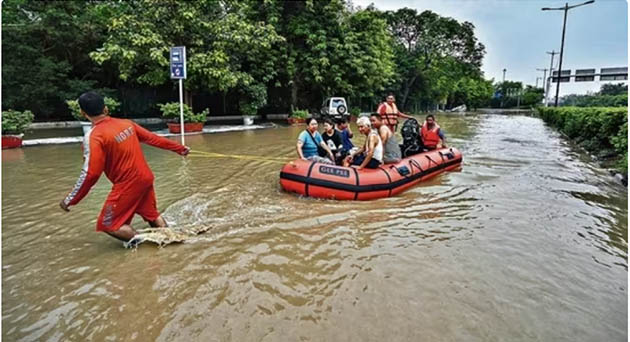
Delhi floodwaters knock Supreme Court’s doors, literally!

News Network
July 14, 2023

floods.jpg

New Delhi, July 14: After breaching a 45-year record three days ago, water levels in the Yamuna here came down to 208.35 metres at 11 am on Friday even as several key areas in Delhi remained inundated.

On Thursday, the water level had started rising after remaining stable for three hours and reached 208.66 metres by 7 pm, three metres above the danger mark of 205.33 metres.

According to Central Water Commission (CWC) data, the water level stood at 208.57 metres on Friday and fell marginally to 208.48 metres at 5 am.

The water level in the Yamuna was 208.42 metres at 8 am, 208.38 metres at 10 am and 208.35 metres at 11 am.

The Yamuna in Delhi swelled to 207.71 metres on Wednesday, breaching its all-time record of 207.49 metres set in 1978.

Meanwhile, the floodwaters reached the entrance of the Supreme Court in central Delhi and submerged the busy ITO intersection and Rajghat as the Irrigation and Flood Control Department's regulator was damaged.

Chief Minister Arvind Kejriwal and Revenue Minister Atishi directed Chief Secretary Naresh Kumar to seek help from the National Disaster Response Force (NDRF) and the Army to prevent the entry of floodwaters to new areas in the national capital.

In a tweet, Kejriwal said he will visit ITO to take stock of the situation.

"This breach is causing flooding of ITO and surroundings. Engineers have been working whole nite. I have directed the Chief Secretary to seek help of Army/NDRF but this shud be fixed urgently," he said.

Commuters faced difficulties as traffic was diverted due to waterlogging at ITO road, a key stretch connecting east Delhi to Lutyens's Delhi.

"No vehicular traffic will be allowed on Mahatma Gandhi Marg from Sarai Kale Khan towards IP Flyover due to overflow of drain water near WHO Building. Commuters are advised to avoid the stretch," the Delhi Traffic Police said in a tweet.

Some commuters were seen dragging their vehicles on the waterlogged road. 

Comments

Add new comment

  • Coastaldigest.com reserves the right to delete or block any comments.
  • Coastaldigset.com is not responsible for its readers’ comments.
  • Comments that are abusive, incendiary or irrelevant are strictly prohibited.
  • Please use a genuine email ID and provide your name to avoid reject.
News Network
January 23,2026

Karnataka Governor Thaawarchand Gehlot read only three lines from the 122-paragraph address prepared by the Congress-led state government while addressing the joint session of the Legislature on Thursday, effectively bypassing large sections critical of the BJP-led Union government.

The omitted portions of the customary Governor’s address outlined what the state government described as a “suppressive situation in economic and policy matters” under India’s federal framework. The speech also sharply criticised the Centre’s move to replace the Mahatma Gandhi National Rural Employment Guarantee Act (MGNREGA) with the Viksit Bharat–Guarantee for Rozgar and Ajeevika Mission (Gramin) Act, commonly referred to as the VB-GRAM (G) Act.

Governor Gehlot had earlier conveyed his objection to several paragraphs that were explicitly critical of the Union government. On Thursday, he confined himself to the opening lines — “I extend a warm welcome to all of you to the joint session of the State legislature. I am extremely pleased to address this august House” — before jumping directly to the concluding sentence of the final paragraph.

He ended the address by reading the last line of paragraph 122: “Overall, my government is firmly committed to doubling the pace of the State’s economic, social and physical development. Jai Hind — Jai Karnataka.”

According to the prepared speech, the Karnataka government demanded the scrapping of the VB-GRAM (G) Act, describing it as “contractor-centric” and detrimental to rural livelihoods, and called for the full restoration of MGNREGA. The state government argued that the new law undermines decentralisation, weakens labour protections, and centralises decision-making in violation of constitutional norms.

Key points from the unread sections of the speech:

•    Karnataka facing a “suppressive” economic and policy environment within the federal system

•    Repeal of MGNREGA described as a blow to rural livelihoods

•    VB-GRAM (G) Act accused of protecting corporate and contractor interests

•    New law alleged to weaken decentralised governance

•    Decision-making said to be imposed by the Centre without consulting states

•    Rights of Adivasis, women, backward classes and agrarian communities curtailed

•    Labourers allegedly placed under contractor control

•    States facing mounting fiscal stress due to central policies

•    VB-GRAM (G) Act accused of enabling large-scale corruption

Comments

Add new comment

  • Coastaldigest.com reserves the right to delete or block any comments.
  • Coastaldigset.com is not responsible for its readers’ comments.
  • Comments that are abusive, incendiary or irrelevant are strictly prohibited.
  • Please use a genuine email ID and provide your name to avoid reject.
News Network
February 5,2026

Bengaluru: As air quality continues to worsen across several parts of the city, hospitals in Bengaluru are reporting a steady rise in patients suffering from respiratory illnesses such as asthma, bronchitis and Chronic Obstructive Pulmonary Disease (COPD), health officials and doctors said.

Data from the Suvarna Arogya Suraksha Trust (SAST) shows that 3,891 patients received treatment for respiratory ailments between April and November 2024. The figure rose to 4,187 during the same period in 2025.

Private hospitals, too, are witnessing a 10–15 per cent year-on-year increase in such cases.

While doctors caution that the rise cannot be attributed solely to air pollution, a significant number of patients are non-smokers with no prior history of respiratory disease.

“Nearly 70 per cent of the patients we see are non-smokers with no previous respiratory issues. When other causes are ruled out, air pollution emerges as the most likely factor,” said Dr Manjunath PH, consultant interventional pulmonologist at a hospital in Kengeri.

Doctors noted that patient footfall spikes during the winter months and around Deepavali, when air quality typically worsens.

“There is a clear correlation between poor air quality and the rise in cases. People commonly present with persistent cough, breathlessness and irritation of the respiratory tract, indicating the impact of polluted air on their health,” said Dr Sheetal Chaurasia, consultant in pulmonary medicine at a private hospital in Whitefield.

Dr Chaurasia added that respiratory tract infections are also on the rise.

“Poor air quality leads to chronic airway inflammation, making the airways more vulnerable to infections. We are seeing an increase in both upper and lower respiratory tract infections,” she said.

Patients with pre-existing respiratory conditions remain the worst affected.

“For those already diagnosed with respiratory illnesses, deteriorating air quality significantly worsens the condition. Both the frequency and severity of attacks increase sharply,” said Dr Vandana P, a pulmonologist at a hospital on Bannerghatta Road.

Doctors also flagged a worrying trend of rising respiratory problems among younger adults and children.

To reduce exposure, they advised people to wear masks while travelling on two-wheelers or autos and ensure adequate ventilation at home to minimise indoor air pollution.

Comments

Add new comment

  • Coastaldigest.com reserves the right to delete or block any comments.
  • Coastaldigset.com is not responsible for its readers’ comments.
  • Comments that are abusive, incendiary or irrelevant are strictly prohibited.
  • Please use a genuine email ID and provide your name to avoid reject.
News Network
February 5,2026

In an era where digital distractions are the primary rival to academic excellence, the Karnataka Education Department is taking the fight directly to the living room. As the SSLC (Class 10) annual examinations loom, officials have launched a localized "digital strike" to ensure students aren't losing their competitive edge to scrolling or soap operas.

The 7-to-9 Lockdown

The department has issued a formal directive urging—and in some cases, enforcing via home visits—a total blackout of mobile phones and television sets between 7:00 PM and 9:00 PM. This two-hour window is being designated as "sacred study time" across the state until the examinations conclude on April 2.

Key Pillars of the Initiative:

•    Doorstep Advocacy: Teachers are transitioning from classrooms to living rooms, meeting parents to explain the psychological benefits of a distraction-free environment.

•    Parental Accountability: The campaign shifts the burden of discipline from the student to the household, asking parents to lead by example and switch off their own devices.

•    The Timeline: The focus remains sharp on the upcoming exam block, scheduled from March 18 to April 2.

"The objective is simple: uninterrupted focus. We are reclaiming the evening hours for the students, ensuring their environment is as prepared as their minds," stated a senior department official.

Student vs. Reality

While the student community has largely welcomed the "forced focus"—with many admitting they lack the willpower to ignore notifications—the move has sparked a debate on enforceability. Without a "TV Police," the success of this initiative rests entirely on the shoulders of parents and the persuasive power of visiting educators.

Comments

Add new comment

  • Coastaldigest.com reserves the right to delete or block any comments.
  • Coastaldigset.com is not responsible for its readers’ comments.
  • Comments that are abusive, incendiary or irrelevant are strictly prohibited.
  • Please use a genuine email ID and provide your name to avoid reject.